We are now in the seventh month of America’s Operation Epic Fury against Iran, a military campaign whose leaders said would last three days, and a peaceful resolution seems no nearer now than it did on 28 February, despite April’s peace deal and June’s Memorandum of Understanding.
The price of Brent crude oil for one-month delivery is up by a third since the start of the conflict and European gas prices are up seven-fold to their highest mark since January 2023, even if the US Henry Hub natural gas benchmark is broadly flat. Stock markets seem to be taking this in their stride, in the view that a peace deal remains the most logical and likely outcome, but bond markets are far from happy and commodity markets are lapping it up.
This gives advisers and clients much to ponder, especially if the bond markets’ worries about the first-round inflationary implications of the ongoing closure of the Straits of Hormuz prove well founded thanks to energy, let alone the second- and third-round impacts in industrial metals and food, thanks to possible shortages of key mining materials such as sulphuric acid, and urea, a vital input for fertilisers.
Equity markets continue to focus on the long-term potential of Artificial Intelligence, not to mention the near-term profits generated by the providers of the modern-day picks and shovels that facilitate AI – anything from earth-moving equipment to memory chips to semiconductor production equipment. But if the war drags on, fuel prices stay elevated and inflation really does prove sticky then it may be the unfashionable energy sector that provides a valuable hedge against any worst-case scenarios.
Bear cases look at their most compelling when they confirm a long-term price trend, and in this respect it is easy to write off hydrocarbons as a bad job, given how the all-time peak price for crude oil dates back to 2007 in nominal terms, let alone inflation-adjusted ones.
The inability of oil to challenge its prior high feeds the bearish narrative. This rests upon:
Traders are acting. They continue to build up short positions against the commodity, elongating a trend that dates back three years.
Traders continue to build short positions against crude oil

Source: LSEG Refinitiv data, US Commodity Futures Trading Commission
It is easy to see why traders are tacking to the bear case, given how the US continues to assert that a peace deal is near as it releases reserves to try and put a lid on oil, and thus gasoline, diesel, and heating oil prices ahead of November’s mid-term elections.
But America’s reserves are dwindling and at some stage must surely be replenished, if only to protect it from any further possible energy-related geopolitical shocks. Nor would it be a surprise were Tehran to be closely watching the weekly inventory data kindly published by the US Energy Information Administration with the same mid-term ballot in mind as it seeks leverage in its negotiations with Washington.
American strategic oil reserves continue to dwindle

Source: US Energy Information Administration
Moreover, a research paper from specialist natural resource investors Goehring and Rozencwajg tests the bear case and argues it may be complacent, especially given those lofty short positions, on three counts:
A speedy peaceful resolution to US-Iran conflict could take the sting out of these considerations, but there are no guarantees of that. Even though the world is less reliant on oil now, the alternative scenario conjures up bad memories of the stagflation of the 1970s, when equities, bonds and cash were all terrible performers and commodities proved the best store of value.
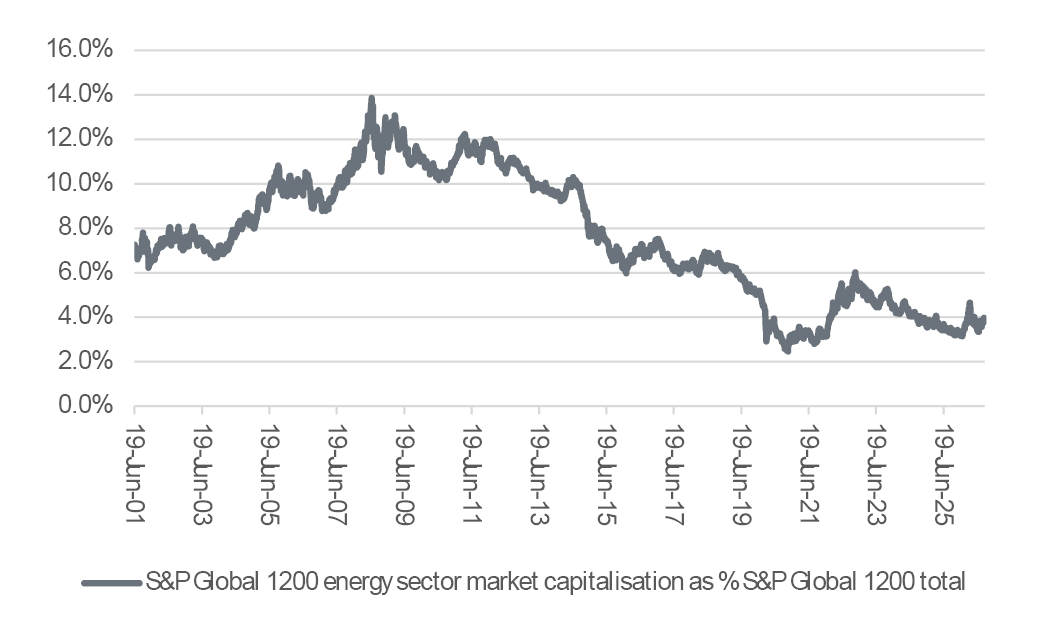
Nor are stock or commodity markets prepared for rising energy prices, even if bonds are paying attention. The energy index remains near all-time lows as a percentage of total, global stock market capitalisation, even though COVID, Ukraine and Iran are reminders of the importance of natural resources and supply chains as part of wider national security concerns.
Energy stocks remain unloved
Source: LSEG Refinitiv data
Another way to look at this is to return to AI. While advisers and clients will not have the time or inclination to get involved in the rough and tumble of individual stock selection, they will be aware that AI enabler NVIDIA is currently the world’s most valuable public company, with a market capitalisation of $5.5 trillion. They may be less aware that for the same price tag they could buy the West’s seven oil and gas majors nearly three times over.
NVIDIA’s stock market valuation is three times that of the West’s seven oil majors combined

Source: LSEG Refinitiv data, Marketscreener, analysts’ consensus forecasts
Past performance is not a guide to future performance and some investments need to be held for the long term.



This area of the website is intended for financial advisers and other financial professionals only. If you are a customer of AJ Bell Investcentre, please click ‘Go to the customer area’ below.
We will remember your preference, so you should only be asked to select the appropriate website once per device.