Oil has climbed above $100/barrel once again, creating turbulence in financial markets. While bond yields have moved higher, equities have shown remarkable resilience. Confused? You needn’t be.
Bond investors are increasingly pricing in a risk that higher oil prices become embedded in inflation, whereas current market pricing suggests many equity investors view the move as temporary.
Were bond investors to think $100 oil is temporary, they may not change their inflation forecasts much. However, if they think it will persist and feed into transport, manufacturing and energy costs across the economy, they will demand higher yields to compensate for inflation risk. That trend is emerging in bond markets now.
The fact that equity markets haven't tanked as crude has moved through $100 suggests investors largely view the move as temporary, or at least not sufficiently severe to derail corporate earnings expectations.
There is limited evidence so far of widespread earnings damage from higher oil prices. Moreover, investors currently have a powerful positive narrative to offset concerns about energy costs. The enormous sums being invested in AI continue to support earnings expectations for a wide range of companies.
Parts of the stock market also benefit from a higher oil price and ongoing geopolitical tensions in the Middle East. For example, oil producers tend to earn more, defence companies benefit from geopolitical tensions, and some mining companies can benefit when inflation is accompanied by rising commodity prices.
The UK stock market is a case in point – it is big on oil, defence and miners, and their robust performance provides ballast to the index. Financial stocks are another major weight in the FTSE 100, and banks can benefit from a higher-rate environment if margins improve.
History suggests investors should be alert rather than alarmed when oil suddenly moves higher. The impact on markets depends not only on the oil price itself, but also on why it is rising and how long it remains elevated.
Using periods where Brent crude remained above $90 for at least two consecutive months over the past 20 years, analysis by AJ Bell found the global stock market (as measured by the FTSE All World index) fell in two of the four occasions.
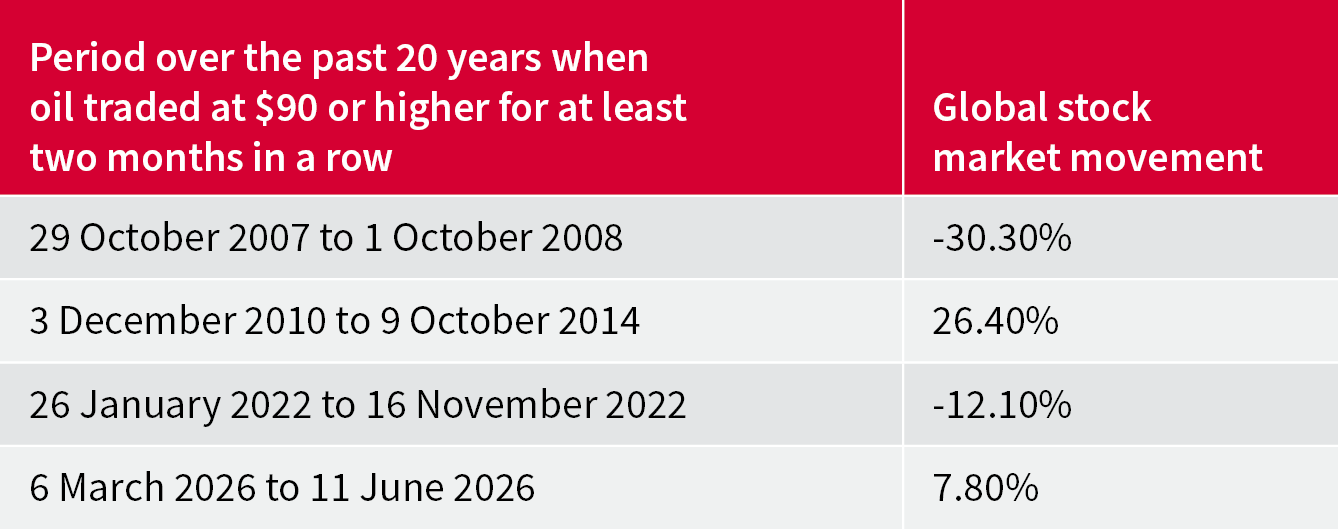
Source: AJ Bell, LSEG. Oil data relates to Brent crude oil price for delivery one month ahead. Global stock market data relates to FTSE All World performance in US dollars
The biggest drop was a 30.3% decline between October 2007 and October 2008. Although oil prices were high, the global financial crisis was by far the primary driver of the 2008 equity market collapse.
Another occurrence was in 2022 when Russia invaded Ukraine. In this example, the market decline was driven by an energy price shock as sanctions led to major oil supply disruptions, investor unease around war, inflation, and aggressive interest rate hikes. Importantly, in both periods, neither market decline was caused solely by high oil prices.
The two other examples are interesting. The global stock market advanced 26.4% in the period between December 2010 and October 2014 when oil remained stubbornly higher than $90 per barrel for nearly four years, peaking at $126 in March 2012.
That oil price spike was caused by strong demand, conflicts and political unrest in the Middle East, and producers’ cartel OPEC changing management style. The latter eventually led to a policy shift that saw OPEC members flood the market with oil to regain market share lost to US producers, triggering a big decline in the commodity price.
The escalation of the Iran conflict earlier this year saw the FTSE All World index rise 7.8% between March and June when oil traded above $90 for a three-month stint.
There were market wobbles along the way, but investors are forward-looking and price in what they think will happen next. In both instances, investors ultimately concluded elevated oil prices would not become a permanent feature of the global economy.
While four periods are too small a sample from which to draw definitive conclusions, it nevertheless illustrates that high oil prices do not automatically lead to falling equity markets.
Oil surpassing the year-to-date peak of $126 could certainly cause jitters on the stock market.
However, some energy experts argue equity investors may be focusing on the wrong metric. It’s the price of refined products that matters this time, not the untreated oil.
Some oil is now flowing out of the Strait of Hormuz, so supply hasn’t stopped completely. More important is refining capacity being constrained by damage to facilities in the Middle East and Ukrainian drone strikes on Russian refineries.
Refined capacity is constrained – recent trading has seen refined products such as diesel and gasoline rise sharply – while refined inventories are falling; and markets may be underestimating the severity of the supply squeeze.
Adam Rozencwajg, co-founder of commodities investment firm G&R, says this is where the industry has poor data. He adds: “We're flying blind when it comes to how much is in refined inventories.”
Rozencwajg believes the solution is not to get refineries in the world to operate at full capacity, as that could lead to a collapse in crude oil inventories. Therein lies the problem – global oil production growth has been weaker than many analysts expected, meaning the system is straining at different points: refinery capacity is tight now, but oil supplies could also be tight if refinery output increases.
The solution to these situations is often the same – the cure for high prices is high prices. When something is expensive, demand eases off and pressures on the system begin to ease. How long that will take to play out is anyone’s guess.
Oil producers cannot meaningfully increase output at the click of a finger. As a result, there is a real chance oil prices remain elevated for an extended period. That has major implications for interest rates, corporate earnings and financial markets.
Importantly, stock markets are not ignoring higher oil prices. For now, equity investors appear comfortable that higher oil prices will prove a temporary shock rather than a lasting economic problem.
History suggests that assumption can hold for longer than many expect. However, if elevated energy costs begin feeding more persistently into inflation, interest rates and corporate earnings, the stock markets’ resilience could be tested much more severely.
Past performance is not a guide to future performance and some investments need to be held for the long term.



This area of the website is intended for financial advisers and other financial professionals only. If you are a customer of AJ Bell Investcentre, please click ‘Go to the customer area’ below.
We will remember your preference, so you should only be asked to select the appropriate website once per device.