Financial advisers might experience an increase in client requests to review portfolios ahead of the Budget, given speculation around a potential change to capital gains tax (CGT) rates.
Rumours that CGT rates will be equalised with income tax rates could prompt investors to bring forward any plans to sell assets or shift them into more tax-efficient wrappers.
CGT rate increases, if implemented, could come into force immediately, creating a change midway through the tax year. That’s what happened when rates increased in 2024, causing a headache for advisers and investors. As a result, some clients will choose to act before the Budget.
The strongest incentive to realise gains would be among investors who hold assets outside ISAs and pensions, have gains substantially above the £3,000 annual allowance, were already considering selling in the next year or two, and have significant exposure to long-term winners.
Investors do not pay CGT on gains inside an ISA or SIPP, meaning the focus of any capital gains tax-related portfolio changes will be on dealing accounts. Also known as general investment accounts, any capital gains inside dealing accounts are subject to tax once the individual has used up their £3,000 CGT annual allowance.
Advisers are likely to have recommended their clients only use dealing accounts after ISA allowances have been maxed out, or when adding to a pension does not fit with their plan – such as a need for withdrawals before pension age.
The exception is for investments that come with tax benefits. For example, gilts are popular holdings in dealing accounts as they are exempt from capital gains tax.
Short-dated gilts are particularly popular with investors this year, as they seek to buy below par and sell at either maturity, or if the price rises, for a tax-free capital gain.
For those who still have investments in dealing accounts subject to tax, there might be a natural desire to consider selling investments that have delivered exceptional gains or where valuations remain elevated.
Some might feel now is the time to get out while the going is good, while others might think that because stock valuations eventually experience mean reversion, they shouldn’t pass up the opportunity to exit a high-performing stock which currently holds an above-average rating.
Curious advisers and their clients might look to the DIY investment market to see the type of investments that a certain investor might jettison from their portfolio.
After gilts, the most popular investments in AJ Bell DIY dealing accounts are UK blue-chip stocks, alongside a select number of growth-oriented investment trusts, and tracker funds following the price of gold and stock markets globally and in the US.
The table below shows the five-year share price performance and price-to-earnings (PE) valuation metrics for the most widely-held stocks in AJ Bell DIY dealing accounts. Notably, Rolls-Royce has generated a share price return of 1,080% over the past five years, followed by NVIDIA (+899%) and BAE Systems (+261%).
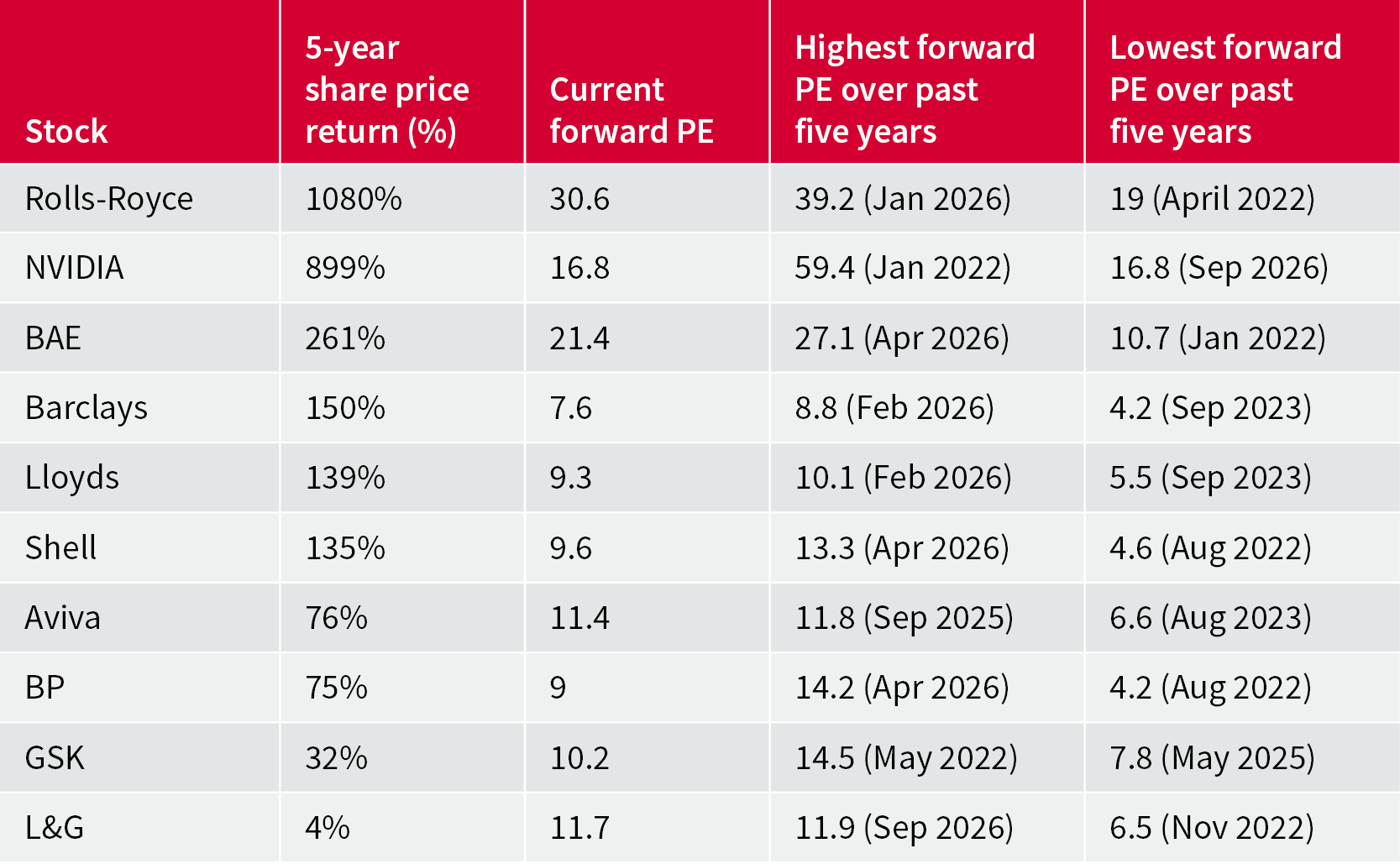
Source: AJ Bell, ShareScope, LSEG, data correct as at 23 September 2026. Excludes dividends (which are taxed separately to capital gains).
The returns from Rolls-Royce are significant multiples of what someone might normally expect from a UK share, meaning long-term investors could be sitting on massive capital gains.
Rolls-Royce shares hit a five-year forward price-to-earnings (PE) high of 39.2 at the start of 2026, and while the rating has pulled back to 30.6, they still trade significantly above the five-year low of 19 times. That means Rolls-Royce could be among the stocks investors consider selling if they are looking to realise gains at current tax rates.
NVIDIA has been a superstar on the stock market, but its shares are trading at an 11-year valuation low of 16.8 times next 12 months’ forecast earnings. A significant derating in the stock since summer 2025 could encourage certain investors to hold onto the shares rather than abandon NVIDIA completely, in the hope that its valuation could improve again.
It’s possible that we see a spike in Bed & ISA and Bed & SIPP transactions ahead of the Budget. As advisers will be aware, these are straightforward ways to lock in capital gains now and pay tax at the current rate but protect future gains from the taxman. Using them does, however, mean a short time out of the market.
Individuals may be seeking discussions with advisers around using allowable losses to offset gains on a tax return. Advisers may also be busy discussing the tax benefits of transferring of assets between married people or civil partners to avoid triggering a CGT bill now.
It’s important not to let the tax tail wag the investment dog. Any decision to sell should be driven primarily by investment objectives and portfolio needs, not speculation around future tax policy.
It is also worth noting that CGT rates can and do fluctuate – a future government could undo any CGT rate hike, and some investors will hope to play a waiting game, sitting on paper gains and doing nothing in the hope a future government drops rates back down.
Ultimately, nobody can say for certain, and advisers will need to consider what is right for their clients’ own circumstances. However, it’s sensible for the end investor to understand the options available should capital gains tax rates change.
Past performance is not a guide to future performance and some investments need to be held for the long term.



This area of the website is intended for financial advisers and other financial professionals only. If you are a customer of AJ Bell Investcentre, please click ‘Go to the customer area’ below.
We will remember your preference, so you should only be asked to select the appropriate website once per device.