NVIDIA has exceeded revenue forecasts for 16 consecutive quarters, generating over $1 billion in daily sales. Its shares are near record highs, but there are risks advisers and investors should consider.
NVIDIA has set a high standard for specialised graphics processing units that help to power AI, and has enjoyed rapid earnings growth as companies scramble to deploy its chips. Demand currently exceeds supply.
In an August results call, NVIDIA CEO Jensen Huang said: “Everybody wants to be part of the AI revolution. Everybody will have to be part of this computing shift, and everybody has to build infrastructure.” These bold statements reflect NVIDIA’s confidence in strong demand for its products over the coming year.
Pre-tax profit increased from $9 billion in the fiscal year ending 31 January 2023 to $139.5 billion in 2026. Analysts expect NVIDIA to generate $276.3 billion in 2027, $413 billion in 2028 and $593.4 billion in 2029, according to consensus estimates published by LSEG.
Investors have been richly rewarded, with the share price up 1,190% over the past four years. That compares to a mere 89% from the S&P 500 over the same period.
NVIDIA says demand for its products is accelerating, and it is doing everything possible to support customers, including offering financial assistance and credit to help them buy more chips. This “circular finance” approach worries some investors, who fear it could backfire if demand slows, leaving NVIDIA with unsold products.
This approach has echoes of the vendor financing boom of the late 1990s, when telecom equipment firms offered generous financing to customers building fibre and 3G networks.
That worked well until supply of capacity outstripped demand. Certain capacity providers began to cut back on spending or even failed altogether and left the equipment suppliers with either unpaid bills, or lower revenues and profits than expected, or both. As a result, their share prices collapsed as lofty valuations and lofty growth expectations proved unsustainable.
NVIDIA has been quick to shoot down any suggestions that its investments and financing deals are risky, saying demand remains strong for the products. A key figure to watch closely is accounts receivables which has jumped by 64% over the past six months to $63 billion. That is money customers still owe for goods or services they receive on credit. It suggests customers are either taking longer to pay or more of NVIDIA’s products are being provided on credit.
It was notable that NVIDIA sought to address concerns on the recent results conference call, seemingly going for a more transparent approach. For example, it was open about margins coming under pressure near-term to reflect the spike in memory chip prices it has to stomach.
However, the revelation there is no contribution from China data centre-related revenue in its forward guidance would suggest NVIDIA still doesn’t see a clear way to resolving one of its biggest challenges – being able to sell freely to the Asian superpower. Chinese users are not allowed to buy NVIDIA’s most powerful chips due to US export controls, and certain investors see this as a major lost opportunity.
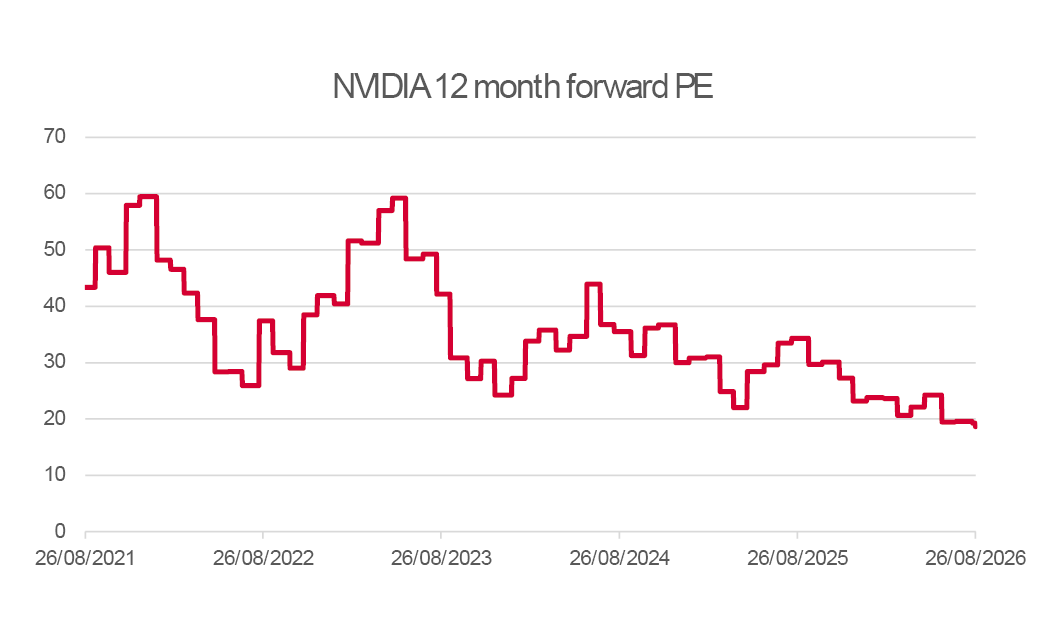
Despite NVIDIA’s best efforts to reassure the market, there is a telltale sign that not everyone is convinced. There is evidence of multiple compression, meaning investors are paying less for each dollar of NVIDIA’s earnings. This is reflected in the falling price-to-earnings (PE) ratio.
NVIDIA’s PE has gone from 34 times next 12 months’ expected earnings last September to 19 times. Normally, one might expect investors to be prepared to pay a higher multiple for a stock delivering strong earnings upgrades in the way NVIDIA has achieved.
Source: AJ Bell, LSEG, Data to 26 August 2026
One might argue NVIDIA is heading towards ‘peak earnings trap’ territory. This is when a stock looks cheap based on the classic PE ratio but is risky because profit growth could be unsustainable.
If demand for its products starts to weaken, prices fall because of new competition, or the market is hit by oversupply of chips, the earnings could fall. Investors who bought thinking it was cheap could be trapped with massive losses.
This is a hypothetical situation and not something NVIDIA is experiencing now. But it is telling that the peak earnings trap concept is most common in highly-cyclical industries including semiconductors. It’s particularly important as NVIDIA is so widely held by investors, either directly or indirectly through global or US tracker funds.
On the flipside, the multiple compression could be a positive as a lower PE ratio can provide a valuation cushion. If the market goes through a bad patch, a stock trading on sub-20 times earnings might fall a lot less than one on 40 or 60-times earnings – a status NVIDIA has held in the not-too-distant-past.
NVIDIA’s success has made it a key player in global markets, but its potential risks mean advisers and investors should stay cautious. Any misstep could send shockwaves through the tech sector and beyond.
Past performance is not a guide to future performance and some investments need to be held for the long term.



This area of the website is intended for financial advisers and other financial professionals only. If you are a customer of AJ Bell Investcentre, please click ‘Go to the customer area’ below.
We will remember your preference, so you should only be asked to select the appropriate website once per device.