For anyone looking for ways to make their money work hard during the football World Cup, it might seem like common sense to invest in the host country given the economic benefits from people spending on travel, hotels, food and drink, and infrastructure upgrades to put on the games. But looking at history, they may want to think again.
New analysis by AJ Bell finds that since 1990, investing in funds tracking the host country’s stock market delivered a worse return on average than backing the two sides that reached the World Cup final. In fact, the runner-up proved to be the best investment.
We analysed performance data for tracker funds related to each World Cup host country, winner and runner-up going back to 1990. We compared performance assuming you had bought each relevant fund the day after the World Cup final, and sold on the day before the next tournament began four years later.
Investing in the second-placed country for the relevant four-year periods between 1990 and the present day would have returned 61% on average. In comparison, investing in the winner produced a 59% average return versus just 27% from the host country.
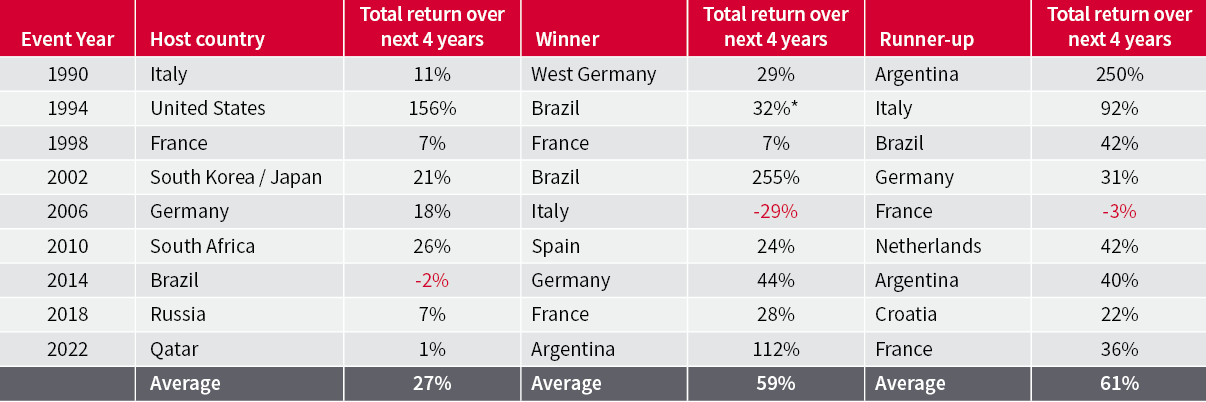
Source: AJ Bell, FE Analytics, LSEG. Performance data in pounds sterling. 2022-2026 data runs until 1 June 2026. *Data only available from 3 Nov 1994. Indices used for calculations: MSCI Italy, MSCI Germany, S&P Merval, S&P 500, MSCI Brazil, MSCI France, Nikkei 225, MSCI South Africa, MSCI Spain, MSCI Netherlands, MOEX Russia, MSCI Croatia, MSCI Qatar. Returns from indices used as a proxy for performance and do not factor in fund or platform charges.
The results counter common wisdom, and highlight the potential benefits of going against the crowd. That is something people find to be the winning strategy with investing in general, and is a strategy applied by certain fund managers or more experienced investors looking to beat the market.
Returns were much more consistent among World Cup second-place countries, whereas a blockbuster showing from the US stock market after the 1994 event skewed the average return for the hosts of the past nine tournaments.
The latest betting odds put France as runner up, against Spain as the winner, and the US is the main host country alongside Mexico and Canada. France has come in second place twice over the past nine World Cup tournaments, won it twice, and hosted once.
There are various tracker funds mirroring the performance of key equity indices in France. For example, iShares MSCI France ETF follows the MSCI France index used in our calculations and covers 54 companies including luxury goods specialist LVMH and aircraft manufacturer Airbus.
Amundi CAC 40 ETF tracks the CAC 40 index which contains 40 of the most prominent companies on the French stock market. The list includes cosmetics group L’Oréal and insurer Axa.
Any investment decision comes with risks, and investors should always consider wider economic data and market valuations rather than simply who might finish first or second at a sporting event.
Investors may find that investing in the US or Spain might prove a better fit with their portfolio than France, or even that Brazil or England (the UK) could be worth exploring, so it is important to make any decision with the appropriate level of research before committing money to it.
Other examples of funds tracking the markets of different countries include Amundi IBEX 35 ETF for Spain, iShares Core S&P 500 ETF for the US, and iShares Core FTSE 100 ETF for the UK. For those seeking broader global exposure rather than just individual countries’ markets, global tracker funds such as Fidelity Index World are popular with investors.
Anyone looking for specific World Cup-related opportunities might wish to take a different approach and focus on certain sectors if they are looking to fill their (football) boots. Travel, accommodation, hospitality, sportswear, media, and gambling are the obvious hotspots, but none are guaranteed winners.
As always, it is vital to drill down into each sector to understand which stocks would have the most exposure, rather than simply picking anything from that industry. For example, Whitbread is a well-known hotel operator, but it would not benefit from the World Cup because it does not have sites in the host countries. In contrast, InterContinental Hotels (IHG) has sites in all three of the World Cup locations this year: the US, Canada, and Mexico.
When looking at investment opportunities, it is important to consider the negatives as well as the positives. There are reports that hotel bookings in host cities are below expectations because of high match ticket and travel costs. That suggests hotel operators such as IHG are not guaranteed to score big from the World Cup.
The public often show more interest in sportswear during major sporting events such as the World Cup. Adidas has ploughed a reported £50 million into its World Cup advert starring Timothée Chalamet, Lionel Messi, Lamine Yamal, Jude Bellingham and a host of other big names.
Adidas is hoping the buzz around the advert will put its brand front of mind for sports fans and translate into mega sales of its footwear. JD Sports is one to watch in this context, given it is a major retailer of Adidas products in both the UK and US.
Big sporting events like the World Cup attract millions of eyeballs, which is precisely why companies like to spend big on advertising during televised matches. Broadcaster ITV is showing 51 premium live matches and could see a big boost to advertising-related income around the event.
Flutter is a major name in sports betting and has operations in various parts of the world. The big unknown is the amount of money that traditionally might have gone to betting companies for the tournament, and which will now flow into prediction markets dominated by Polymarket and Kalshi.
Past performance is not a guide to future performance and some investments need to be held for the long term.



This area of the website is intended for financial advisers and other financial professionals only. If you are a customer of AJ Bell Investcentre, please click ‘Go to the customer area’ below.
We will remember your preference, so you should only be asked to select the appropriate website once per device.