Such is the Japanese yen’s decline this decade, both Washington and Tokyo are stepping in to support it in the currency markets.
Japan is keen to stave off further declines to help it rein in inflation and avoid the sort of rapid increases in interest rates that could stifle economic growth and further increase the burden of its sovereign debts. America’s involvement is no less self-interested. Treasury Secretary Bessent will be keen to dissuade Japan from selling some of its huge US government bond holdings and driving up the cost of US government borrowing in the process.
The early signs are that the intervention is working. But the history of governments’ efforts to bend currency markets to their will is not good, and the risk of unintended consequences further down the line cannot be dismissed out of hand.
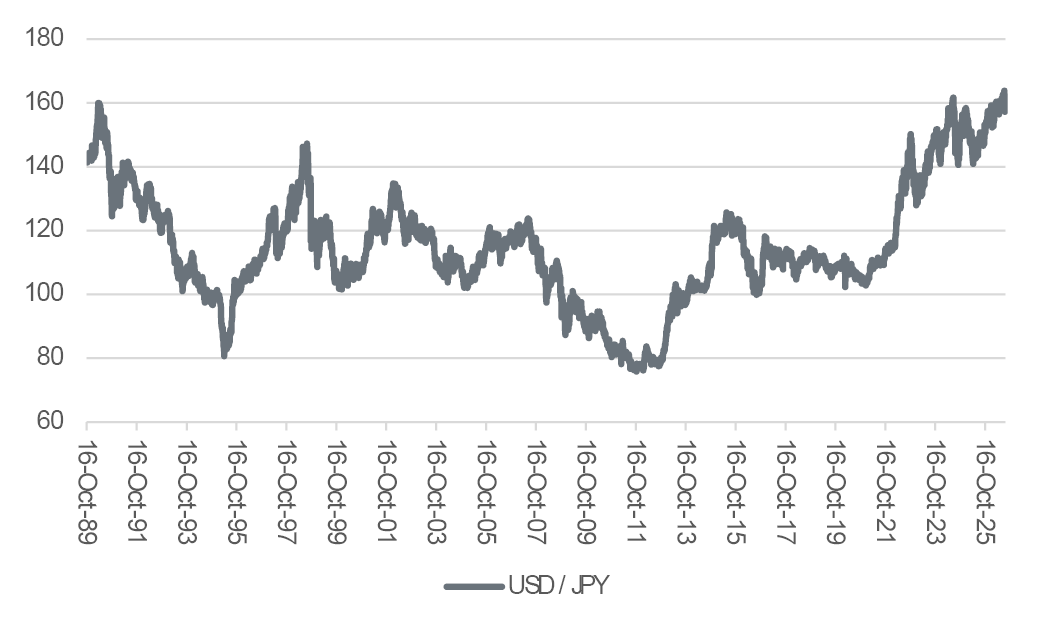
In late July, the yen slid to its lowest levels against the dollar since 1990, at almost ¥164. Its high point this decade was ¥102 to the buck, back in March 2020.
The yen hit a 36-year low against the dollar at the end of July
Source: LSEG Refinitiv data
The currency had taken fright from Prime Minister Sanae Takaichi’s cut on consumption tax on food, for two years from 1 April 2027, and how this could further pressure Japan’s already stretched sovereign finances, where the government debt-to-GDP ratio is around 250%.
One worry is that the Bank of Japan will have to revert to Quantitative Easing and start buying Japanese Government Bonds (JGBs) hand over to fist, in an effort to rein in Tokyo’s borrowing costs, which are rising relentlessly in response to lofty supply and another ongoing concern, inflation.
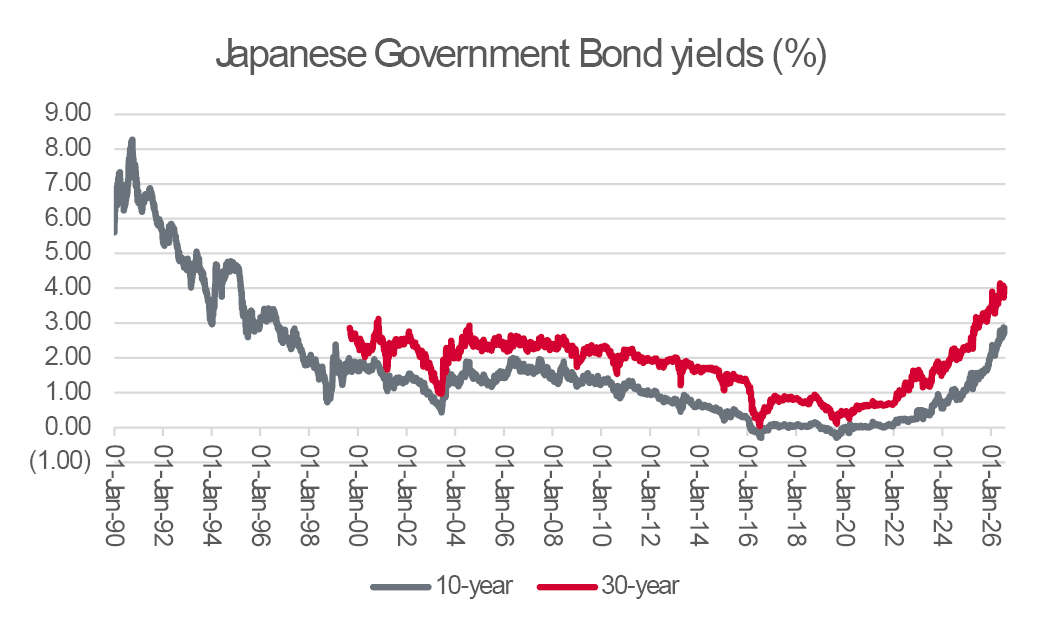
Japanese ten-year yields stand at their highest mark since 1996, and the thirty-year paper, which has a shorter trading history, offers its highest yield ever.
Japanese Government Bond (JGB) yields are rising inexorably
Source: LSEG Refinitiv data
Both trends only aggravate the weakness of Japan’s sovereign finances and raise fears that the Bank of Japan is losing control.
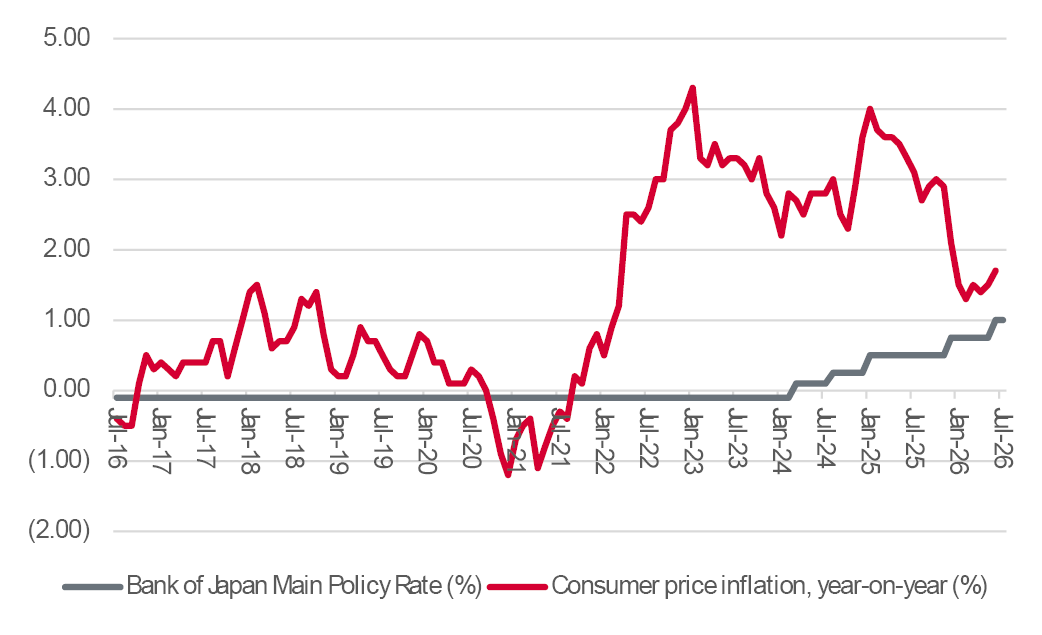
Its Governor, Kazuo Ueda, and his colleagues face criticism that they are being too timid and should be raising interest rates faster to head off inflation. Five interest rate increases in two years still leave the headline Main Policy Rate at just 1.00%, a level exceeded by the Japanese inflation rate in each and every month since early 2022.
Markets fear the Bank of Japan is acting too slowly to curb inflation
Source: LSEG Refinitiv data
Ueda’s caution may reflect worries that draconian rate rises will increase debt servicing costs and strengthen the yen to the point where exports take a hit and the economy slows down, or even tips into recession.
On the other hand, however, the weak yen makes imports more expensive, to stoke inflation, and is giving owners of JGBs ulcers, with the result that JGB yields are going up anyway.
In this respect, the Bank of Japan may be trapped between two unappealing policy options, but if Tokyo really was worried about defending the yen, then getting Udea and the BoJ to act in a decisive manner and raise interest rates would be the easiest way to do it.
Instead, the USA is stepping in to help. But its motives are unlikely to be wholly charitable.
If Japan were to intervene unilaterally in the currency markets, one way to do so would be to sell some of its enormous holdings of US Government bonds, or Treasuries.
Japan owns more than $1.1 trillion of US sovereign debt, to make it easily the largest foreign individual holder. A fire sale would increase yields on the paper and further pressure America’s increasingly fragile finances, where sovereign debt is careering toward the $40 trillion market and the annual interest bill gobbles up a fifth of tax receipts.
Any economic slowdown, or stock market wobble, in the USA would reduce Washington’s tax take and increase welfare spending, while higher bond yields would chew up more precious income, at a time when the war in the Middle East means defence spending is on the march once more.
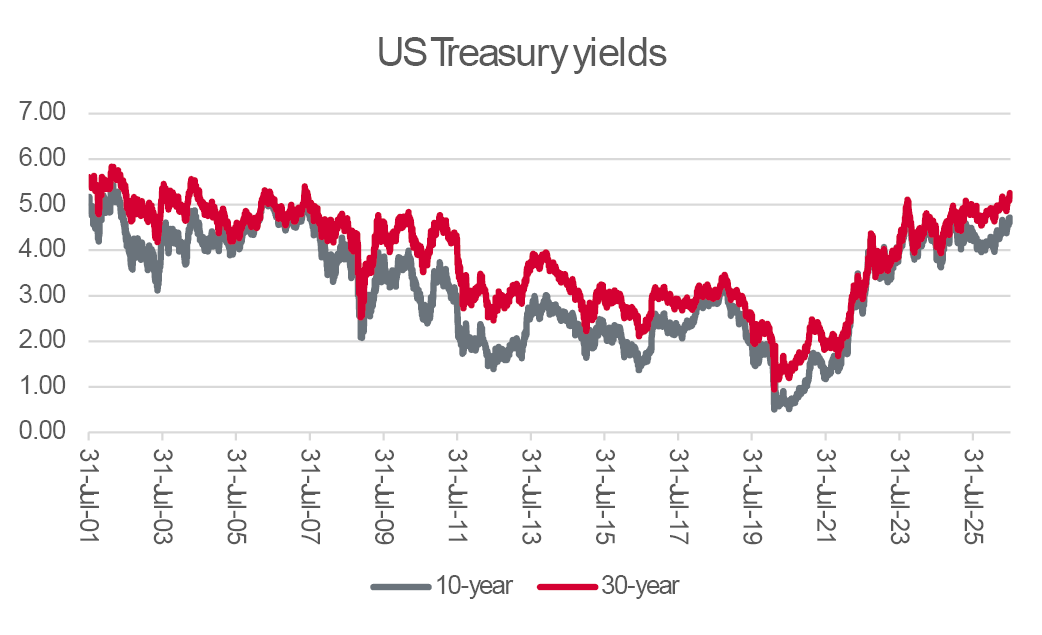
Bond vigilantes are getting edgy Stateside, judging by how thirty-year Treasury yields stand at their highest mark since 2007 and ten-year yields are nudging their way back toward 5.00%, a threshold also last crossed in 2007.
Bond vigilantes are stalking the US Treasury market, too
Source: LSEG Refinitiv data
This helps to explain why US Treasury Secretary Bessent is taking decisive action. Whether it appeases currency markets for long remains to be seen, but advisers and clients with global equity exposure should be watching too. A sudden surge in the yen in August 2024 prompted a squall across global share prices.
The yen had long been a major source of global liquidity, as major market players shorted it, borrowed against it, and used that money to go long risk assets around the globe.
Summer 2024’s unexpected yen rally forced the closure of massive short positions against it, drove the currency higher still and forced yet more liquidation by the shorts, who had to sell their long positions elsewhere, such as global equities, that they had funded with cheap yen.
That storm abated quickly but advisers and clients should be on alert all the same. Major currency market intervention, in the form of 1985’s Plaza Accord among the G5 (as it was then), weakened the dollar but did it so effectively that two years later the 1987 Louvre Accord helped to prop it up.
The currency tinkering spilled over into early signs of inflation on both sides of the Atlantic. Bundesbank chairman Karl Otto Pöhl began to threaten interest rate increases just as a new head of the US Federal Reserve took over with a reputation as a gold bug – no less a figure than Alan Greenspan. Although he ultimately proved a dove, not a hawk, the combination of Greenspan and Pöhl terrified markets and went some way to flattening overheating equity prices in October 1987’s Black Monday Crash.
Greenspan then showed his true colours with slashing rate cuts to support markets, but that only spawned more inflation and forced the Fed, Bundesbank and Bank of England, among others, into tightening monetary policy to such a degree that there followed a recession in 1991-92, and one so severe that it cost President George H. W. Bush re-election and helped to force sterling out of the Exchange Rate Mechanism. Manipulators of the yen be warned.
Past performance is not a guide to future performance and some investments need to be held for the long term.



This area of the website is intended for financial advisers and other financial professionals only. If you are a customer of AJ Bell Investcentre, please click ‘Go to the customer area’ below.
We will remember your preference, so you should only be asked to select the appropriate website once per device.