The interest rate cycle is turning, with markets expecting further rate hikes across major economies.
Three scenarios could emerge: a return to normality, stagflation, or renewed inflation driven by policy intervention.
Asset class performance may vary, making diversification and strategic asset allocation more important than ever.
Although the Bank of England continues to sit on its hands, the Monetary Policy Committee is also laying the groundwork for tighter policy, and markets are already pricing in two interest rate hikes this year from the Old Lady of Threadneedle Street, with one more to follow in 2027.
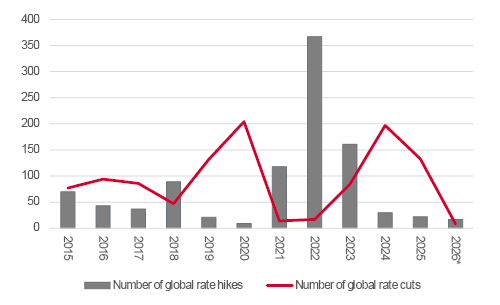
The first interest rate hike from the US Federal Reserve in more than three years, the second from the European Central Bank in 2026 and the Bank of Japan’s move to take its key policy rate to its highest level since 1995 also all suggest that the global interest rate cycle is turning upward.
The interest rate cycle looks to be turning upward once more
Source: www.cb.rates.com. *2026 to 18 September
The pace may be gradual, but 2026’s current tally of just eight global interest rate cuts compares to totals of 84, 197 and 133 in 2023, 2024 and 2025, respectively. However, the picture may be more complex than it seems, as the US Treasury continues to intervene in the US bond and global currency markets, while the Bank of England is seeking to finesse its policy, with a pause in gilt sales, or Quantitative Tightening, and slower rate of disposals thereafter, alongside a commitment to keep £120 billion of long-dated gilts that mature after 2049 to the end of their lifetime.
There are three possible interpretations of the latest policy manoeuvrings. They may not be mutually exclusive, but they may have different implications for asset classes across the board and therefore advisers’ and clients’ strategic allocation strategies.
Rate of response
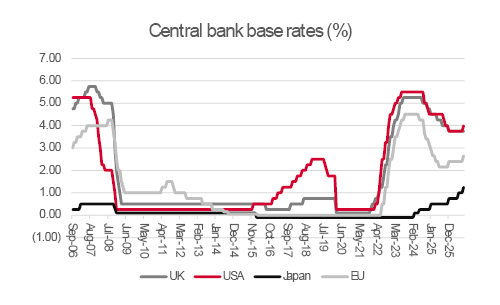
Central banks are nudging interest rates higher or at least laying the groundwork for policy tightening. Markets expect further hikes this year and next, as well. However, the US government’s move to buy long-dated Treasuries and issue short-dated ones in their stead, and the Bank of England’s decision to retain gilts that mature before 2035 and after 2049, and sell its medium-dated holdings over the next eight years, suggest there is more to policy than meets the eye and there are several theories for why this may be:
Interest rates are finally approaching something akin to normal, after a fifteen-year period in the wake of the Great Financial Crisis whereby the cost of money, and time, was artificially low, owing to central bank intervention in the form of unorthodox policies such as Zero Rate Policy (ZIRP), Quantitative Easing (QE) and Yield Curve Control (YCC).
Central banks responded too slowly to inflation at the start of this decade, with the result that annual increases in the cost of living have exceeded their 2% target for most of the last five years on both sides of the Atlantic. As a result, policymakers are now starting to correct this blunder, albeit at a gradual rate, even if events in the Middle East and higher oil prices may be forcing their hand, at least to some degree.
Central banks are moving at moderate speed thus far, but more rate hikes are expected
Source: Bank of England, Bank of Japan, European Central Bank, US Federal Reserve and LSEG Refinitiv data
US Treasury and Bank of England tinkering with the long-dated end of the Treasury and gilt markets imply that unorthodox policies may never be far away, and that burgeoning American and British sovereign debts could yet oblige central banks to look into an attempt to control bond yields and government borrowing costs. Such policies may involve keeping yields below inflation, or least nominal GDP growth, to try and salt down debt-to-GDP ratios and help governments manage their burgeoning debt interest bills.
Range of outcomes
The implications are each scenario could be as follows:
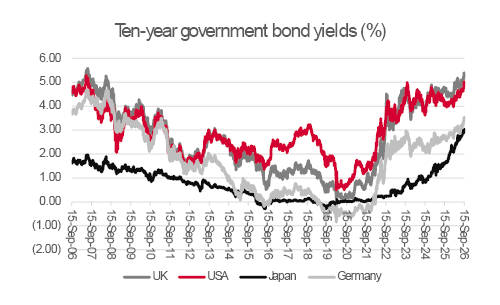
The first suggests the world is healthy and returning to ‘normal.’ A forty-year bond bull run broke in 2021, but benchmark, ten-year sovereign yields have risen to a point whereby they have begun to offer some compensation for inflation risk and also interest rate risk, especially as further interest rate hikes are already priced in. For equities, higher interest rates usually mean lower multiples of earnings, but rate hikes may mean that nominal GDP and earnings growth are strong enough carry share indices higher all the same, albeit at perhaps a slower rate than seen during the early half of the decade. Industrial metals may respond if economic growth is good but precious metals may sag as the cost of ownership rises the higher interest rates go.
Sovereign benchmark bonds offer more compensation for risk than for nearly two decades
Source: LSEG Refinitiv data
The second raises the spectre of a second policy error to follow the first, as policy becomes too tight having become too loose. The bulk of the inflationary impulse currently stems from oil and energy prices, areas where central banks have little or no influence. High hydrocarbon prices act as a tax on corporate profits and consumer spending and, if left to their own devices, will lead to demand destruction and a natural correction. Stagflation could result if central prices push too hard and slow down the global economy, especially if geopolitics keep oil prices high, whether demand holds up or not. The last real bout of stagflation was the 1970s, and in that decade precious metals did best, while equities did well in nominal terms but badly in real ones, and cash and bonds were just terrible.
The third suggests inflation could be the outcome. This would normally be bad for fixed income, but any initial launch of unorthodox policy could see more price-insensitive central bank buying, with the erosion of artificially depressed yields by inflation to follow thereafter. Income-generating assets could benefit relative to fixed income if yields are forced lower, including equities, while hard assets such as commodities and property could also benefit, if history is any guide. They cannot be printed, and supply grows only slowly, especially relative to the growth in paper promises such as government bonds.
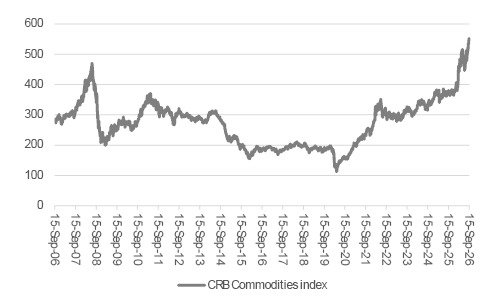
Commodity markets remain buoyant after spending the 2010s in the doldrums
Source: LSEG Refinitiv data
Note that none of these scenarios discusses a recession.
With the annual US deficit standing around 7% of GDP such largesse should help to support growth the world over, given America’s role as the globe’s economic engine, although an investment bust involving Artificial Intelligence could test even that.
Past performance is not a guide to future performance and some investments need to be held for the long term.
Author
Profile Picture
Name
Russ Mould
Job Title
AJ Bell Investment Director
Russ Mould’s long experience of the capital markets began in 1991 when he became a Fund Manager at a leading provider of life insurance, pensions and asset management services. In 1993 he joined a prestigious investment bank, working as an Equity Analyst covering the technology sector for 12 years. Russ eventually joined Shares magazine in November 2005 as Technology Correspondent and became Editor of the magazine in July 2008. Following the acquisition of Shares' parent company, MSM Media, by AJ Bell Group, he was appointed as AJ Bell’s Investment Director in summer 2013.
The information on this page is intended for professional advisers only.
Authorised and regulated by the Financial Conduct Authority.
Financial adviser verification
This area of the website is intended for financial advisers and other financial professionals only. If you are a customer of AJ Bell Investcentre, please click ‘Go to the customer area’ below.
We will remember your preference, so you should only be asked to select the appropriate website once per device.