10 Downing Street sign

How to tell if politics will prompt a bout of buyers’ remorse for gilt holders

1 day ago

At a glance

  • Benchmark UK gilt yield exceeds 5% for the first time since 2008
  • Inflation worries, uncertain economic outlook and unstable politics all driving yields higher
  • UK now has the highest ten-year yield in the G7

The UK is the world’s sixth biggest economy, third biggest individual stock market and arguably still punches above its weight in terms of global geopolitical influence. It has a track record for excellence in the creative media, life sciences, and technology (despite all the worrying, the UK ranks second all-time in the list for total Nobel Science Prizes since 1901 and the University of Cambridge has more all on its own than France).

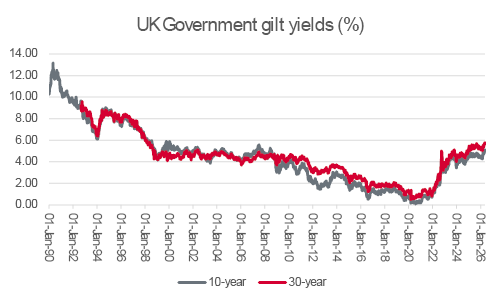
Yet the Government bond, or gilt, market is not having any of it. The benchmark ten-year yield stands above 5.00% for the first time since 2008 and the 30-year is at levels last seen in 1998.

An uneven economic outlook, heavy sovereign debt burden, and a further round of political turbulence in Westminster all explain bond markets’ sceptical view and demands for such a lofty yield. Advisers and clients now have the chance to decide whether the yields on offer are sufficient compensation for the risks and what portion of a balanced portfolio can be allocated to fixed income, and UK sovereign bonds in particular.

State of the nation

A ten-year yield of around 5.00% should not necessarily be a reason for dread. UK Government ten-year paper yielded between 4.50% and 5.50% for most of Tony Blair’s ten-year stint in office as a Labour Prime Minister. The economy ticked over nicely and the FTSE All-Share rose by two-thirds during that spell, even though the 2000-2003 bear market did a lot of damage in Blair’s second term.

Yet there are differences between then and now.

  • The first is that UK Government debt-to-GDP was 37% when Blair took the helm, not 94% as it is now. The annual deficit was £11 billion, or 1.1% of GDP, not £133 billion and 4.3% of GDP for the year to March 2026.
  • The second is that the annual interest bill on the £350 billion stock of Government debt in 1997 was £22 billion, compared to forecasts from last November’s Budget of £135 billion on £2.9 trillion of borrowing.
  • The third is this trend toward fratricidal politics in Westminster. Should Sir Kier Starmer fall, or be forced, from office and take Chancellor of the Exchequer Rachel Reeves with him, then their successors would become the seventh and ninth people to hold those posts respectively in the past ten years, starting with David Cameron and George Osborne in 2016. The seven PMs and nine Chancellors before that pairing lasted 40 years in office on both counts, going back to Ted Heath and Anthony Barber respectively, back in 1970.

There are further additional complications, notably a prevailing rate of inflation that exceeds the Bank of England’s 2% target every month bar one since August 2021. That has forced the Old Lady of Threadneedle Street to finally take interest rates up from all-but-zero and obliged the Monetary Policy Committee to start to sell gilts under Quantitative Tightening. The danger of the war in the Middle East further fuelling inflation, thanks to higher oil prices and second-round effects from fertiliser, food, and other sources, also lingers.

Global view

Given such circumstances, it is easy to see why fixed-income investors take such a dim view of the UK. Britain has the seventh-highest borrowing costs within the G20, as benchmarked by the 10-year sovereign bond; the highest in the G7; and its paper offers a higher yield than any of Portugal, Greece, Ireland, Italy and Spain, the so-called PIIGS whose public finances were such a shambles at the start of the last decade.

UK’s 10-year gilt yield compares unfavourably with developed Western peers
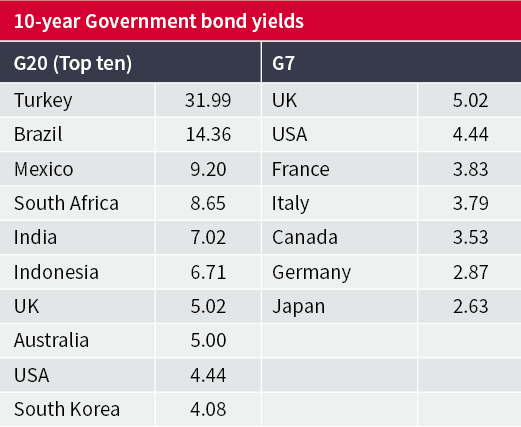
UK’s 10-year gilt yield compares unfavourably with developed Western peers

Source: LSEG Refinitiv data

Some degree of political stability may help UK gilts to catch a bid, but advisers and clients must now assess the risks that come with any fixed-income investment:
  • Credit risk. This can be dismissed, since the UK has not defaulted on its debt since the Stop of Exchequer under King Charles II in 1672 (although some may argue that 1932’s reset of the 5% coupon on the War Loan came close).
  • Inflation risk. This is perhaps the biggest danger, even if the consumer price index reading for inflation is currently 3.3%, given the scope for spill-over from the Middle Eastern war. In a worst case, the Government and Bank of England could also resort to more Quantitative Easing and financial repression if growth falters or fresh borrowing accumulates faster than expected.
  • Liquidity risk. The gilt market seizures of 2022 are fresh in the memory – although so are the lessons drawn from use of derivatives and liability-driven investing. As a result, the foundations of the gilt market should be less fragile.
  • Interest rate risk. This is less of an issue for those who hold gilts from issue to maturity, but anyone who buys a bond during its lifetime may have some exposure here. At the moment, the trend in interest rates may be up, not down, and the UK two-year gilt yield of 4.45% is a proxy for where markets currently think the Bank of England could settle.
UK Government yield curve has a relatively normal shape to it (for once)

UK Government yield curve has a relatively normal shape to it (for once)

Source: LSEG Refinitiv data

Inflation and money-printing are the biggest dangers, and any chatter of an expansive Budget under a new Labour leadership team would only fuel the fears of bond vigilantes. As such, advisers and clients could be forgiven of bearing in mind the warning given by J.H. Clapham in his magisterial Economic History of Modern Britain about “blind capital, seeking its 5%.”

Key takeaways

  • Yields at multi-year highs – UK gilt yields above 5% present a renewed income opportunity not seen since before the financial crisis.
  • Clearer risk–reward trade-off – Higher yields reflect inflation, fiscal pressures and political uncertainty, giving advisers a more defined basis for portfolio decisions.
  • Role in diversified portfolios – With the UK offering the highest 10-year yields in the G7, gilts may play an increasingly relevant role in delivering income and balance.

Past performance is not a guide to future performance and some investments need to be held for the long term.

Gilt MPS

Author
Profile Picture
Russ Mould
Name

Russ Mould

Job Title
AJ Bell Investment Director

Russ Mould’s long experience of the capital markets began in 1991 when he became a Fund Manager at a leading provider of life insurance, pensions and asset management services. In 1993 he joined a prestigious investment bank, working as an Equity Analyst covering the technology sector for 12 years. Russ eventually joined Shares magazine in November 2005 as Technology Correspondent and became Editor of the magazine in July 2008. Following the acquisition of Shares' parent company, MSM Media, by AJ Bell Group, he was appointed as AJ Bell’s Investment Director in summer 2013.

Financial adviser verification

This area of the website is intended for financial advisers and other financial professionals only. If you are a customer of AJ Bell Investcentre, please click ‘Go to the customer area’ below. 

We will remember your preference, so you should only be asked to select the appropriate website once per device.

Scroll to Top