Disruption is the buzz word of the year. New AI tools have caused upset to a multitude of stocks globally amid fears they could displace existing services offered by established companies.
Data, advertising and software-related companies have suffered a decline in market valuation, with investors fearing names like RELX and Experian could see a big hit to earnings if clients switch to third party AI tools. Insurance brokers and financial comparison website operators have also been rocked by AI developments.
Despite share price declines for companies linked to AI threats and many mega cap tech stocks like NVIDIA losing momentum, it’s interesting to see major equity indices such as the Dow Jones in the US and the FTSE 100 in the UK continue to hit new highs.
This pattern suggests that investors aren’t panicking, but they are clearly finding opportunities outside the tech space – which is a big shift in the narrative we’ve seen for the past decade.
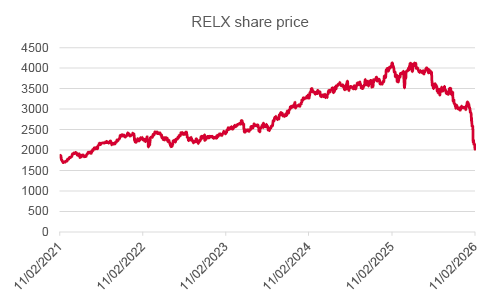
RELX’s share price fell by 14% on 3 February after investors cottoned on to Anthropic’s Claude product update that included open-source plugins capable of automating certain legal work. RELX has prospered for decades as its services are embedded into legal professionals’ day-to-day work.
Source: LSEG. Data to 11 February 2026.
The FTSE 100 stock has traditionally commanded a premium rating from investors, and any company in its situation stands to fall on the stock market when worrying news comes out of nowhere. RELX traded on 29.6 times earnings in February 2025, and it has now de-rated to 14.1 times – its cheapest valuation in 13 years.
The market had already priced in pain for advertising agencies during 2025 as it became clear that clients could do more work themselves using AI technology, even to the extent of making video creatives. Anthropic’s latest tools create even more pain for advertising agencies as the technology can draft content, plan campaigns and manage marketing launches. It’s no wonder shares like WPP have struggled.
Big questions have hung over ‘old school’ software players in areas such as accounting, for fears that AI could do a lot of their work. For example, Sage’s shares have been on a downward path for the past 12 months on fears its best days are over.
There are reasons why AI might not simply upturn all these industries in one fell swoop. A lack of trust in the accuracy of AI-sourced information is one reason. RELX and Sage, among others, already have customers’ trust and they’re deploying AI in their own businesses to make their lives, and clients’, easier. This suggests clients might prefer to use their AI systems rather than those from a more generic company like Anthropic.
Another reason why third-party AI may not instantly destroy companies is the fact names like RELX have proprietary information that won’t be fed into AI models for anyone to view.
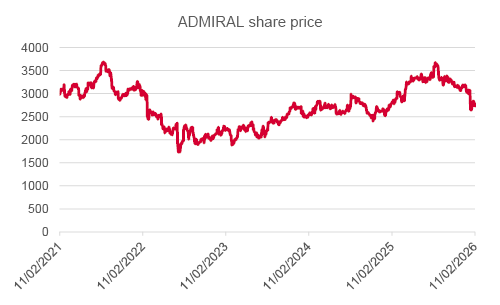
Admiral saw £1.3 billion wiped off the value of its share price between 21 January and 26 January 2026 after US insurer Lemonade launched cover for autonomous vehicles.
Normally a new insurance product wouldn’t move the dial, yet Lemonade’s policy is half the estimated cost of what you’d pay on a car controlled by a real person.
Source: LSEG. Data to 11 February 2026.
Lemonade uses AI to help with claims processing, underwriting, customer service and fraud decisions, making it a lower cost operator in the sector. AI is also deployed the systems used to run self-driving cars. However, the new autonomous vehicle policy isn’t simply Lemonade engaging in a price war – it’s a radical shift in the insurance sector and potentially bad news for companies like Admiral.
Lemonade’s new policy is specifically for Tesla self-driving vehicles and is based on the principle that autonomous vehicles are safer and involved in fewer accidents. Therefore, Lemonade believes they are cheaper to insure. This echoes what’s happening in China, with suggestions that autonomous vehicle insurance policies could be as little as a quarter of the price of traditional motor cover.
It also begs the question as to whether the car manufacturer and vehicle software provider are liable in the event of an accident involving a fully self-driving car, not the person in the front seat. After all, the human wouldn’t be controlling the vehicle.
If so, would that mean car insurers like Admiral who mainly serve the public would lose business to bigger commercial car insurers? That certainly poses a new challenge to the sector, and when new information is presented, investors often react first and think later – hence the slump in Admiral’s share price.
It’s hard not to ignore the fact that fully self-driving cars aren’t allowed on roads in the UK yet. The Government is keen for that to happen at some point, but it feels like investor panic around the likes of Admiral might be a tad premature.
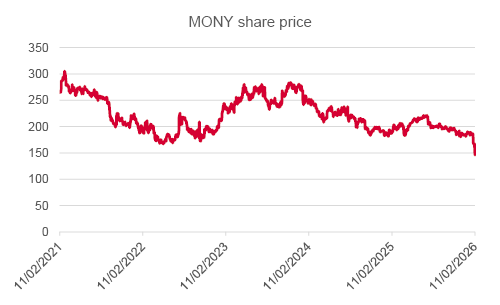
Shares in the owners of financial comparison websites Moneysupermarket and GoCompare, as well as various insurance brokers, tumbled in early February after developments in the AI space.
US-based insurance aggregator Insurify launched a new service where users can compare car insurance directly through OpenAI’s ChatGPT app. Spanish insurer Tuio has also received approval to provide home insurance quotes directly inside ChatGPT.
Source: LSEG. Data to 11 February 2026.
ChatGPT’s parent OpenAI last year said it would allow users to see prices and reviews more easily and have direct links to buy items. Offering insurance is a natural extension to this service.
Comparison portals will have to quickly find a way to get in on the game, such as embedding their services into ChatGPT. Moneysupermarket’s owner MONY has already built an app to fit inside ChatGPT and is awaiting approval.
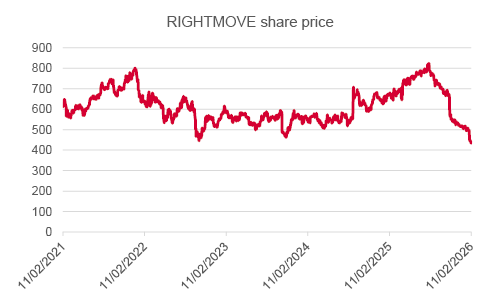
Other portals have wobbled on the market, including Rightmove, Autotrader and Baltic Classifieds as investors question if AI could be a help or hindrance.
More sophisticated search facilities on generative AI platforms mean users now have a different way to find houses or cars, and potentially as part of a more convenient process. This means portals must up their game and spend more money to make their sites essential places to visit.
Source: LSEG. Data to 11 February 2026.
It’s no coincidence that Rightmove’s shares have been in steady decline since announcing last November it would make AI-related investments. A year earlier, any mention of AI would have been cause for celebration. Now it’s a suggestion that Rightmove is having to move with the times, and investors are jittery about companies spending on tech.
The question people need to ask is whether Rightmove’s AI spending plans are an offensive or defensive move.
Past performance is not a guide to future performance and some investments need to be held for the long term.



This area of the website is intended for financial advisers and other financial professionals only. If you are a customer of AJ Bell Investcentre, please click ‘Go to the customer area’ below.
We will remember your preference, so you should only be asked to select the appropriate website once per device.