Activist investor Carl Icahn’s once asserted that, “Some people get rich studying artificial intelligence. Me, I make money studying natural stupidity.”
Make of that what you will, but right now, those who are riding the Artificial Intelligence (AI) wave are the ones getting rich and looking smart: the tech-laden NASDAQ index trades at an all-time high; Europe’s two biggest companies by stock market capitalisation, SAP and ASML, are both AI plays, as is Asia’s most highly valued company, TSMC; and the Chinese AI 50 index is going through the ceiling.
But the proposed $100 billion investment by the world’s most highly valued public company, American silicon chip specialist NVIDIA, into ChatGPT’s owner OpenAI echoes so loudly of the technology, media and telecoms (TMT) bubble of 1998 to 2000 that it merits further analysis.
“Although the final terms of the agreement are yet to be finalised, the idea is that NVIDIA and OpenAI deepen their existing relationship. OpenAI is already a leading buyer of NVIDIA’s chips, and it will be able to buy an awful lot more of them if it gets its hands on all of the $100 billion.”
Although the final terms of the agreement are yet to be finalised, the idea is that NVIDIA and OpenAI deepen their existing relationship. OpenAI is already a leading buyer of NVIDIA’s chips, and it will be able to buy an awful lot more of them if it gets its hands on all of the $100 billion.
But this agreement does seem reminiscent of deals struck during the TMT bubble, which looked like clever vendor financing when things were going well and mistaken financial engineering once it all started to go wrong.
Telecom equipment giants like Lucent and Nortel invested heavily in dot.com and telecom start-ups, who were also customers, and booked huge sales of their kit only for growth to disappoint and receivables to be written off as those early-stage firms faltered. The telecom and internet service providers WorldCom and Global Crossing built far too much capacity and engaged in reciprocal deals, or ‘capacity swaps,’ where services were offered and taken but no cash actually changed hands, and no payment was made. All four of those one-time stock market darlings had filed for bankruptcy or been taken over by 2009, two amid allegations of accounting fraud.
None of this is to accuse NVIDIA or OpenAI or any malpractice or anything illegal. True believers will argue that this will be $100 billion well spent.
“In the end, the forecasts that underpinned the TMT boom more than two decades ago proved conservative. The problem was that the S-curve of demand did not develop as rapidly as valuations and share prices required to maintain their momentum at that time.”
But the ripple effects could be considerable if the AI market does not develop as expected, or even as fast as expected. In the end, the forecasts that underpinned the TMT boom more than two decades ago proved conservative. The problem was that the S-curve of demand did not develop as rapidly as valuations and share prices required to maintain their momentum at that time.
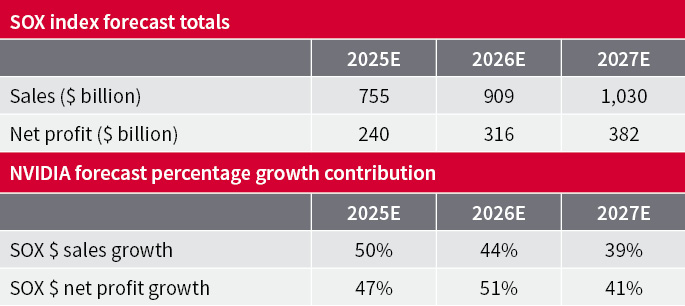
Regular readers will know of this column’s faith in the Philadelphia Semiconductor index, or the SOX, which consists of thirty leading American, Asian and European silicon chip and semiconductor production equipment (SPE) specialists. The ubiquity of semiconductors and the machines needed to make them, across computers, cars, robots, servers and consumer electronics, means they are a good guide to global growth. Aggregate net income across the SOX’s members rose more than 300% between 2015 and 2024, for a 12% compound annual growth rate – but there were still four down years during that span, due to economic soft patches, industry overcapacity or both.
Analysts believe the SOX index’s 30 members will show accelerated growth in 2025-2027

Source: LSEG Refinitiv data.
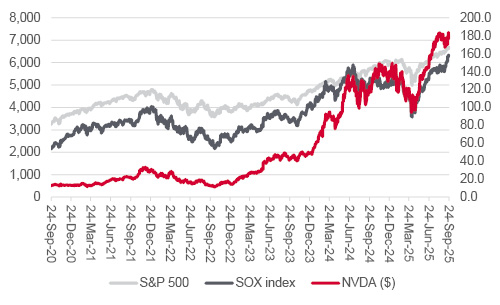
In addition, the SOX thrives off earnings upgrades and recoils from earnings downgrades and is thus a good proxy not just for the economy but financial markets’ risk appetite. Whither goes the SOX, major benchmarks like the S&P 500 and FTSE All-World index seem to follow.
The SOX leads the S&P 500…
Source: LSEG Refinitiv data.
This only serves to reinforce the importance of NVIDIA, the world’s largest company by stock market valuation.
“Advisers and clients may have neither time nor the inclination for stock specifics, but NVIDIA represents 48% of the SOX’s aggregate $9 trillion market capitalisation, 27% of forecast sales for 2025 and 45% of analysts’ profit estimates for this year. The company also represents a major chunk of the rapid growth expected from the SOX’s members in total for each of the next three years.”
Advisers and clients may have neither time nor the inclination for stock specifics, but NVIDIA represents 48% of the SOX’s aggregate $9 trillion market capitalisation, 27% of forecast sales for 2025 and 45% of analysts’ profit estimates for this year. The company also represents a major chunk of the rapid growth expected from the SOX’s members in total for each of the next three years.
...and NVIDIA dominates and powers the SOX index
Source: Company accounts, Marketscreener, analysts’ consensus forecasts
Even allowing for that anticipated progress, the SOX trades on 24 times forecast earnings for 2027. If – and it remains a big if – the deal between OpenAI and NVIDIA is more about financial engineering than product engineering, then there could be trouble ahead, as such valuations offer little downside protection. And even if AI and demand for semiconductors and chip-making equipment develop as forecast, the competitive threat from China remains a live one.
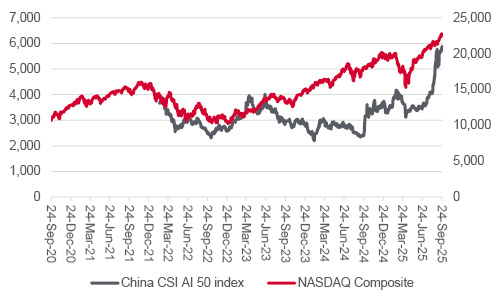
Chinese AI stocks are on a tear
Source: LSEG Refinitiv data.
“DeepSeek’s open-model, low-cost approach challenges the narrative that is driving US investment in AI, namely more computing power, more chips and more energy are essential.””
DeepSeek’s announcement of its R1 model in January caused a major flap. NVIDIA’s shares have brushed it off, but China’s AI 50 index’s gains suggest investors there are hopefully of great things, perhaps with the result that established American incumbents do not have it all their own way. DeepSeek’s open-model, low-cost approach challenges the narrative that is driving US investment in AI, namely more computing power, more chips and more energy are essential, so advisers and clients, or their appointed fund managers, will have to keep an eye on DeepSeek’s R2 and future releases, as and when they come.
Past performance is not a guide to future performance and some investments need to be held for the long term.



This area of the website is intended for financial advisers and other financial professionals only. If you are a customer of AJ Bell Investcentre, please click ‘Go to the customer area’ below.
We will remember your preference, so you should only be asked to select the appropriate website once per device.