Trade deals, talks with China and even the reversal of the Biden administration’s restrictions on exports of advanced silicon chips all help to justify the furious rally in global share prices from the early-April lows, which means most, if not all, of the losses in major headline indices are now recouped. The Trump presidency, thus far at least, therefore seems to be sticking to Treasury Secretary Scott Bessent’s script of ‘escalate to de-escalate,’ to raise hopes that the 90-day pause will see reciprocal tariffs rolled back.
Whether that leaves untouched the base, 10% tariff on imported goods into America remains to be seen. If so, the world will be a less straightforward place than it was on 1 April, before Liberation Day, but the hit to global trade flows, corporate profit margins and consumers’ spending power may not be as bad as initially feared, if Trump and Bessent strike trade deals.
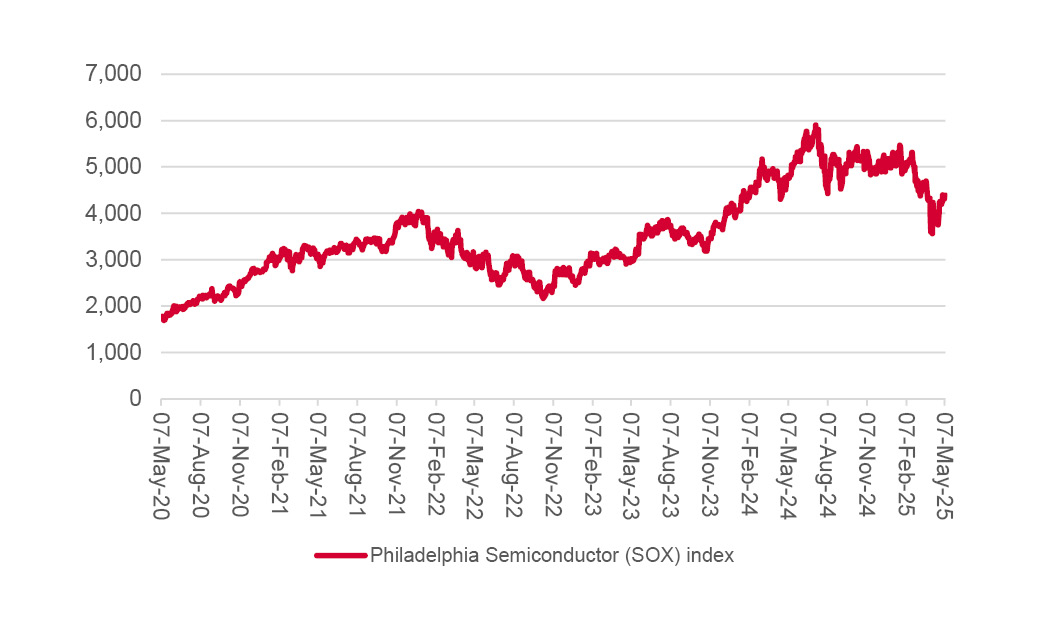
The move to replace the tiered structure for American semiconductor exports is particularly telling, given how technology, and access to its development in areas such as artificial intelligence, is still a flashpoint between Washington and Beijing. It adds to the tariff exemption for smartphones and computer hardware and potentially helps NVIDIA (NVDA:NDQ) recoup some of the $5.5 billion in revenue it estimates it could lose if the Biden restrictions remain in place. It may also help to boost the semiconductor industry more widely and thus reaffirm the importance of following its fortunes and those of the Philadelphia Semiconductor index, or SOX.
The SOX fell into a bear market early in 2025 before Trump’s tariff launch
Source: LSEG Refinitiv data
“The SOX comprises thirty global makers and designers of both silicon chips and semiconductor production equipment (SPE), and it is worth following from an investment perspective for two reasons.”
The SOX comprises thirty global makers and designers of both silicon chips and semiconductor production equipment (SPE), and it is worth following from an investment perspective for two reasons.
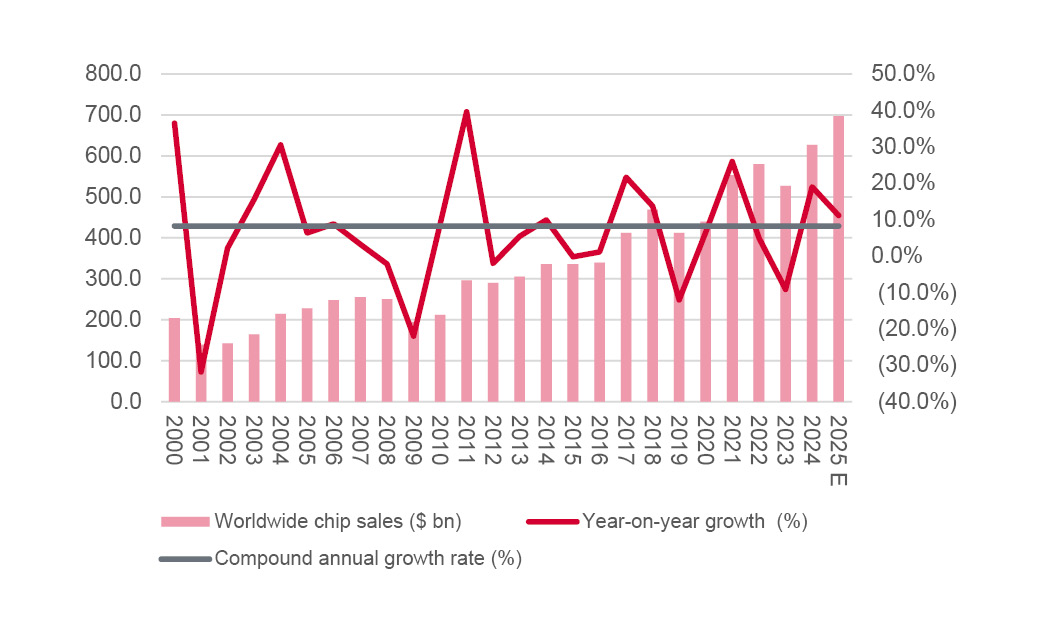
Global chip sales are expected to increase for the second year in a row in 2025
Source: WSTS, SIA, Gartner
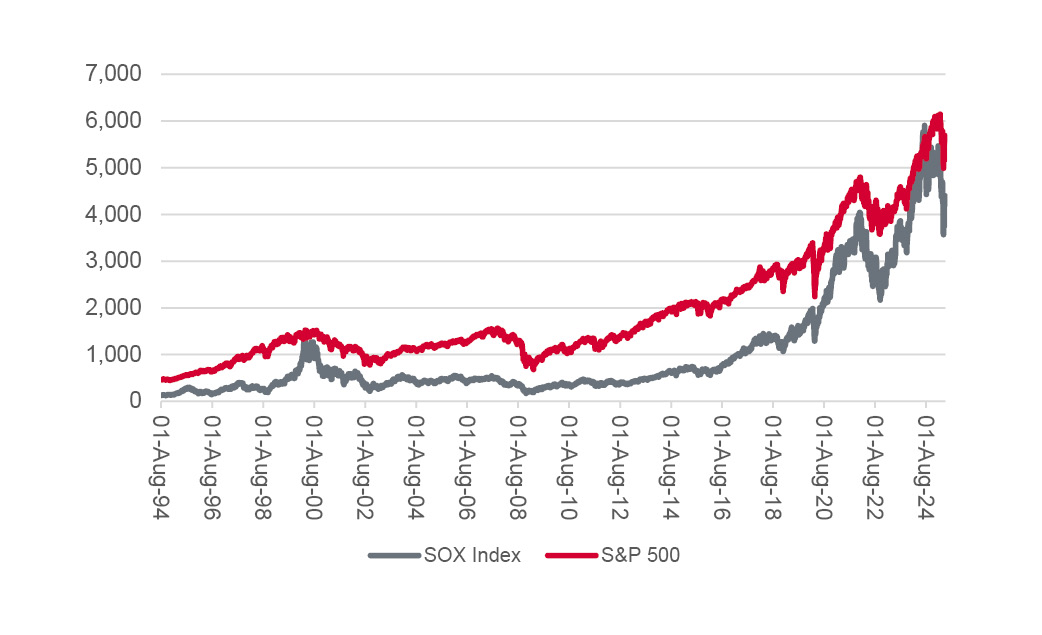
“Advisers and clients will note how the SOX peaked before the wider markets did in 2000 and 2007 and bottomed in 2002 and 2008, before the headline indices started to turn for the better.”
Advisers and clients will note how the SOX peaked before the wider markets did in 2000 and 2007 and bottomed in 2002 and 2008, before the headline indices started to turn for the better.
The SOX has been a good barometer for wider market risk appetite in the past
Source: WSTS, SIA, Gartner
At this point, we must acknowledge that the past is no guarantee for the future, but the SOX made a good job of spotting 2022’s economic slowdown and subsequent stumble in the S&P 500.
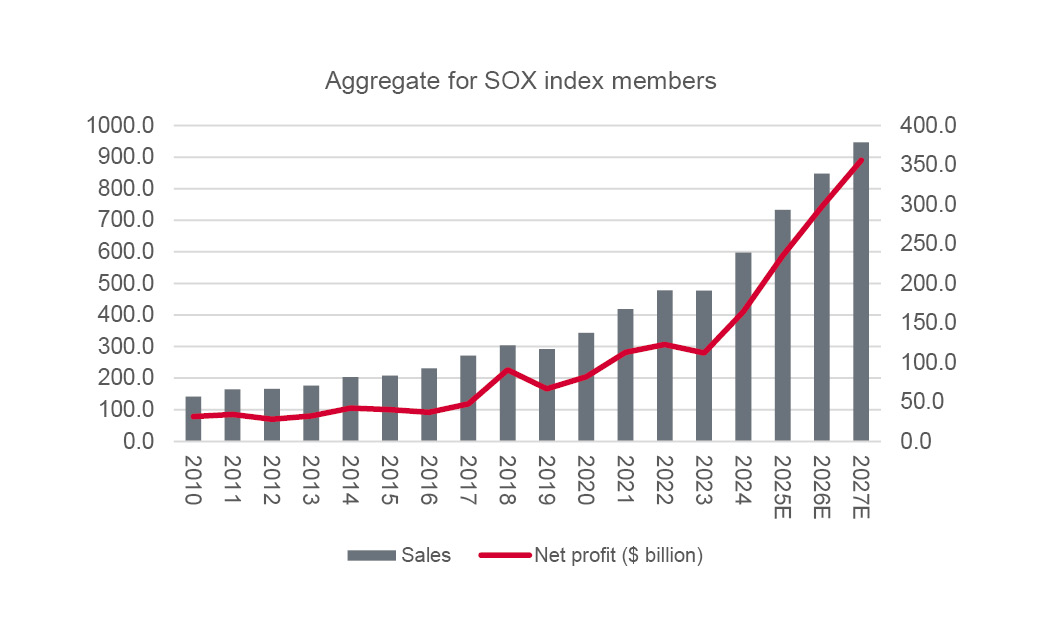
That downturn in the SOX was the result of a marked deceleration in sales and a big drop in profits across the industry and specifically at its members.
“The good news is that consensus analysts’ forecasts expect very strong profits growth in 2025, 2026 and 2027.”
The good news is that consensus analysts’ forecasts expect very strong profits growth in 2025, 2026 and 2027. The less good is that the SOX members’ aggregate market capitalisation of $6.2 trillion, three quarters of which comes from just NVIDIA, Broadcom, TSMC and ASML, trades on 26 times, 21 times and 17 times those respective earnings forecasts, multiples which do not offer much downside protection of anything goes wrong, so those earnings (and a few upside surprises) had better come through.
SOX index members’ profits are forecast to boom in 2025-27
Source: Company accounts, Marketscreener, analysts' consensus forecasts
“If growth in capital investment and growth in inventory starts to outstrip growth in sales across the SOX’s thirty members, then watch out, because there could be trouble ahead, as supply catches up with, and then exceeds, demand.”
Thankfully, there is a way to see if the forecasts are in with a chance of being realistic and that is to check chip stocks’ cashflows and balance sheets. If growth in capital investment and growth in inventory starts to outstrip growth in sales across the SOX’s thirty members, then watch out, because there could be trouble ahead as supply catches up with, and then exceeds, demand.
This is exactly what happened in 2022 and 2023, with the result that profits plunged and took the SOX with it. Capex cuts and inventory digestion (or write-downs) followed.
Inventories and capex can be a good guide to future SOX total profit trends Source: Company accounts
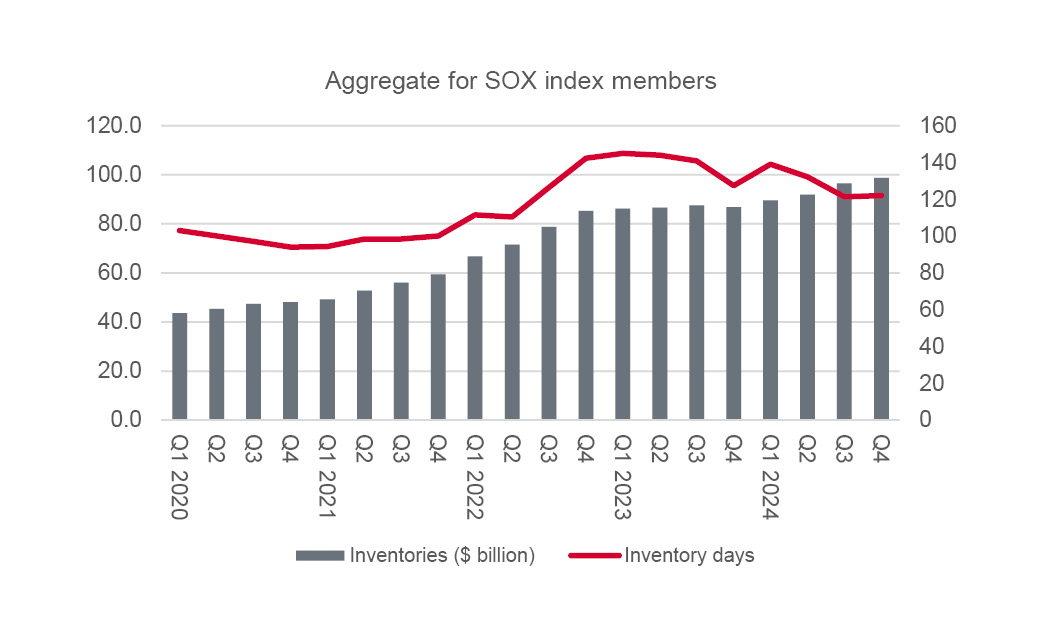
Source: Company accounts
That hair-shirt episode now looks to be behind us, so advisers’ and clients’ appointed fund managers need to keep an eye on cash flows and balance sheets and look beyond just the headline earnings per share numbers, to see if the SOX is going pull wider indices like the S&P 500 up or down with it.
Past performance is not a guide to future performance and some investments need to be held for the long term.



This area of the website is intended for financial advisers and other financial professionals only. If you are a customer of AJ Bell Investcentre, please click ‘Go to the customer area’ below.
We will remember your preference, so you should only be asked to select the appropriate website once per device.