It was a patchy year for UK IPOs in 2025 both in terms of performance and volume, going against the grain for a superb year for UK stocks more generally.
While a handful of stocks delivered strong returns, investors who bought every one of the 20 UK IPOs in 2025 would have lost money on average. In contrast, those who bought a FTSE 100 tracker fund at start of January and sat back and did nothing for the rest of the year would have cleaned up with a 25.8% return including dividends.
The average share price return on UK IPOs was -3.3% in 2025 when comparing the IPO offer price with the year-end market closing level – versus a 35.7% positive return on average in 2024. The top performing UK IPO in 2025 was tax and advisory services group MHA with a 54% share price return, whereas the worst performer, wellness products provider Wellnex Life, fell by 81.1%.
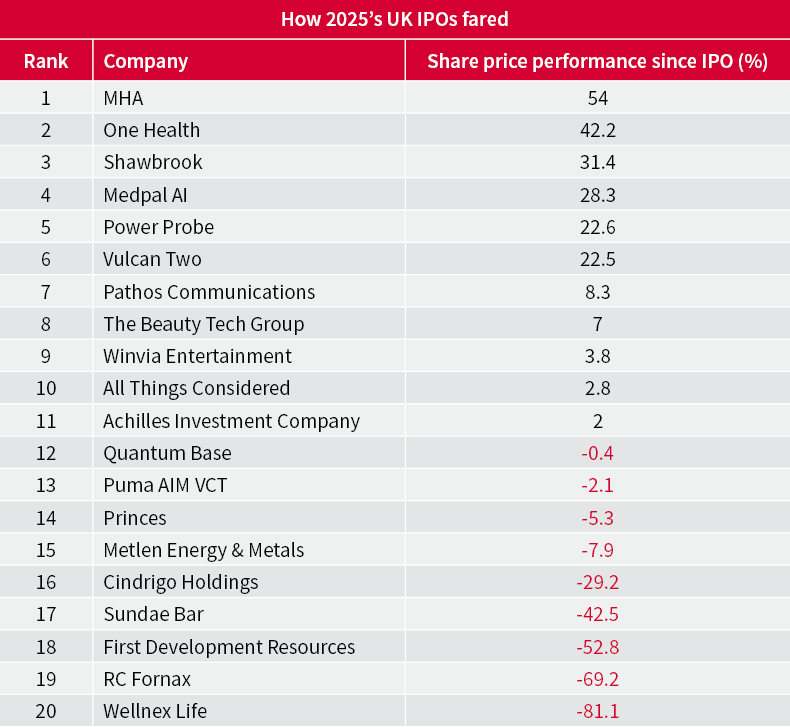
Source: AJ Bell, LSEG, Company Announcements, Google Finance. Data is based on difference between IPO offer price and closing price on 31 December 2025. Excludes Introductions, International Main Market IPOs, and demergers where the entity has a primary listing outside the UK.
Among the top performing IPOs, several stood out including accounting and professional services firm MHA. It joined the market two weeks after Liberation Day, listing at a time when investor sentiment was battered and bruised.
The shares returned 54% between its IPO on 15 April and the end of 2025, helped by two solid trading updates, decent financial results, one acquisition under its belt and another in motion.
Mid-cap financial services group Shawbrook returned to the UK stock market in 2025 after a period owned by private equity. It didn’t take long for the shares to warm up, delivering a healthy 31.4% return on its IPO offer price by the end of 2025. Grabbing a place in the FTSE 250 index helped its cause as it meant UK mid-cap tracker funds had to buy the stock.
Shawbrook is targeting mid-to-high teens annual profit growth over the medium term. Analysts forecast 10.48p per share in dividends for 2026, putting the stock on a 2.2% yield based on the share price at the time of writing. Dividends are expected to jump to 20.1p in 2027, equal to a 4.1% yield which is more in line with what you’d expect from the UK banking sector.
Tinned tuna seller Princes Group has yet to be a good catch for investors fishing for opportunities. The October IPO was priced at the bottom of its 475p to 590p range, indicating low demand from investors. A week after listing, Princes hit a 412p intraday low. While the shares have subsequently recovered closer to the IPO price, it’s not the best start to life as a listed entity.
he tinned goods group needs to deliver on its promise to become a more diversified business, both in terms of products and geographies. Making acquisitions is one thing, but identifying the right deals and paying a good price is another. Expect Princes’ every move to be scrutinised by the market until there is clear evidence that it can deliver the goods.
Despite the best efforts of the Government, the financial regulator, and the London Stock Exchange, the flow of IPOs in 2025 was only marginally greater than seen in 2024 (20 listings versus 16 respectively).
These figures exclude introductions where a company was already listed on another exchange and doesn’t raise any new money with its AIM or Main Market listing. The figures also exclude International Main Market listings in the UK, and demergers where the primary listing is in a different country.
More relaxed listing rules were meant to attract a greater number of companies to the UK stock market. Government efforts to drive greater public engagement with investing also had the potential to make the UK a more attractive listing venue. After all, companies admit their shares for public trading as a way of accessing a broad pool of investors through the capital markets. In theory, the more people buying and selling shares, the easier it should be to raise money to support growth activities.
So, what went wrong? Uncertainty around tariffs and politics at home and abroad, mixed consumer and business sentiment, and lacklustre economic growth were the prime ingredients to dampen the appeal of undertaking an IPO.
Companies once again sat on the sidelines, nervous about taking the plunge with a stock market listing. Volatile market conditions towards the end of 2025 also didn’t help, as investors were spooked by a potential AI bubble and whether it might burst.
The quality of company listings in 2025 was mixed. While some offered excitement around potential earnings growth, others looked like lame ducks with little to offer. You can have bucketloads of companies listing, but investors must want to buy the shares for them to succeed on the market.
Does that mean 2026 will be another dud for UK listings? Not necessarily. Chancellor Rachel Reeves has given some much-needed clarity on taxes, inflationary pressures are easing, interest rates are coming down, and the UK’s strong stock market performance in 2025 are all ticks in the right box to attract more IPOs. Companies now have a firmer idea how to plan, in terms of taxes, costs and more, and the FTSE 100’s blockbuster year in 2025 has shown that the UK is capable of rewarding investors handsomely.
There is also another incentive for companies to list in the form of stamp duty relief. As of 27 November 2025, stamp duty is not payable when buying shares in companies who listed on or after this date for the first three years of their life on the market. Let’s see if these factors drive greater IPO activity.
Past performance is not a guide to future performance and some investments need to be held for the long term.



This area of the website is intended for financial advisers and other financial professionals only. If you are a customer of AJ Bell Investcentre, please click ‘Go to the customer area’ below.
We will remember your preference, so you should only be asked to select the appropriate website once per device.