Fund management legend Sir John Templeton once asserted that “Bull markets are born on pessimism, grow on scepticism, mature on optimism and die on euphoria.”
Using price action as a guide, one area where it is possible to discern pessimism right now is in bonds, especially government bonds. Yields to maturity have been rising, and thus prices falling, for most of the last five years, to prompt some to argue a forty-year bond bull run is over. Since its summer 2020 peak at 225, the generic UK ten-year government bond, or gilt, index has fallen by almost a third, to erase any financial benefits of the 0.08% running yield on offer six years ago.
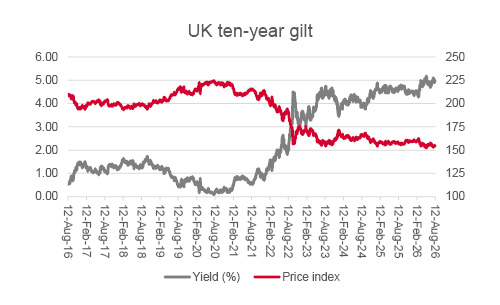
Source: LSEG Refinitiv data
That capital loss only crystallises if the bond holder sells, and anyone patient enough to buy a bond at issue and hang on until maturity should, all things being equal, bank their coupons and get their money back.
But the trend in yields and prices looks so resolutely negative, contrarian advisers and clients could be forgiven for wondering whether it may be time to take a closer look.
Advisers will be aware of fixed income’s scope to be a portfolio diversifier, especially for clients who fear a bout of equity market turbulence or seek income or both: one rule of thumb is that the fixed income weighting within a portfolio should equal the client’s age, for both of those reasons.
Plain, vanilla bonds will redeem at their issue price, or par, but their price will change during their lifetime, and things can and do go wrong. Bond funds do not mature or close either, so the investor must therefore assess four risks when investing in bonds, either via individual issues, or actively- or passively-managed collectives.
They are interest rate risk, inflation risk, creditor risk, and liquidity risk.
Any bond must offer a coupon which, in the eyes of the buyer, offers sufficient compensation for any and all of those dangers.
The UK has not formally defaulted on its debt since 1672 and King Charles II’s Stop of Exchequer, and the UK can always print money to pay the interest if it has to do so.
As such, default is not a concern. However, rising government borrowing, and thus supply of gilts, is a genuine worry especially as the Bank of England is no longer a price-insensitive buyer under its Quantitative Easing (QE) scheme, and is actually reducing its bond holdings by selling paper or not reinvesting on maturity, in a process called Quantitative Tightening (QT).
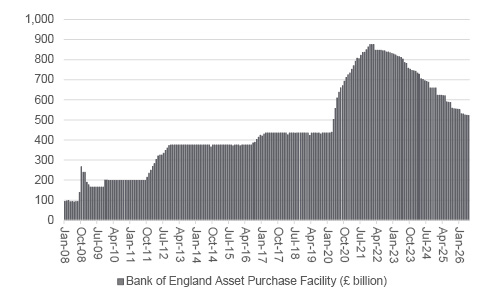
Source: LSEG Refinitiv data, Bank of England
This, along with the manner in which the Bank of England has failed to meet its 2% inflation mandate in every month bar two since spring 2021, explains why UK gilt yields are marching higher.
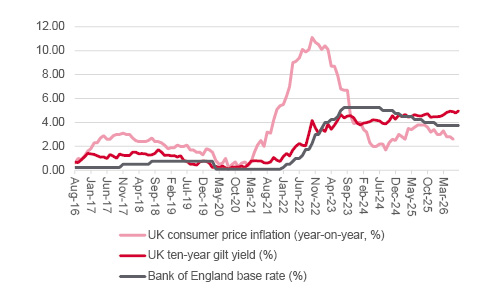
Source: Bank of England, LSEG Refinitiv data, ONS
A further issue to ponder is the trajectory of Bank of England base rates. The Monetary Policy Committee is expected to raise the base rate once or twice, at a quarter of one per cent a time, in the next two years, to a peak of 4.25%.
The risk is therefore that inflation gallops away and the Bank of England is forced into more interest rates than expected, increasing the government’s interest bill and supply of gilts at the same time, to create a vicious circle that could leave bonds looking like return-free risk.
The potential upside is that the war in the Middle East comes to a peaceful and lasting resolution, oil prices recede and inflation cools. That gives the Monetary Policy Committee scope for rate cuts.
Meanwhile, it could also help gilts if the new Labour Government achieves its goal of generating growth in every postcode, as that could help to increase tax receipts and cut welfare spending, to boost the UK’s sovereign finances and ease gilt supply.
Another scenario is an unexpected recession, where taxation income would fall and welfare spending rise, forces the Bank of England back to QE, as it blindly buys gilts to force down the yield and thus drive up the price, although such money printing would surely have consequences further down the road, just as it did last time. It is possible to argue that higher inflation, higher interest rates, and higher taxes are the price we are all paying for the QE used in the wake of the Great Financial Crisis that started nearly twenty years ago.
One method may help advisers and clients to decide whether unloved gilts offer value or not.
One seasoned bond fund manager argues that the neutral rate for the Bank of England base rate – to which the benchmark ten-year gilt will usually offer a premium running yield – is best assessed as the aggregate of trend GDP growth rate and trend inflation.
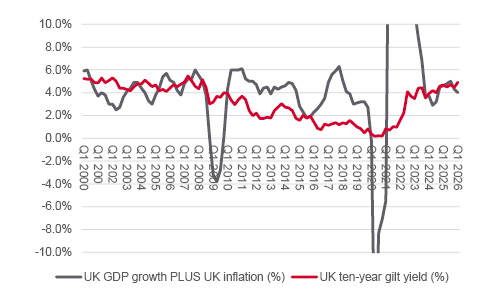
Source: LSEG Refinitiv data, ONS
If the adviser and client think that trend GDP growth will be 1.5% and the Bank of England can meet its 2% inflation target, then the base rate should be 3.5%, with the ten-year gilt yield coming in above that, to reflect the four risks discussed above.
Armed with that formula, advisers and clients can take a long-term view on where they think the base rate should be over time, and whether gilt yields, and thus prices, are too high or too low.
Past performance is not a guide to future performance and some investments need to be held for the long term.



This area of the website is intended for financial advisers and other financial professionals only. If you are a customer of AJ Bell Investcentre, please click ‘Go to the customer area’ below.
We will remember your preference, so you should only be asked to select the appropriate website once per device.