The value investing style has gained momentum over the past four months while the growth investing style has waned. This represents a major shift compared to the previous three years’ market performance.
It suggests more advisers and investors are readjusting portfolios as they seek alternative places to make money.
Source: LSEG.
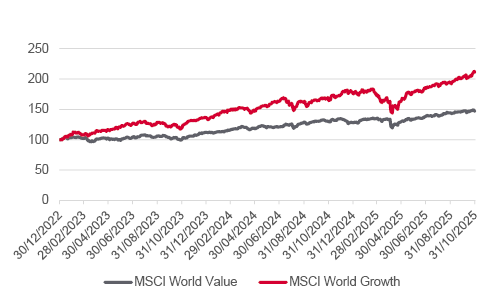
Growth stocks enjoyed a strong run between the start of January 2023 and end of October 2025, quickly recovering from blips along the way. The MSCI World Growth index generated a 112% total return between that period, versus 47% from the MSCI World Value index, according to data from LSEG.
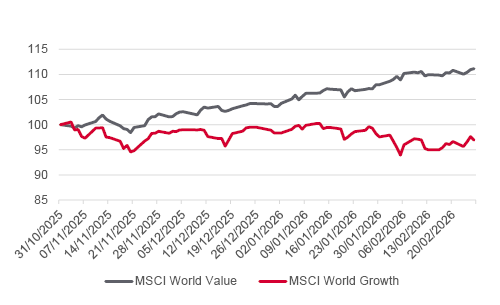
The laggard has now become the leader, with the value index returning 11% since 1 November 2025 (until 26 February 2026) versus a 3% loss from the growth index.
Source: LSEG.
The roots of this trend shift date back to when Donald Trump returned to the White House as US president in January 2025. That event led to divergent views about US policies and led certain people to shift their portfolios away from North America and towards cheaper parts of the world including the UK, Europe, and Japan.
The accelerated momentum in the value index since last November is partly down to growing concern around big tech companies spending unnecessarily large sums on AI infrastructure. There are also concerns that other tech-related companies might have their business models challenged by new AI tools.
Tech stocks are synonymous with the growth investing style, and they’ve gone off the boil since late 2025. Certain investors have reached the point where they want less tech exposure, so we have seen share price weakness in large parts of this sector. The only real winners in the world of tech so far in 2026 have been memory chip suppliers off the back of higher product selling prices and semiconductor equipment makers.
Growth stocks can command high valuations when they are in favour. In the US, certain big tech firms trade on rich valuations, and investors are now questioning if it is worth paying up when the outlook has become more uncertain. That is another reason value stocks are getting more attention, as is the interest rate environment.
Growth stocks often benefit from low interest rates where it is cheap to borrow money to drive expansion. Higher rates make debt more expensive and reduce the present value of future cash flows in a discounted cash flow model. In effect, they make future money worth less today – and that matters for growth stocks where the focus is on earnings down the line, not the jam they are already making.
The UK stock market is a veritable feast of value opportunities. The FTSE 100 has returned 9.6% year-to-date, including dividends, compared to 1.1% from the S&P 500. Leading the UK market are miners, telecoms, consumer staples and utilities, plus a couple of takeover situations in the financials space. Those lagging are technology, gambling, and consumer discretionary stocks.
There is a common theme among the winners, and it is tangible assets. These companies own physical assets which AI cannot replace at the click of a finger. These firms tend to generate solid cash flows, and certain ones have predictable earnings – which is exactly what investors want in the current environment – and less of the ‘jam tomorrow’ which has been the narrative driving tech stocks over the past 10 years.
This is an interesting U-turn from the decades of investors preferring asset-light businesses with intangible assets. What is ironic is how big tech firms are becoming asset-heavy businesses themselves, with big money ploughed into data centres and chips. However, this specific type of investment is causing an investor backlash.
Nick Kirrage, from asset manager Brown Advisory, says today’s opportunity with value investing is “unusually broad” and notes a wide gap between the most expensive and cheapest stocks in global market. He notes certain companies now sitting in the value bracket are ones that not long ago commanded premium ratings, saying they are now much cheaper and generate strong cash flows. This implies a rich hunting ground for value seekers.
Source: LSEG.
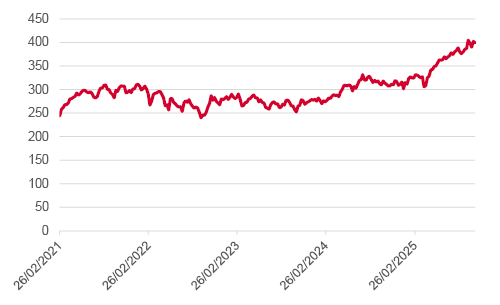
It is notable that investment trust Fidelity Special Values has this year moved to trade at a premium to the value of its underlying assets for the first time since 2021. Fellow investment trust Temple Bar moved to a premium last October and has subsequently stayed that way for most of the time. Both trusts have a value tilt in their investment style. Trading at a premium means investors are happy to pay more than the value of the assets to access the investment approach.
Both Fidelity Special Values and Temple Bar and certain other types of value funds have delivered strong returns for longer than the style shift observed since November 2025. For example, the MSCI World index returned 18.8% in the 12 months to 26 February 2026 in pounds sterling. In comparison, 46 value-themed global equity funds did even better, according to Morningstar data, topped by Artemis SmartGARP Global with a 41.6% return.
The Artemis fund is a good example of how value investing can be feast or famine. Over the past 10 calendar years, the fund has delivered six years of double-digit returns and the rest it made or lost a small amount. Value investing will not always follow that trend, yet for a long-term investor with a patient mindset, it can still be a fruitful way to make money.
Past performance is not a guide to future performance and some investments need to be held for the long term.



This area of the website is intended for financial advisers and other financial professionals only. If you are a customer of AJ Bell Investcentre, please click ‘Go to the customer area’ below.
We will remember your preference, so you should only be asked to select the appropriate website once per device.