Bottom line: Long-term success comes from humility, focus and process — not chasing certainty or reacting to noise.
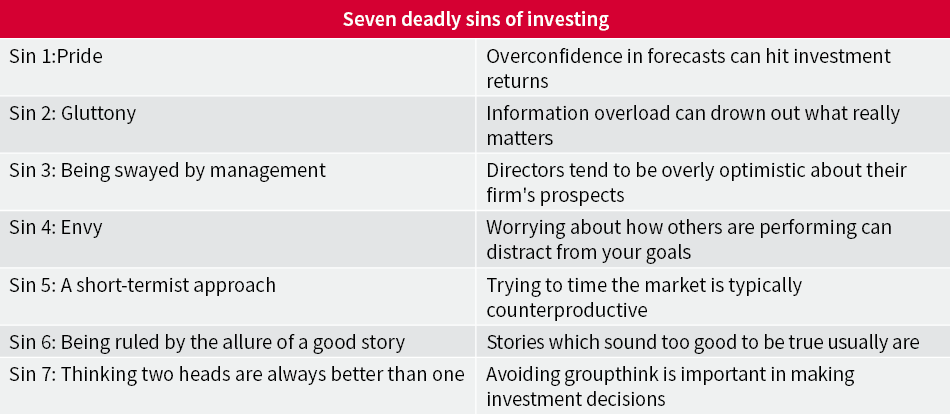
There is a huge body of academic work highlighting behavioural biases which consistently trip up investors’ supposedly rational thinking. Here are seven big sins of investing.
Forecasting sits at the heart of many investment processes in the professional money management world, whether it involves forecasting ‘top down’ economic growth or ‘bottom-up’ company-specific earnings.
“There is nothing intrinsically wrong with attempting to forecast the future. That is, if the forecaster has a realistic view of their chances of being accurate. The problem is the odds are wildly stacked against forecasters. There is overwhelming evidence supporting the idea that humans are poor forecasters.”
This would not be such an issue if people recognised their limitations. Unfortunately, this is not the case, and overconfidence compounds the problem. Studies have shown the worst forecasters tend to be those who are most overconfident.
These people are too sure about their ability to predict. They are described by statisticians as not well calibrated. Psychologists have devised simple tests for this. Imagine you were asked several difficult questions such as how old Martin Luther King was when he died, the diameter of the moon in miles and the weight of an empty Boeing 747 in pounds.
Your task is to provide a low and high answer to each question which captures the actual answer. For example, you might guess 25 years to 50 years for the death of Martin Luther King (the answer is 39).
In one study of 1,000 participants who were asked 10 questions, fewer than 10 people gave nine correct answers and most respondents were in the four to seven range.
The main point is that people who are well calibrated recognise what they do not know and adjust their guesses accordingly to make sure they capture the answer.
There is a lot of evidence suggesting peoples’ opinions of their skills and abilities are at best moderately correlated with actual performance. A good way of dealing with these biases is to take analysts’ forecasts with a pinch of salt.
Information is more widely available today than ever before. There is a popular notion that having access to more information than anyone else is the key to outperformance, but sadly information is not the same thing as knowledge.
Studies have shown that less is more when it comes to information. Humans do not deal with information overload very well due to cognitive constraints. Another difficulty is related to the idea that once an investment decision has been made, new information merely increases confidence in the original decision rather than improving overall accuracy.
In other words, what you do with new information is far more important than how much of it you get.
This is a learned skill honed by practice and requires the forecaster to be humble, cautious, and open-minded. These are the opposite traits of overconfident people.
The psychological challenges of dealing with huge amounts of information can be mitigated to some extent by developing a mindset which focuses on what really matters and ignoring the noise. This involves thinking more like a long-term owner of a business rather than getting distracted by short-term share price volatility. It takes time and effort to figure out the key drivers of a business, but it can reap rewards in the long run.
Given the primary reason for visiting companies is to collect more information, this activity suffers from the same psychological challenges just discussed.
“Overconfidence is not in short supply when it comes to company managements. For example, a Duke University study of chief financial officers showed that corporate managers are always more optimistic about the outlook for their company than the economy at large.”
Company visits can be useful for getting a better understanding of how a business works, but anyone searching for an informational edge might be disappointed.
One study shows that 75% of investment managers believe they are better than average. This shouldn’t be surprising given the earlier discussion on overconfidence.
The evidence suggests a period of underperformance is the price investors must pay for achieving long-term success. This means investors might be better off focusing on achieving their long-term investment goals, within the parameters of their individual risk appetite, rather than worrying how other investors are performing.
This brings the discussion to overtrading. Behavioural finance specialist James Montier highlights that average holding periods at US mutual funds have fallen from over a decade in the 1950s to under five years today. Speculating on the short-term direction of the market or a particular stock is not a sensible strategy for most investors, bar a few professionals who can make it successful.
“Timing the market is virtually impossible and is far less important than time in the market. Compounding works best when it is allowed time to do its magic.”
Financial academics naively assume investors gather evidence, weigh up the risks, then make a rational investment decision, but that is not how things work in practice.
The reality, explains Montier, is that investors collect evidence, usually in a biased fashion, then construct a story to explain the evidence. This story, not the original evidence, is then used to reach an investment decision.
Humans are innately very good story tellers. We have a need to make sense of the world and often see phantom connections. The same instincts which make us good story tellers can also get us into trouble when it comes to investing.
When you add confirmation bias to the equation, whereby we tend to look for supporting evidence and ignore contradictory information, it is easy to see how our expectations are often upended.
A defence against our weakness for a good story is to apply more scepticism and check the underlying facts, while reflecting on the logic being purported. Stories which sound too good to be true invariably are.
You might expect a higher quality, more insightful investment decision from a group compared to individuals. Studies show this is not always the case.
There is a tendency to conform rather than explore different views, and groups are at risk of suffering polarisation and, in the extreme, groupthink.
It transpires that under specific conditions, groups do outperform. For example, in one study comprising a group of 56 students who were asked to guess how many beans were in a jar containing 850 beans, they guessed 871, a better guess than almost all group members.
The ‘wisdom’ comes partly from the effect of outlying guesses cancelling each other out and the fact that each person’s guess is independently made without influence from other members of the group. When people get together, they tend to amplify rather than cancel out individual biases and extreme views. In reaching a consensus, variance is reduced.
The desire to find a consensus means the discussion tends to centre on information available to all group members which reduces the chances of uncovering anything new. Social pressure can also prohibit the sharing of information by people who do not want to look stupid in front of colleagues.
Playing the role of ‘Devil’s Advocate’ is an effective way of discussing contrarian views and exploring non-consensus views. Finally, when group members are acknowledged to be experts, disparate viewpoints are easier to deal with, and it is easier for unshared information to come to light.
Past performance is not a guide to future performance and some investments need to be held for the long term.



This area of the website is intended for financial advisers and other financial professionals only. If you are a customer of AJ Bell Investcentre, please click ‘Go to the customer area’ below.
We will remember your preference, so you should only be asked to select the appropriate website once per device.