The US has been the centre of attention for investors in recent years due to strong returns, yet the tide is turning. Strong gains so far in 2025 have come from a region that’s been royally unloved.
Germany generated a 13.1% total return between 1 January and 14 February 2025, more than three times that of the S&P 500 (4.1%) and the Nasdaq (3.7%) in the US. Admittedly, that’s a brief period in which to assess performance, but it’s unusual for Germany to outperform in such a way.
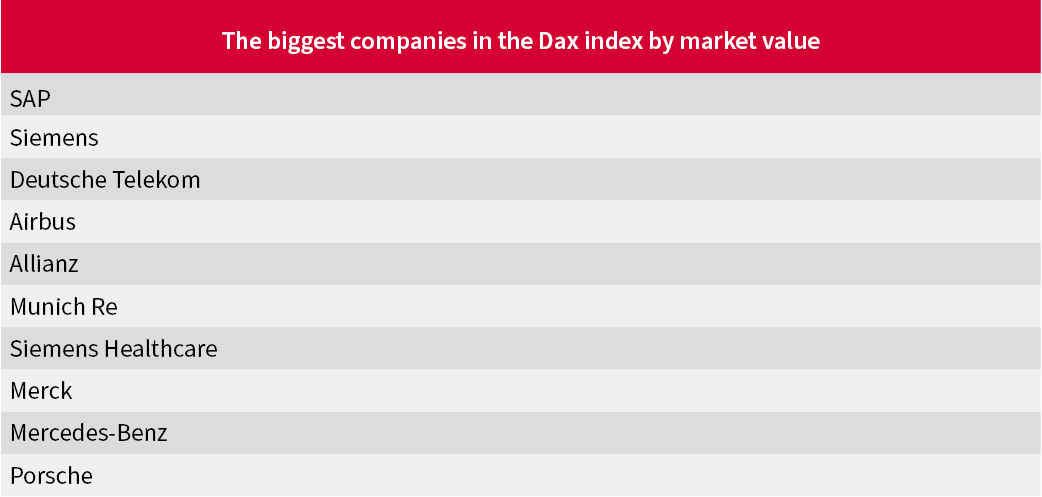
Source: AJ Bell, Market Screener, 18 Feb 2025
Its main index, the Dax, has enjoyed an impressive run so far this year, with 34 out of its 40 constituents delivering positive returns. Importantly, the top gains have been broad-based and not concentrated on one sector. For example, representatives from the banking, building materials, retail, chemical and tech industries have done well.
The US market is looking expensive, and investors have been giving a thumbs-down reaction to big names reporting in recent weeks. This includes a negative reaction to results from big tech companies which have previously generated supersized returns for shareholders. In contrast, big names on the DAX are getting their moment in the sun because they’re cheap and news flow has been positive.
Investors looking to diversify their risks and potentially reallocate money from the US will naturally look for value opportunities and upbeat narratives, and Germany has much to offer. The Dax is trading on 13.9 times forward earnings versus 19.5 times for the S&P 500.
The Dax’s 13.1% year-to-date gain is approaching twice the average 7.7% annual return achieved between 2014 and 2024. That’s a blockbuster performance across a mere six weeks. There have only been two other years with double-digit gains between the start of January and mid-February in the same ten years, which were 2023 (10.5%) and 2015 (11.8%).
The MDAX mid-cap index has had its best start to the year since 2023 with an 8.1% return and the second best since 2019. Star performers include chemicals group Lanxess, infrastructure services expert Hochtief, construction software provider Nemetschek and engineer ThyssenKrupp.
There are similarities between Germany and the UK from an investment perspective. The UK saw a new government last year and Germany has now followed suit. Both countries have a considerable challenge to accelerate economic growth and the journey won’t be easy
Germany and the UK also share a particular trait about the make-up of their main stock index, namely that constituents of the Dax and FTSE 100 generate the bulk of their earnings in foreign countries. It suggests that anticipation around the outcome of the German general election was not the key driver for the Dax’s performance this year.
In fact, one stock has led the Dax over the past year and a bit, and that’s SAP. Its share price has doubled since January 2024 thanks to the AI boom.
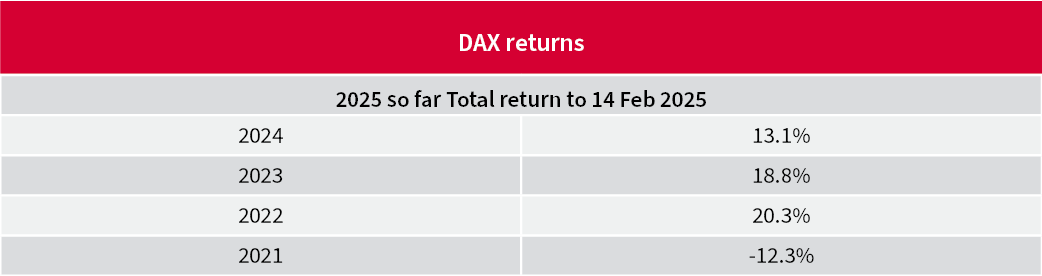
Source: AJ Bell, ShareScope. Total return. *to 14 Feb 2025
SAP is the world’s largest vendor of enterprise resource planning software and it believes its AI systems can save companies big money by boosting productivity. Last October SAP became Europe’s most valuable tech stock, leapfrogging past chip equipment maker ASML thanks to upbeat forward guidance for earnings fuelling the share price rally.
SAP trades on 42.7 times next 12 months’ forecast earnings, a premium rating versus the relative cheapness of the Dax. That poses a slight issue. Stocks on premium ratings have to keep beating earnings expectations to justify trading on a high multiple of earnings.
Simply meeting expectations might not be enough to sustain the share price momentum and that could see SAP pull back, should the news flow fail to impress. Given SAP plays such a dominant role in the make-up of the Dax, its success has made the index hostage to its fortune. The Dax only contains 40 stocks, making it more than twice as concentrated as the FTSE 100.
At least the Dax has a diverse range of sectors, unlike the Nasdaq in the US where technology dominates. Any setback by one of the Nasdaq’s biggest tech constituents could cause a negative read-across to the whole index. In contrast, SAP having a difficult day may not drag down the telecoms, automobile and financial stocks at the top end of the Dax.
Despite the Dax having more of an international flavour than you might expect, what’s going on domestically can still influence sentiment towards the index. The potential for fiscal stimulus in Germany and the ECB cutting interest rates could be positive share price catalysts.
Bank of America said on 18 February that in its poll of fund managers across Europe, Germany is the most preferred region from an investment perspective.
There is always the potential for near-term volatility when there is a change in government, and the results of Germany’s general election and what it means for the country was still a live issue at the time of writing. However, Germany’s stock market performance over the past two years has been impressive and investors who had written off the country as a source of positive returns should think again.
Past performance is not a guide to future performance and some investments need to be held for the long term.



This area of the website is intended for financial advisers and other financial professionals only. If you are a customer of AJ Bell Investcentre, please click ‘Go to the customer area’ below.
We will remember your preference, so you should only be asked to select the appropriate website once per device.