Markets continue to digest the implications of this week’s mid-term elections in the USA, and how they may shape both the final two years of this Trump Presidency and 2028’s race for the White House. But two earlier political developments, or appointments, could yet have as great a say in how equities, bonds, currencies, and commodities perform in the next twenty-four months, and possibly beyond.
Back in late September and early October respectively, US Treasury Secretary Scott Bessent named David Zervos and Judy Shelton as counsellors to his office.
Zervos came from US investment bank Jefferies, where he had been a prominent market strategist, via two stints at the Federal Reserve with a record of calling for lower interest rates and a smaller central bank balance sheet. Shelton is a bit less orthodox, as she is an advocate for gold and has argued for using the precious metal as backing for both US Treasuries and the dollar.
This puts both US sovereign bonds and gold centre stage.
Bessent’s attempt to beat down US Treasury yields into submission this autumn through buying back long-dated paper and issuing short-dated bills as cover did not work as planned.
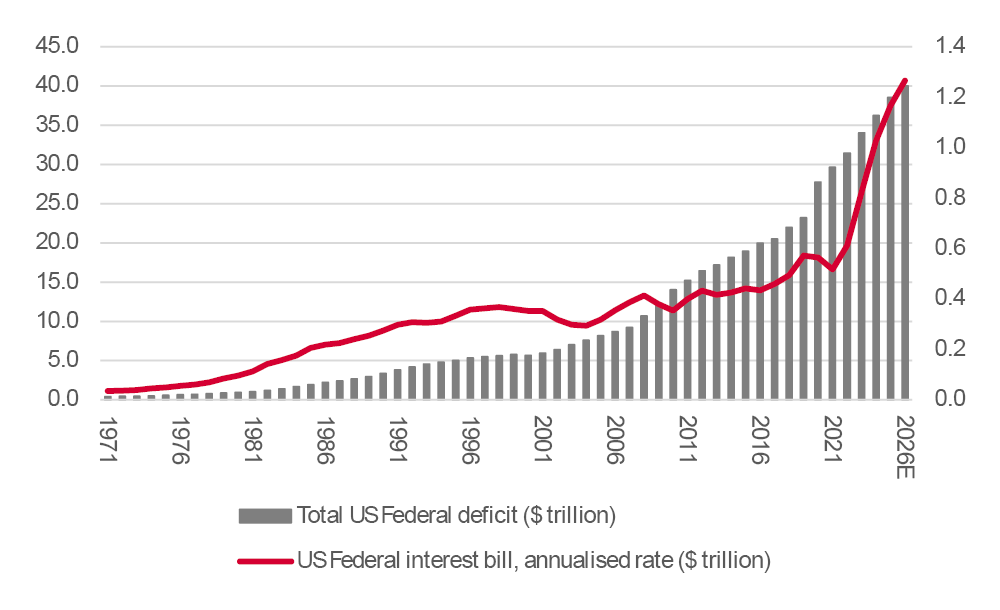
It therefore seems logical to assume he has hired both Shelton and Zervos for some contingency planning at the very least, with a view to helping the US tackle its $40 trillion Federal deficit and $1.2 trillion annual interest bill. Given their backgrounds, any policy pronouncements may be designed in such a way that could be bullish for US sovereign fixed income and the precious metal alike.
US sovereign debt continues to gallop higher and take the interest bill with it
Source: FRED – St. Louis Federal Reserve database, US Congressional Budget Office
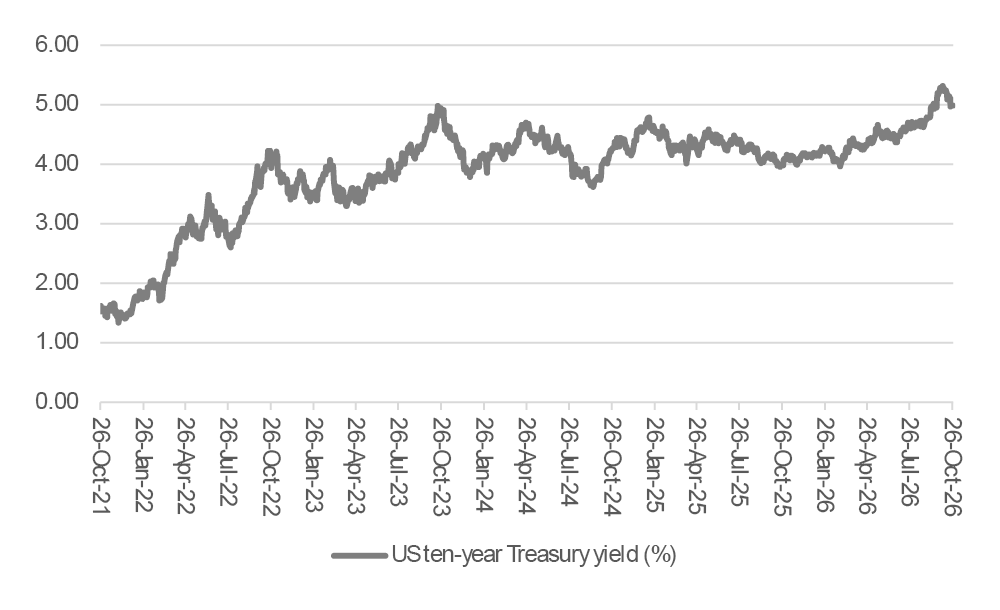
US Treasuries may already be preparing themselves for something unorthodox. Bessent’s $6 billion buyback scheme, not surprisingly, failed to move the $32 trillion US Treasury market, but ten-year yields have trickled down subsequently, despite some very hot inflation figures.
US ten-year Treasury yields have pulled back from their highs
Source: FRED – St. Louis Federal Reserve database, US Congressional Budget Office
This may reflect uncertainty over the Federal Reserve’s next move after September’s hike, amid Presidential pressure for a cut, chair Kevin Warsh’s determination to get inflation back toward the central bank’s mandated 2% target and perhaps concern that rising oil prices could, in conjunction with higher mortgage costs and a resilient dollar, finally put the brakes on US economic and corporate profits growth. Further declines in the benchmark ten-year yield in the event of further Fed rate rises would be the bond market’s way of saying the central bank is making a mistake by squeezing too hard.
Equally, it could just be the product of market positioning and shorts taking evasive action as they await Bessent’s next move, with Zervos’ advice at his side, given how rising debt and sticky inflation are both, on paper, negative for Treasuries.
Shelton is not the first US government official to have a hankering for gold. Hard to believe as it may be now, but former Fed chair Alan Greenspan was a gold bug in his younger days. In a 1966 essay, the so-called ‘Maestro’ argued in favour backing Treasury issuance with the metal to, over time, sneak America back onto a gold standard and drive down federal borrowing costs in the process, thanks to the hair-shirt implications for fiscal policy. By the time he took the helm at the Fed for twenty years from 1987 such inclinations had long since rubbed off.
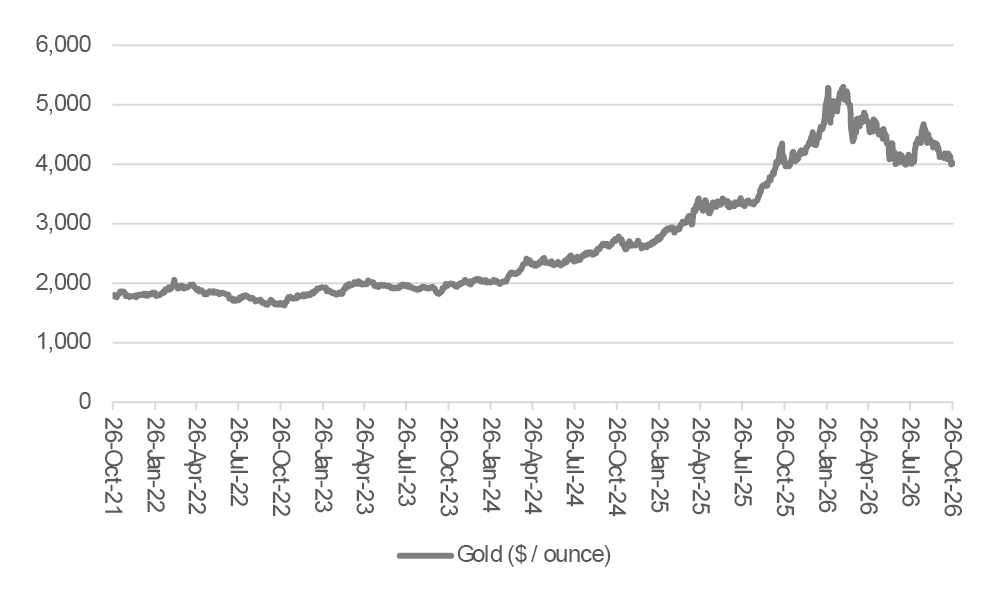
All the same, the US currently owns 261.5 million ounces of gold with an audited book value of just $42 an ounce, or $11 billion in all. At the prevailing market price for gold of $4,000 that hoard is worth $1 trillion, yet it still covers just 2.5% of the prevailing US debt.
Gold has retreated in 2026 after major gains in 2025
Source: LSEG Refinitiv data
Even a spectacular upward revision of the gold price may not make a huge dent in that, so any creative measures would still need some unpopular spending cuts or tax increases to support efforts to make the interest burden more manageable and ensure any reduction in Treasury yields are sustainable.
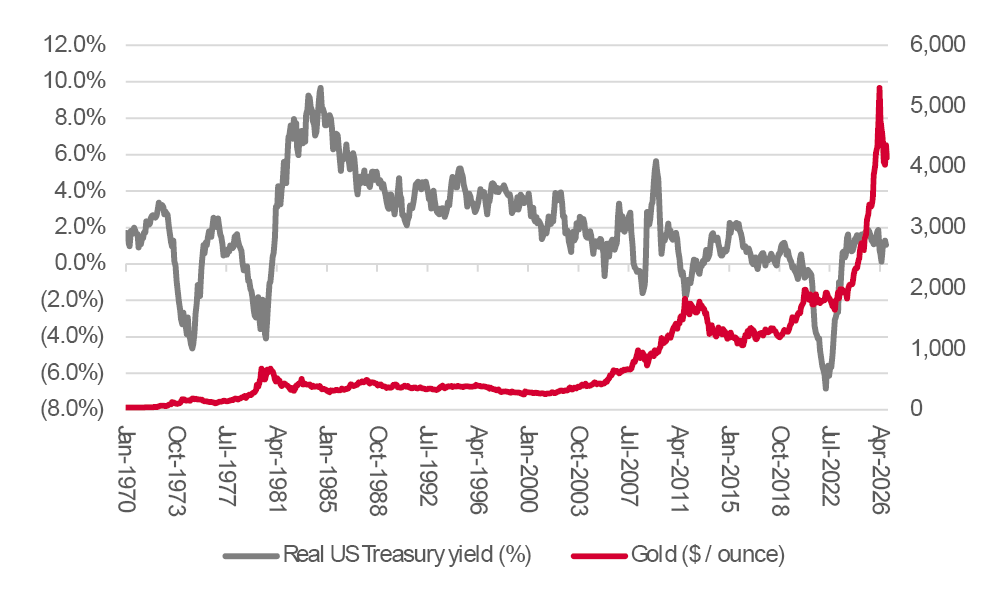
For the moment, gold is not taking a shine to such conjecture anyway, as it slides back toward $4,000 an ounce. Higher real US yields are the issue here, as Fed interest rate hikes and higher benchmark Treasury yields increase the opportunity cost of holding the inert metal that generates no cash and thus no yield of its own.
Higher real yields have historically weighed on gold prices
Source: LSEG Refinitiv data
Very sharp increases in real yields, after periods of low or even negative ones, have held back gold before, especially if the reason is an increase in interest rates rather than a moderation in inflation. History may repeat itself this time, depending upon how far Mr Warsh pushes the Fed Funds Rate, although gold is no stranger to pullbacks.
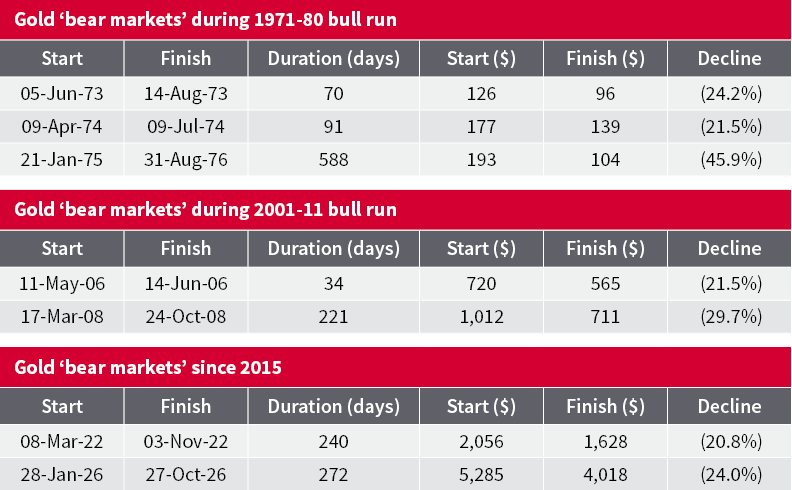
Even as it surged from $35 to $835 an ounce between 1971 and 1980, gold suffered no fewer than three mini bear-markets, when it fell by more than 20%, in 1973, 1974 and then one more that tested supporters’ mettle between January 1975 and summer 1976.
Gold’s second bull run, from $250 to $1,100 ounce, between 2001 and 2011 featured two further major retreats.
This third surge has already featured one decline of more than 20%, and a second may be brewing.
Gold has endured major pullbacks during its three major bull runs to date
Source: LSEG Refinitiv data
Unchecked debt growth and inflation may play to gold bugs’ investment case for a portfolio allocation to precious metals, while a fierce cycle of Fed rate hikes could seriously dent it.
Equally, unorthodox solutions from the US Treasury and Federal Reserve to America’s debt and interest challenge may represent the next real catalyst if the outcome is some form of monetary reset, in an unexpected boost for both US sovereign bonds and the metal at a time when equities, and technology stocks in particular, continue to dominate market’s affections.
Advisers and clients should await any policy pronouncements made by Bessent, with either Zervos or Shelton at his side, with interest.
Past performance is not a guide to future performance and some investments need to be held for the long term.



This area of the website is intended for financial advisers and other financial professionals only. If you are a customer of AJ Bell Investcentre, please click ‘Go to the customer area’ below.
We will remember your preference, so you should only be asked to select the appropriate website once per device.