It is almost a year since Sanae Takaichi was elected as Japan’s one-hundred-and-fourth Prime Minister, and its first female leader. She has, thus far, lived up (or down, depending upon your viewpoint) to the policies she championed before she won leadership of the Liberal Democratic Party, namely fiscal stimulus, loose monetary policy and a push to revise Article Nine of the constitution, whereby Japan can strengthen its military capability and increase defence spending to 2% of GDP.
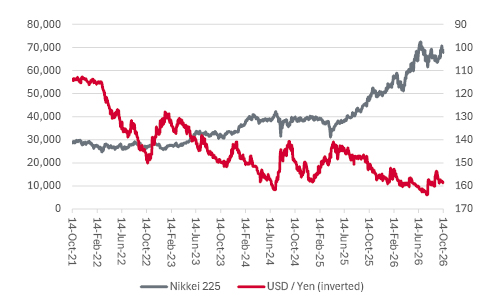
None of this greatly differs from the ‘Three Arrows’ programme successfully implemented by Shinzō Abe from 2012 to 2020 and, from the point of view of financial markets, it is having very similar effects. The yen continues to go down, and the Nikkei 225 benchmark equity index continues to go up.
The Nikkei 225 stands near all-time highs and the yen near thirty-six lows
Source: LSEG Refinitiv data
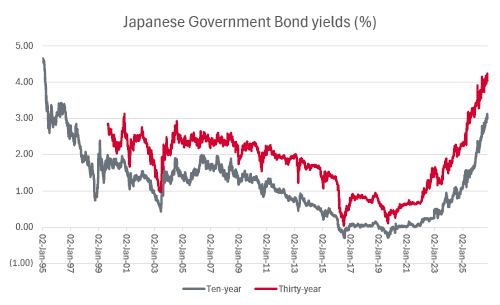
There is one fundamental difference, however, and that is how yields on Japanese Government Bonds (JGBs) are surging to levels not seen in thirty years, based on the ten-year paper, rather than staying at rock-bottom levels as they did during ‘Abenomics.’
Japanese Government Bond yields continue to surge
Source: LSEG Refinitiv data
If this trend continues, it could have wider implications for clients’ and advisers’ strategic asset allocations for portfolios, whether they have exposure to Japan or not.
JGB yields are on the march for four reasons.
One person who is definitely paying attention is US Treasury Secretary Scott Bessent. He has already tried to intervene and support the yen over the summer, with mixed results at best. The Japanese currency remains mired at around ¥160 to the dollar.
It may seem odd that Mr. Bessent would wish to weaken the dollar against the Japanese currency, but the logic is irrefutable.
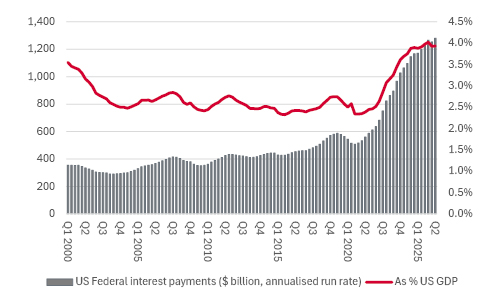
If the BoJ persists in moving slower than markets think is appropriate, the yen may weaken, to stoke inflation and force further increases in JGB yields, with two possible further consequences:
America’s sovereign interest bill keeps growing
Source: FRED – St. Louis Federal Reserve database
Equally, there is a danger in Mr. Bessent going in too hard, and he will be aware of this from his time as a hedge fund manager.
The yen is a huge source of cheap financing for investment institutions the world over, because the interest is low and the currency keeps falling. Hedge funds borrow in yen and use that liquidity to invest elsewhere, arbitraging the higher returns.
If the yen suddenly surges, margin calls could force the hedgies to buy back their yen, and sell the positions funded with the borrowed Japanese currency so they can do so first.
It is a high-stakes game.
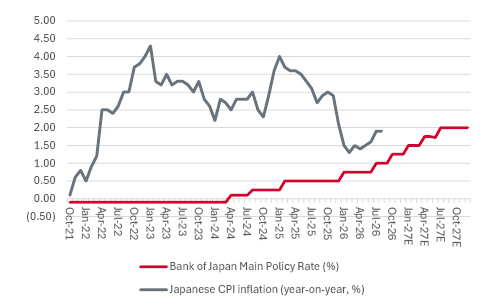
The best case is the Bank of Japan acts more decisively than expected, to take the base rate to a little above the 2% that the markets see as the peak, and the yen stabilises or makes only modest gains as a result.
The Nikkei 225 stands near all-time highs and the yen near thirty-six lows
Source: LSEG Refinitiv data, Bank of Japan
In a worst-case scenario, the Bank of Japan does too little and rising JGB yields drag fixed-income investors’ money to the East from the West, where Government bond yields rise amid the sales by Japanese holders. Corporate earnings can still grow, so share prices need not collapse, but investors may pay lower multiples for them, owing to the higher discount rates implied by higher bond yields, and that could slow benchmark indices’ giddy ascent, if not stop it altogether.
Past performance is not a guide to future performance and some investments need to be held for the long term.



This area of the website is intended for financial advisers and other financial professionals only. If you are a customer of AJ Bell Investcentre, please click ‘Go to the customer area’ below.
We will remember your preference, so you should only be asked to select the appropriate website once per device.