NVIDIA remains pivotal to markets, accounting for 6% of the S&P 500 and sitting at the heart of the AI investment boom.
Leadership uncertainty could test investor confidence, with potential implications for NVIDIA, AI spending and wider markets.
History offers some useful clues, as today’s AI excitement shares characteristics with previous investment booms and bubbles.
Advisers and clients are unlikely to have either the time or the inclination to delve too deeply into the pros and cons of individual stocks, but even they will surely be keeping an eye on events at NVIDIA.
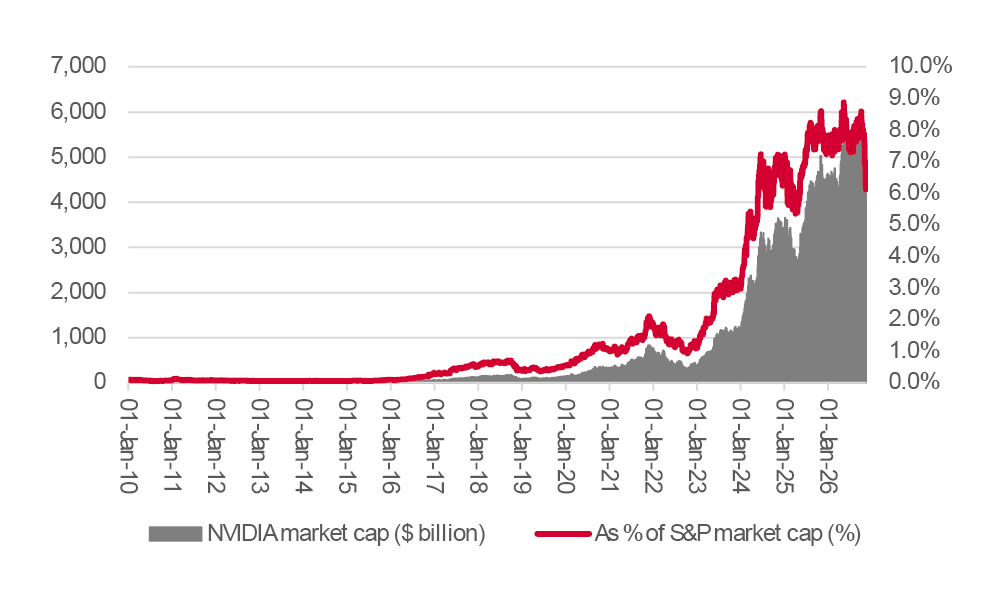
At the time of writing, it is still the world’s second-largest company by stock market capitalisation, and represents 6% of the S&P 500’s $65 trillion price tag all on its own.
NVIDIA’s share price advance has been meteoric
Source: LSEG Refinitiv data
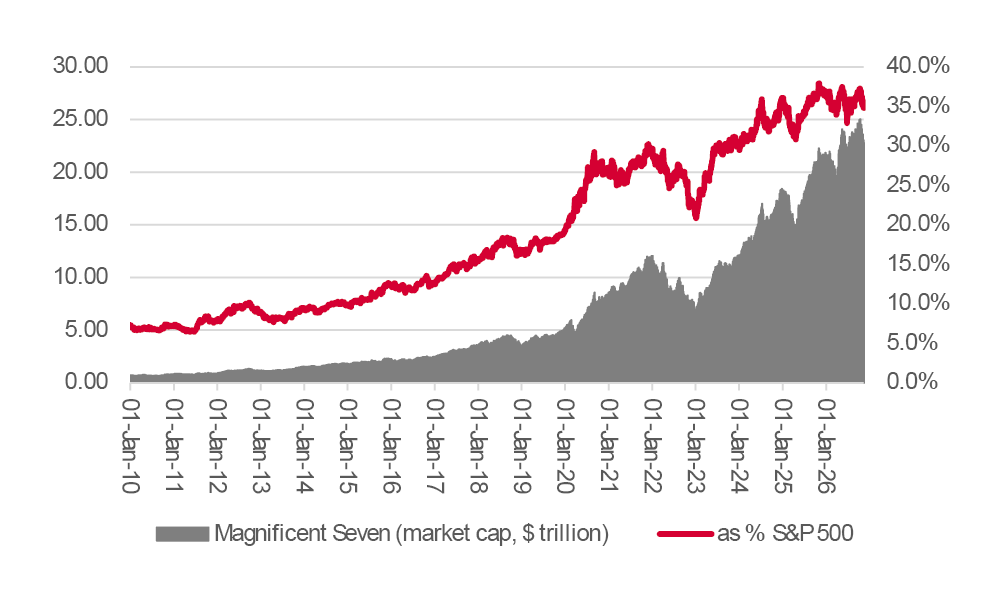
It is one of the so-called Magnificent Seven and therefore, alongside Alphabet, Amazon, Apple, Meta, Microsoft and Tesla, contributes 35% of the S&P 500’s total valuation. And it is so large because is the clear leader in graphic processing units (GPUs), a key source of computing power for Artificial Intelligence, where huge investment by large language model labs and data centre and cloud service providers is driving economic and corporate profits growth alike.
The Magnificent 7 still represent more than a third of the S&P 500’s market capitalisation
Source: LSEG Refinitiv data
The question now is whether the fall from grace of its co-founder, president, chief executive officer (CEO) and key driving force Jensen Huang will blow the company and its share price, or the AI industry, or the wider stock market, off course.
Steady as she goes
Tuesday’s (17 November) third-quarter results and guidance for the three months to the end of January from interim CEO Colette Kress came a bit early to be any sort of test, but in the end sales, profits, cash flow and returns to shareholders will be the ultimate arbiter of Mr Huang’s lasting legacy and how his eventual successor is viewed.
In the meantime, the arguments that his departure amid salacious stories of spies, sex and semiconductors will not mean much in the long term include:
NVIDIA has more than 42,000 employees. Mr Huang was just one of them and did not do everything on his own. Apple and Microsoft are just two examples where the successors to inspirational leaders produced equally impressive results for shareholders, to the benefit of the wider US stock market.
The GPU designer still has a clear technological lead over would-be rivals, such as AMD and Intel.
Interim CEO Kress and new board chair Harvey Jones have both been at the company a long time, and there are potentially strong internal candidates for the top job on a permanent basis, notably Ian Buck, the developer of the CUDA interface which allows programmers to use NVIDIA’s silicon chips for powering apps, tools and graphics, and senior product engineer Jonah Alben.
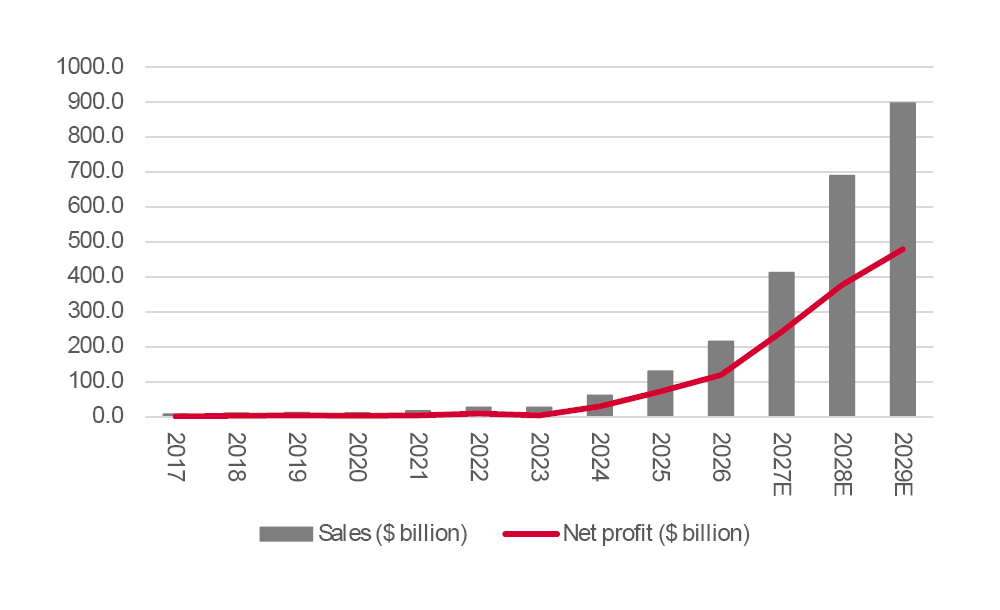
NVIDIA is still growing fast and is wildly profitable and cash generative thanks to the AI spending boom.
AI is in its formative stages and is poised to deliver the productivity and growth boom craved by economists, central bankers, politicians, investors and (presumably) the public alike.
NVIDIA’s profit trajectory is still expected to be very dynamic
Source: Company accounts, Marketscreener, analysts’ consensus forecasts. Financial year to January.
Abandon ship
The arguments that Mr Huang’s departure has the potentially to fundamentally change the narratives that surround NVIDIA, AI and wider markets are thus:
Mr Huang was the company’s guiding force for more than three decades and the key to many of its industrial and political relationships as NVIDIA positioned itself at the apex of AI technology. General Electric and Intel have never quite been the same since Jack Welch and Andy Grove stepped down, so losing a key leader can matter.
Successful as it is, as the world’s largest company by stock market capitalisation, Apple become a less buccaneering company under Tim Cook than it was under Steve Jobs. Share buybacks and dividends became as important as product engineering. With its chief financial officer in charge, even if only temporarily, NVIDIA may become more risk averse.
This really matters because of how NVIDIA is bankrolling so much of the AI boom itself, though direct equity investments in customers or complex and opaque vendor financing agreements, many of which lie off balance sheet. These deals have helped to boost sales and profits. A more conservative approach could have the opposite effect.
Allegations that Mr Huang was involved with a Chinese intelligence asset do not sit well with US sanctions on Chinese technology purchases or reports of smuggling of NVIDIA’s chips into China through other Asian nations, notably Singapore. Shareholders will not be pleased if growth slows because these avenues are shut off once more and the share price, already down by 30% from its high, could come under further pressure.
That could in turn sour sentiment toward the wider AI trade, especially if any decision by NVIDIA to take less risk with its own balance sheet leads to a slowdown in wider spending on AI, which, thus far, is boosting profits at, and the share prices of, not just semiconductor companies but data centre operators, earth moving equipment makers and providers of water purification, cooling and power systems. A slowdown in spend could have deceptively far-reaching ramifications.
NVIDIA may be 6% of the S&P 500, but even that weighty representation means 499 firms still represent the other 94%, while 40% of the world’s market cap lies outside America. Advisers and clients have plenty of options and can calibrate their risks, weightings and portfolio allocations accordingly, if they so choose.
Past performance is not a guide to future performance and some investments need to be held for the long term.
Author
Profile Picture
Name
Russ Mould
Job Title
AJ Bell Investment Director
Russ Mould’s long experience of the capital markets began in 1991 when he became a Fund Manager at a leading provider of life insurance, pensions and asset management services. In 1993 he joined a prestigious investment bank, working as an Equity Analyst covering the technology sector for 12 years. Russ eventually joined Shares magazine in November 2005 as Technology Correspondent and became Editor of the magazine in July 2008. Following the acquisition of Shares' parent company, MSM Media, by AJ Bell Group, he was appointed as AJ Bell’s Investment Director in summer 2013.
The information on this page is intended for professional advisers only.
Authorised and regulated by the Financial Conduct Authority.
Financial adviser verification
This area of the website is intended for financial advisers and other financial professionals only. If you are a customer of AJ Bell Investcentre, please click ‘Go to the customer area’ below.
We will remember your preference, so you should only be asked to select the appropriate website once per device.