Perhaps, thanks to AI, we need to heed the words of American industrialist J. Paul Getty, who once asserted, “In times of rapid change, experience can be your worst enemy.” Right now, portfolio builders who are sticking to long-held valuation disciplines are getting left behind, as US equities generally, AI-related names more specifically and cryptocurrencies are all on a roll. And once markets start rolling, then they can run for a long time, especially when their preferred narrative continues to play out, as it is right now, in the shape of cooling inflation, steady economic growth and falling interest rates.
“Valuation only really matters when a catalyst appears to change perception and persuade investors an asset class or individual security is too dear or too cheap, so advisers and clients need to be on the look-out for changes that might alter the narrative, in the form of either hotter inflation, faster or slower growth, or interest rates that stay higher for longer (or even start to rise again).”
Valuation only really matters when a catalyst appears to change perception and persuade investors an asset class or individual security is too dear or too cheap, so advisers and clients need to be on the look-out for changes that might alter the narrative, in the form of either hotter inflation, faster or slower growth, or interest rates that stay higher for longer (or even start to rise again). These five themes could have a major say on all fronts in 2025 and beyond.
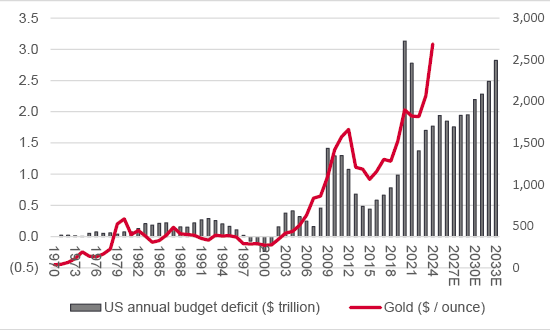
The new Labour Government in the UK still taking brickbats as it seeks to address Britain’s fiscal deficit, a French administration is in tatters after just three months as its efforts to raise taxes and cut spending get the thumbs down and, all the while, America’s federal debt continues to mushroom. President-Elect Trump’s policy package could even accelerate growth in Government borrowing from what is already a record high of $36 trillion.
America keeps adding to its deficit at near-record pace
Source: FRED – St. Louis Federal Reserve database, Congressional Budget Office, LSEG Refinitiv.
“America’s annualised interest bill on that debt already exceeds $1 trillion, a sum that exceeds the defence budget. There could be trouble ahead, unless Elon Musk and Vivek Ramaswamy really do cut spending, or Trump’s tariffs really do raise income and boost domestic output.”
America’s annualised interest bill on that debt already exceeds $1 trillion, a sum that exceeds the defence budget. There could be trouble ahead, unless Elon Musk and Vivek Ramaswamy really do cut spending, or Trump’s tariffs really do raise income and boost domestic output. Either bond yields rise in the face of growing supply, or interest rates stay higher for longer, or the Fed looks to cut rates and take a chance with inflation to lower the interest bill (contrary to the prevailing narrative of cooler inflation). This final scenario may be why gold (and bitcoin, for that matter) are on a roll, as investors seek perceived stores of value.
Trump talked loudly and carried a big stick on the subject of tariffs during his first term, but he only really wielded the stick at China. Other nations, such as France and Mexico, were spared, albeit only once they offered concessions. We may see the same again this time around given Trump’s propensity to seek a deal.
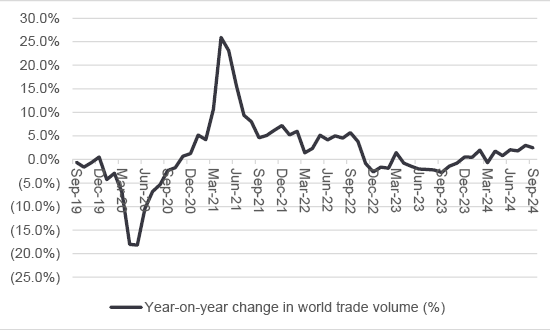
Tariffs could affect global trade flows and growth in 2025
Source: CPB World Trade Monitor, www.cpb.nl.
“Markets still think growth is set fair in 2025, and tracking world trade flows will help to gauge whether that is the case or not. At the moment, the picture looks healthy.”
If all of the planned tariffs are imposed, it seems logical to assume this will boost inflation, as the price of imported goods will rise owing to the duties, or the higher cost of domestic production. But the best cure for higher prices is higher prices, as they ultimately curtail demand (or stoke output), and tariffs are seen as a major contributor to the deep global downturn suffered in the 1930s, so the picture may not be so simple. Markets still think growth is set fair in 2025, and tracking world trade flows will help to gauge whether that is the case or not. At the moment, the picture looks healthy.
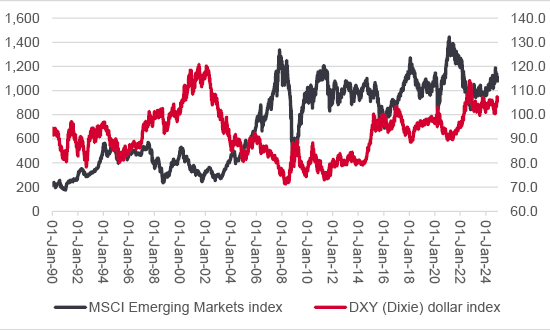
If Trump’s tariffs succeed in reducing America’s trade deficit, that will mean fewer dollars leave America. If they produce America’s first trade surplus since 1975, dollars will actively flow back into the US. That could be a problem, according to Professor Robert Triffin’s theories, because of the dollar’s status as the world’s reserve currency. In essence, greenbacks are the green grease that oils the global economy and financial markets and without them global liquidity could dry up quickly, with potentially deleterious consequences.
Tariffs could affect global trade flows and growth in 2025
Source: LSEG Refinitiv data.
“In essence, greenbacks are the green grease that oils the global economy and financial markets and without them global liquidity could dry up quickly, with potentially deleterious consequences.”
Emerging markets are traditionally very sensitive to the dollar, as many developing nations tend to borrow in bucks, and a strong US currency increases the cost of servicing that debt, to the detriment of local growth and investment. Advisers and clients with emerging market exposure will therefore be watching US trade policies with particular care.
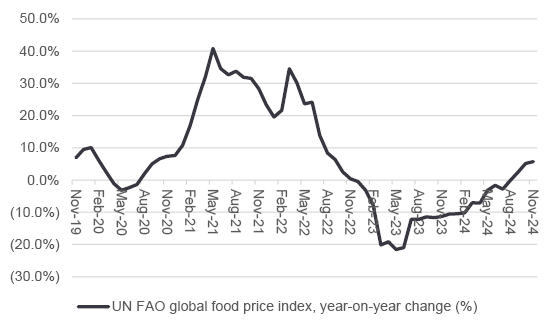
“Inflation continues to hover around the 2% target given to central bankers around the world, thanks to a marked easing in goods prices. Food and oil prices are helping here, but they remain highly unpredictable, thanks to the vagaries of the weather and geopolitics.”
Inflation continues to hover around the 2% target given to central bankers around the world, thanks to a marked easing in goods prices. Food and oil prices are helping here, but they remain highly unpredictable, thanks to the vagaries of the weather and geopolitics. It should be worth tracking both in 2025, especially as services inflation remains elevated and that could in turn yet stoke wage demands.
America keeps adding to its deficit at near-record pace
Source: United National Food and Agriculture Organization.
“The scientist and science fiction writer Arthur C. Clarke asserted that “Any sufficiently advanced technology is indistinguishable from magic,” and financial markets seem as bedazzled as ever by the so-called Magnificent Seven.”
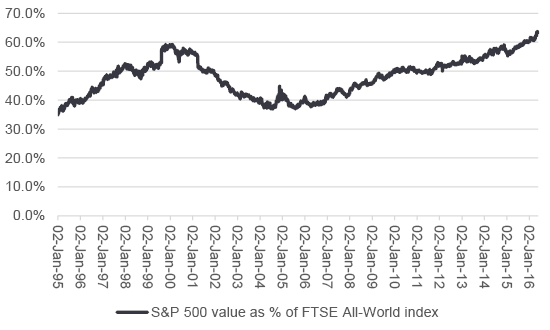
The scientist and science fiction writer Arthur C. Clarke asserted that “Any sufficiently advanced technology is indistinguishable from magic,” and financial markets seem as bedazzled as ever by the so-called Magnificent Seven of Alphabet, Amazon.com, Apple, Meta, Microsoft, NVIDIA and Tesla. This year’s average 65% gain across the septet leaves them with an aggregate market capitalisation of $18 trillion, or 35% of the S&P 500. That powerful performance
e in turn means the S&P 500 represents 63% of the FTSE All-World’s market valuation, a level that exceeds even the high seen at the peak of the technology, media and telecoms bubble in 2000.
US equities represent a record percentage of global stock markets’ value
Source: LSEG Refinitiv data.
The share price and profit wobbles of 2022 showed that the Mag7 are not entirely immune to the economic cycle, so an unexpected recession could be one challenge. Sustained inflation could be another if it keeps rates higher than expected and boosts nominal growth from downtrodden cyclicals and value stocks. Again, only a perfect middle path may do.
Past performance is not a guide to future performance and some investments need to be held for the long term.



This area of the website is intended for financial advisers and other financial professionals only. If you are a customer of AJ Bell Investcentre, please click ‘Go to the customer area’ below.
We will remember your preference, so you should only be asked to select the appropriate website once per device.