Investors are increasingly going cold on tech stocks. As major drivers of wealth creation in recent years, and significant holdings in millions of investment portfolios, heightened volatility in tech stocks is being felt globally.
An astonishing $5.1 trillion was wiped off the tech-heavy Nasdaq 100 index between 6 October and 5 November as investors focused on cracks appearing in the AI story.
Some AI-related stocks came under further pressure after the US midterm elections, amid fears Democratic victories could lead to greater scrutiny of data centres and lay the groundwork for tighter AI regulation.
Source: LSEG
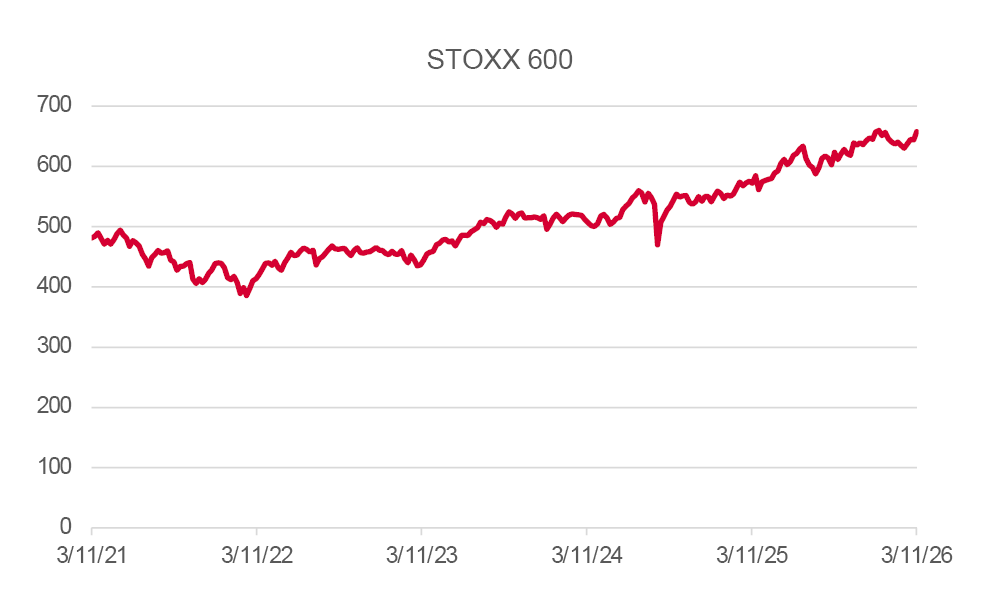
Against this backdrop, European equities moved towards new all-time highs and Indian shares enjoyed a big bounce as investors rotated away from tech-dominant regions – particularly in the US and South Korea – to other parts of the world. The big market rotation is in motion again. If the move persists, the sums involved could be significant given how dominant technology has become in global portfolios.
One factor supporting European equities is the view that the US election result leaves Donald Trump more politically constrained, potentially limiting his ability to pursue policies seen as negative for the region. Chemicals, pharmaceuticals and engineering have been among the stronger areas for European equities year-to-date. Europe excels in these types of industries and investors are once again happy to own them.
Investors are increasingly uneasy about the huge sums being spent on AI infrastructure without clear evidence of when, or whether, those investments will generate adequate returns.
Big tech companies are going all-in with their bets that AI will be the biggest thing in decades to transform business and consumer life. If they get that bet wrong, the fallout could be huge.
With all the big tech firms, near-term cloud and data centre-related demand is clearly very strong, but the bigger question hangs over the longer-term outlook.
The tech giants have gone from having oodles of spare cash for innovation and generous share buybacks to directing a much bigger share of their cash flow towards AI infrastructure. In parts of the sector, companies are also tapping debt and equity markets to fund expansion.
Investors are using the ‘sell’ button to let the tech sector know that it might be time to play it cool. Just as bond investors become vigilantes when they don’t like government policies, equity investors also have the power to make their voice heard.
Tech stocks may rebound this month, but that does not remove the concerns behind last month’s sell-off and whether this is a precursor to a full-blown market correction. A banking crisis or US recession could cause a much deeper downturn, although there are no signs of either at present. More immediate risks are emerging within the AI boom itself.
One is that AI adoption and the productivity benefits it delivers disappoint expectations. Another is that the huge AI infrastructure build-out starts to hurt some of its supposed beneficiaries.
Source: LSEG
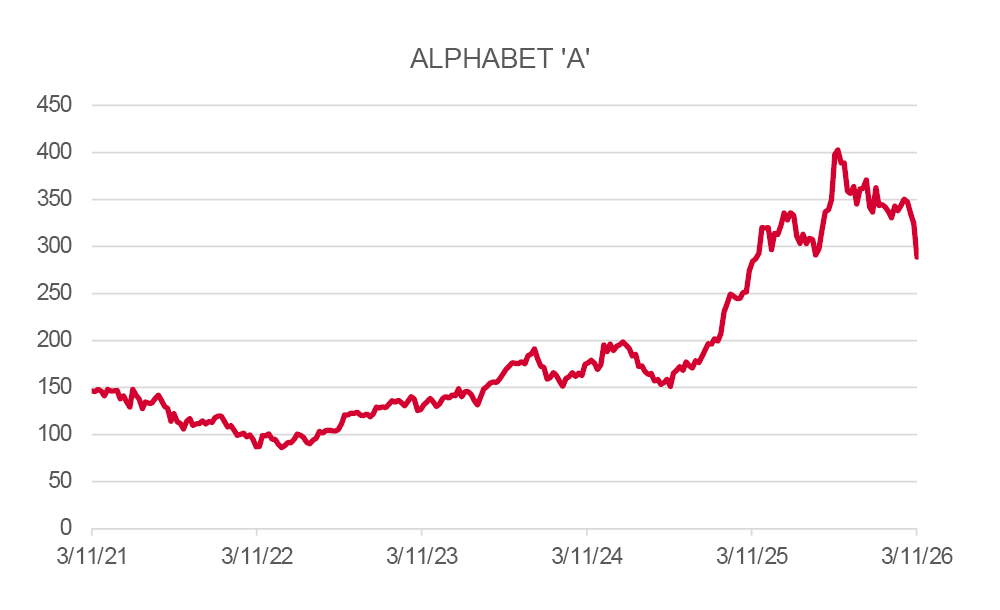
Alphabet highlighted the challenge of monetising changing search habits, with growth in its core search advertising business slowing even as people increasingly use AI-driven search tools. Intel blamed PC market weakness partly on component shortages in that industry as data-centre companies competed for limited supplies.
That echoes lessons from the TMT bubble. Suppliers became sold out months or years in advance, encouraging customers to double-order scarce components and making order books appear stronger than underlying demand. When demand weakened, orders disappeared quickly.
Today, companies including Nvidia, SK Hynix, Samsung, TSMC and ASML are signalling extremely strong demand for leading-edge products. Being sold out is plainly positive for suppliers, but it can also make further upgrades harder to achieve if extremely strong demand is already baked into earnings expectations and share prices.
During the TMT boom and bust, spending cuts rippled through the supply chain from telecoms operators to equipment manufacturers and semiconductor suppliers, compounding an already severe downturn in technology shares.
History is unlikely to repeat exactly. Today’s biggest technology companies are generally much larger, more profitable and more cash-generative than many of the businesses at the centre of the dotcom boom. But the lesson about extrapolating exceptional demand indefinitely remains relevant.
Investors are increasingly asking if we’re now seeing the same dynamics playing out again. Many people don’t want to risk losing money by waiting to see if history repeats itself. Instead, they’re packing up their stuff and preparing to board a different train.
Past performance is not a guide to future performance and some investments need to be held for the long term.



This area of the website is intended for financial advisers and other financial professionals only. If you are a customer of AJ Bell Investcentre, please click ‘Go to the customer area’ below.
We will remember your preference, so you should only be asked to select the appropriate website once per device.