London high street

US markets try to defy the Solow Paradox

20 hours ago

At a glance

  • Earnings remain the key driver – upgrades continue across the UK and US, supporting markets and pushing profits towards record highs in 2026–27.
  • Valuations diverge – the FTSE 100 looks reasonably priced, while the S&P 500 appears more expensive relative to history.
  • Risk lies in expectations – strong US growth forecasts rely on AI-driven productivity gains; any disappointment could trigger volatility.

One of the most encouraging features of 2026, from an equity market point of view, remains positive earnings momentum. On both sides of the Atlantic, positive earnings surprises from companies continue to outweigh negative ones, and aggregate profit forecasts for the major indices continue to rise, not fall.

In an era where algorithm-driven funds dominate so much of the near-term trading flow, and passive funds create an ever-greater degree of reflexivity, thanks to the cycle of more buying – higher share prices – higher index weightings and then more buying and so on (and on), this matters more than ever.

It also means that any easing of that upgrade momentum or, worse, a reversal that is so abrupt it leads to downgrades, could have serious consequences. The algo-led funds would dispassionately respond with selling, and the passive funds could, presumably, be at risk of creating a reflexive self-feeding cycle that leans to the downside every bit as vigorously as it currently does to the upside.

Up, up, and away

For all of the brickbats thrown at the FTSE 100, and the prevailing political and economic uncertainty, the good news for clients and advisers with exposure to UK equities on the earnings front is three-fold.

  • First, analysts believe that aggregate earnings across the UK’s premier index will set a new record high in 2026, and again in 2027. That at least helps to explain why the index stands within a fraction of the all-time set in February, before the Middle Eastern war broke out.
FTSE 100 earnings are expected to set new record highs in 2026 and 2027

FTSE

Source: Company accounts, Marketscreener, consensus analysts' forecasts
  • Second, the consensus forecast growth figures of 12% in 2026 and 8% in 2027 do not appear overly ambitious, given that the compound annual growth rate (CAGR) over the last twenty years has been 8.6%, a figure which looks credible in the context of trend GDP growth, average inflation rates and a little productivity and corporate profit margin expansion sprinkled on top. Granted the outlook here in the UK remains murky, but the FTSE 100 generates two-thirds of its profits overseas.
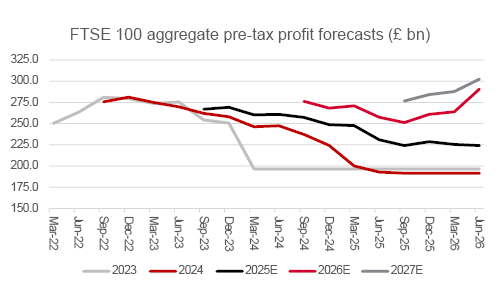
  • Third, analysts are upgrading their estimates. This is a nice change. Usually, they trim forecasts as a year develops and forecasts prove optimistic, but 2026 and 2027 are proving to be welcome exceptions to this rule, at least for now.
Analysts are upgrading forecasts for UK corporate earnings

FTSE

Source: Company accounts, Marketscreener, consensus analysts' forecasts

The net result is the FTSE 100 trades on barely 13 times forward earnings for 2026 and 12 times for 2027. These are not unduly low multiples relative to the index’s own history but nor are they expensive either, which may offer some downside support should anything unexpectedly go wrong.

Turbocharged

The outlook also looks bright in the USA, after a bumper first-quarter reporting season and upgrades galore for the second quarter at the same time.
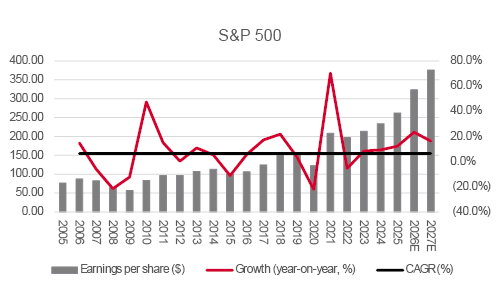
  • Thanks to technology stocks in particular, but with energy and industrials chipping in and only healthcare showing any weakness, analysts now believe that the S&P 500 index’s members will also generate record earnings in 2026 and 2027.
  • Analysts also continue to upgrade their forecasts. At the start of this year, consensus estimates were looking for 17% growth in S&P 500 aggregate earnings to $310 a share. Now analysts expect a 23% rate of increase to $323, with a further 16% advance in 2027 to $376.
US earnings are also expected to set new peaks this year and next

FTSE

Source: Company accounts, Marketscreener, consensus analysts' forecasts

However, there are two key differences between the UK and USA.

  • First, the US equity market does look expensive relative to its history. Even the bumper profits expected for 2026 and 2027 leave the S&P 500 on forward earnings multiples of nearly 23 times and 20 times, respectively. The ten-year average is around 18 times, according to Factset, although bulls will argue that a price-to-earnings growth (or PEG) ratio of barely one times for 2026 does not leave them as hostages to fortune.
  • Second, the growth rates that analysts predict for the next two years are miles above the twenty-year compound annual growth (CAGR) rate of 6.4%. The bull case will assert that productivity gains thanks to Artificial Intelligence more than justify the assumption of an era of premium growth and only time will tell if that is the case. But the forty-year CAGR for S&P 500 earnings per share is … 6.7%. That longer period encompasses not just the technology, media, and telecoms profits boom of 1998 to 2000 but also the long-term economic benefits of the broadband, wireless telecoms, and internet build-out that have exceeded even the wildest dreams of investors and analysts back at the turn of the century.

It may well be different this time, but the absence of any acceleration in American companies’ long-term earnings growth seems to back up the assertion of the American Nobel Laureate economist Robert Solow that, “You can see the computer age everywhere but in the productivity statistics.” Should the so-called Solow Paradox hold true, then the combination of lofty valuations and earnings disappointment could be a recipe for greater volatility in US equities, at the very least, even if such a scenario feels unlikely as we prepare for the second-quarter results season from mid-July onwards.

Past performance is not a guide to future performance and some investments need to be held for the long term.

Author
Profile Picture
Russ Mould
Name

Russ Mould

Job Title
AJ Bell Investment Director

Russ Mould’s long experience of the capital markets began in 1991 when he became a Fund Manager at a leading provider of life insurance, pensions and asset management services. In 1993 he joined a prestigious investment bank, working as an Equity Analyst covering the technology sector for 12 years. Russ eventually joined Shares magazine in November 2005 as Technology Correspondent and became Editor of the magazine in July 2008. Following the acquisition of Shares' parent company, MSM Media, by AJ Bell Group, he was appointed as AJ Bell’s Investment Director in summer 2013.

Financial adviser verification

This area of the website is intended for financial advisers and other financial professionals only. If you are a customer of AJ Bell Investcentre, please click ‘Go to the customer area’ below. 

We will remember your preference, so you should only be asked to select the appropriate website once per device.

Scroll to Top