A market storm is emerging from a seemingly cloudless summer sky. The question now is whether this is just a tempest in a teapot, and the result of thin trading volumes as the big hitters head to the beach and leave deputies and juniors in charge, or whether it is the harbinger of a more serious – and bearish – shift in market sentiment.
The first step to working this out is to understand what may be upsetting markets right now. The second is to see what might influence those trends and issues for better, or worse.
Tricky trio
In sum, three issues seem to be at work.
- First, equity (and to some degree bond) markets have priced in the ‘perfect’ scenario of a cooling in inflation, a soft landing in Western economies (and thus corporate earnings) and rate cuts from the Fed, Bank of England and others. Any deviation from that path could therefore lead to trouble – either stickier inflation, economic and earnings disappointment or slower-than-expected rate cuts.
“A US slowdown is not priced in at all – if anything markets were more concerned about it overheating earlier this year – and those with long memories will remember how frantic rate cuts in 2000-02 and 2007-08 failed to stave off a bear market in stocks, because the economy tipped over and corporate earnings fell far faster than the headline cost of money.”
- Deviations from that path can be found. Rate cuts have come more slowly than hoped (and the Fed has yet to deliver, after the market started 2024 looking for six, one-quarter point cuts from the US central bank). Inflation has proved stickier and there are signs that the US economy is slowing – unemployment is up, the housing market is a mess and the latest purchasing managers’ index for manufacturing showed weak orders and sticky prices. A US slowdown is not priced in at all – if anything markets were more concerned about it overheating earlier this year – and those with long memories will remember how frantic rate cuts in 2000-02 and 2007-08 failed to stave off a bear market in stocks, because the economy tipped over and corporate earnings fell far faster than the headline cost of money.
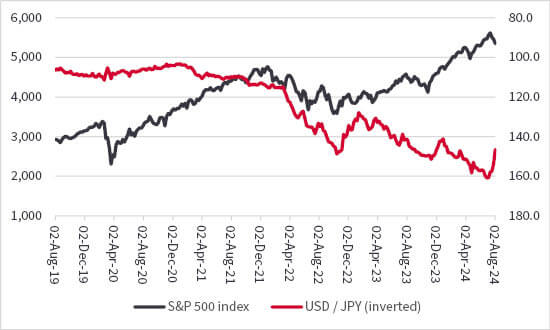
- Second, the yen is rallying. As this column hinted back in late February, the Japanese currency has been a major source of global liquidity, as major market players have shorted it, borrowed against it and used that money to go long risk assets around the globe. The Bank of Japan’s belated efforts to raise rates and defend the yen may be turning off the tap, even if Western central banks are slowly cutting rates to keep liquidity flowing. The yen is rallying, as massive short positions against it are closed out, to drive the currency higher still and force yet more liquidation by the shorts, to potentially create a circle every bit as vicious as it had previously been virtuous.
The yen’s rally has coincided with a stumble in risk assets
Source: LSEG Refinitiv data
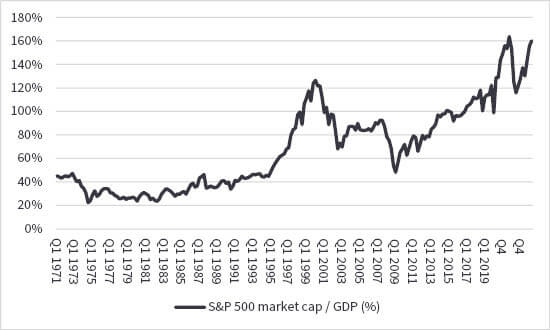
- Finally, US equities in particular have just gone up in a straight line, and done so much faster than GDP growth, or corporate earnings or cash flows. The result is that US equities look expensive.
- According to FactSet, the S&P 500 trades on 20.6 times forward earnings against a 10-year average of 17.9.
- The US S&P 500’s market’s capitalisation represents 160% of GDP, an all-time high.
- According to Professor Robert Shiller, the US stock market trades on a cyclically-adjusted price / earnings ratio (PE) of 35, a figure only exceeded in 2000 (and that did not end well).
US stocks look expensive on a market cap-to-GDP basis
Source: FRED – St. Louis Federal Reserve database, LSEG Refinitiv data
Lead indicators
“As the old saying goes, valuation never tells you when there may be trouble (or an opportunity), but it will tell you how far things can go (up or down) before something snaps back the other way.”
As the old saying goes, valuation never tells you when there may be trouble (or an opportunity), but it will tell you how far things can go (up or down) before something snaps back the other way. And those numbers suggest either prices must fall (some way), or earnings must surge quickly for stock markets to regain their equilibrium – though UK equity prices are nowhere near as stretched as they are in the USA.
To test market sentiment, rather than fundamentals, advisers and clients can watch three indicators.
- The first is the VIX index, the so-called fear index, which measures expectation of US stock market volatility in the month ahead. The long-run average reading since 1994 is 19. It is usually a good counter-cyclical indicator. Sustained periods of low readings, down toward 12 or lower, speak of investor complacency and likely trouble ahead (because it won’t take much to frighten everyone). A sustained run above say 30 suggests there is panic around and there may be bargains appearing, but the shake-out in this case could be violent. (This simply distils Buffett’s maxim about being fearful when others are greedy and greedy when others are fearful).
“If the Bank of Japan backtracks on its promise of more rate hikes that might help, although whether that stokes global inflation expectations is another challenge, and rapid cuts from the Fed and other central banks might stoke money supply and liquidity in the West, but they might fuel inflation fears too – which may be why gold is holding firm.”
- The second is again the yen, given its pivotal role in global market liquidity. If the Bank of Japan backtracks on its promise of more rate hikes that might help, although whether that stokes global inflation expectations is another challenge, and rapid cuts from the Fed and other central banks might stoke money supply and liquidity in the West, but they might fuel inflation fears too – which may be why gold is holding firm.
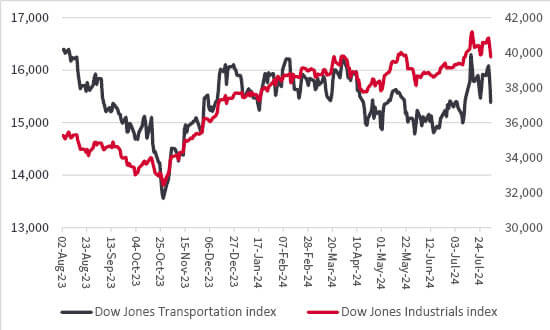
- And for those looking for an indicator that looks at both US markets and the US economy (and we are focusing on those are they are the biggest in the world on both counts) then nothing is usually more helpful than this column’s old friend, the Dow Jones Transportation index. It has lagged the Dow Jones Industrials and lost momentum. That is usually a bad sign, as it speaks of economic weakness. That indicator needs to start trucking again, or a summer squall could turn more serious.
Dow Transports index has hit the skids
Source: LSEG Refinitiv data
Past performance is not a guide to future performance and some investments need to be held for the long term.