The debate over the mental acuity of Joseph R. Biden and his physical readiness to take on a second, four-year term as American’s forty-sixth President at the age of 82 (as he will be this November) is unlikely to abate any time soon. The Democratic Party has until its convention in Chicago, scheduled for 19-22 August, to decide what it wants to do, if anything. However, US financial markets are not waiting to find out. Financial markets are drawing their own conclusions, and assessing opinion polls, and pricing in an increased chance of a return to office for Donald J. Trump – matching the achievement of Grover Cleveland, a Democrat and the only US President to lose office (in 1888) and then win it back (in 1892).
“The benchmark US Government bond saw prices fall and yields rise sharply in response to the broadcast as fixed income markets began to anticipate a Trump win and the inflation they feared that would bring.”
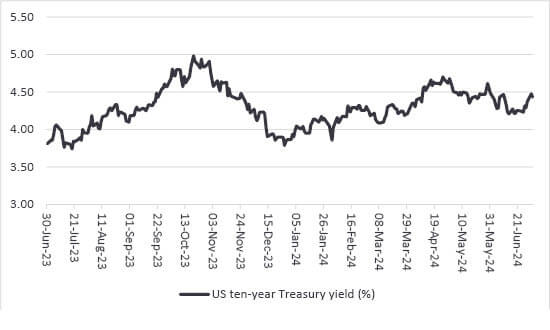
This can be seen most clearly in how the US Ten-year Treasury yield responded to the Presidential debate hosted by CNN on 27 June. The benchmark US Government bond saw prices fall and yields rise sharply in response to the broadcast as fixed-income markets began to anticipate a Trump win and the inflation they feared that would bring.
US ten-year Treasury yield jumped after the first Presidential debate
Source: LSEG Datastream data
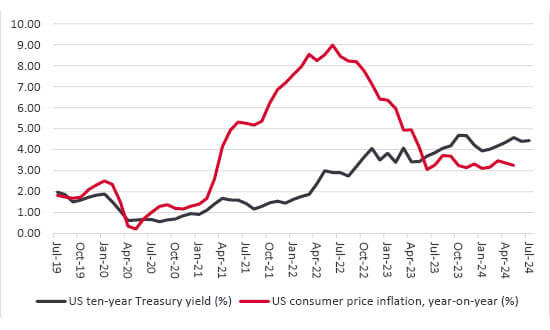
This leaves those advisers and clients with a predilection for US sovereign bonds with a dilemma. On one hand, they may want to lock in the positive real yields on offer, especially if they think the US Federal Reserve will start to cut interest rates in the autumn of this year – the ten-year yield currently exceeds the prevailing rate of US consumer price inflation by one full percentage point. On the other, they will be wary of a reignition of inflation as that could erode the value of their carefully harvested coupons, or even erase it altogether if inflation moves above the ten-year yield on a sustained basis.
US ten-year Treasuries currently offer a positive real (post-inflation) yield
Source: LSEG Datastream data
“Bond markets are looking at the race to the White House with added concern, given how three of Trump’s key policy thrusts, as outlined in the first Presidential debate, all feel inflationary.”
Bond markets are looking at the race to the White House with added concern, given how three of Trump’s key policy thrusts, as outlined in the first Presidential debate, all feel inflationary.
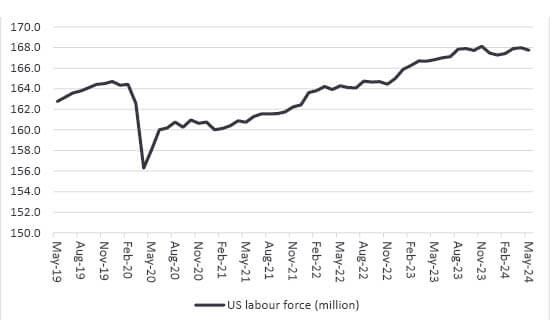
Immigration has helped to boost the US labour force and cool wage growth
Source: FRED – St. Louis Federal Reserve database
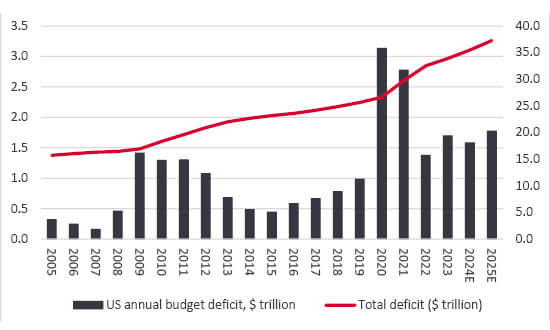
The tax cuts have a further knock-on effect upon the yield on US Treasuries. America is already running an annual deficit that equates to around 6% of GDP and an aggregate deficit that exceeds 100% of GDP (numbers that, until recently, would have made any tin-pot republic blush with shame). The proposed Trump tax cuts would take both higher, and that assumes a benign economic environment – remember that America is racking up this enormous annual deficit when unemployment is barely 4% and the economy is growing.
“Heaven knows what would happen if a soft (or hard) landing were to transpire and tax income recede just as welfare payments rise, although it seems fair to assume that the annual deficit would balloon.”
Heaven knows what would happen if a soft (or hard) landing were to transpire and tax income recede just as welfare payments rise, although it seems fair to assume that the annual deficit would balloon. America would need to issue more debt (Treasuries) to fund itself and it seems logical to assume that it would need to offer plump yields to tempt in buyers.
This is not to say that Biden is promising hair-shirt austerity. His first term will see America rack up an additional $7 trillion or so in borrowing (and it took from 1776 to 2003 for the US to run up an aggregate $7 trillion deficit, to give some perspective on the current rate of overspend).
America’s federal deficit is already rising rapidly
Source: LSEG Datastream data, FRED – US Federal Reserve database, Congressional Budget Office
“All of this begs the question of what an appropriate level for US ten-year yields might be. The base case is the US Federal Reserve’s 2% inflation target.”
All of this begs the question of what an appropriate level for US ten-year yields might be. The base case is the US Federal Reserve’s 2% inflation target. An investor may then wish to add some term premium to that, since the headline rate is stuck near 3%, thanks to strong services inflation, and is no lower than a year ago, so it may take time to return to target. Then there remains the incipient inflation risk offered by both Presidential candidates. Then there is America’s massive deficit which could pressure both the Fed to cut rates to keep the Federal interest bill manageable (since it is now running at $1 trillion a year) and oblige the USA to offer tempting yields so it can find buyers for its newly-issued debt.
None of that suggests a benchmark yield on ten-year Treasuries of anything lower than 4%, which is not much below the 4.43% on offer at the time of writing. Capital upside may therefore be limited. Advisers and clients must then decide whether the coupon is enough to compensate for inflation risk, if US Treasuries are to form a part of a balanced, diversified portfolio.
Past performance is not a guide to future performance and some investments need to be held for the long term.



This area of the website is intended for financial advisers and other financial professionals only. If you are a customer of AJ Bell Investcentre, please click ‘Go to the customer area’ below.
We will remember your preference, so you should only be asked to select the appropriate website once per device.