When a Presidential social media post is capable of sending stock, bond, currency and commodity markets spinning, up or down, there is a danger that any article, podcast or comment has a limited shelf life. Even this is of value in some ways, as it makes it clear that no-one – but no one – knows what is coming next.
It may, therefore, be worth bearing in mind legendary investor Warren Buffett’s observation that “The job of the stock markets is to take money from the impatient and give it to the patient.” Advisers and clients may therefore wish to step back from the day-to-day noise and assess three of the possible scenarios that may develop in the wake of President Trump’s decision to pause reciprocal tariffs for ninety days but stick with the 10% baseline levies and continue to slap extra duties on imported Chinese goods.
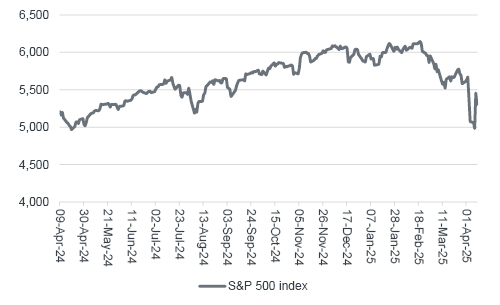
US equities had already rolled over before the tariff turmoil
Source: LSEG Refinitiv data
“Advisers and clients have to decide for themselves which, if any of these, scenarios are most likely to occur and which offers the best balance between risk and reward when it comes to portfolio construction and any weightings toward US assets, and American equities in particular.”
Advisers and clients have to decide for themselves which, if any of these, scenarios are most likely to occur and which offers the best balance between risk and reward when it comes to portfolio construction and any weightings toward US assets, and American equities in particular.
The ultimate guide to the risk-reward equation in each instance is valuation.
In this context, the travails of the US equity market seem a little easier to understand, as does the relative resilience of the UK market. Granted, investors cannot pay bills with relative outperformance when markets are falling, but investing is about getting from one side of the volatility to the next and being ready to benefit from the next upward leg in securities prices. This, again, requires appropriate calibration of risk, and valuation can be a good guide as to how to garner downside protection and leave room for upside once the better times roll.
“The US has been flying high for some time, the UK has not, and this has manifested itself in the valuations afforded each nation’s headline index, the S&P 500 and the FTSE 100, respectively.”
The US has been flying high for some time, the UK has not, and this has manifested itself in the valuations afforded each nation’s headline index, the S&P 500 and the FTSE 100, respectively.
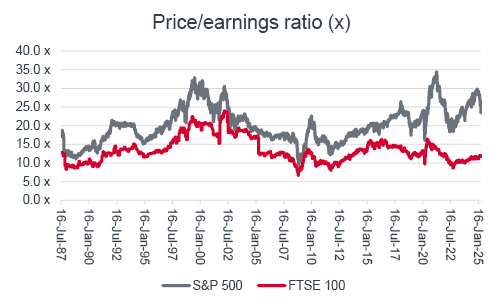
US equities still trade on a historically high multiple of earnings (unlike the UK market)...
Source: LSEG Refinitiv data
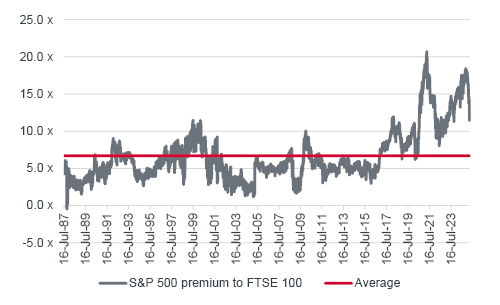
As a result of that, the US trades on a price / earnings premium of more than eleven points, compared to a UK post-1987 average of less than seven (and a premium of less than four points in the run up to 2016’s Brexit vote).
…with the result that the US trades at a very high premium to the UK
Source: LSEG Refinitiv data
In addition, analysts’ consensus profits forecasts assume 14% earnings growth from the S&P 500 in each of 2025 and 2026. By contrast, FTSE 100 aggregate earnings are seen coming in flat in 2025, before a 13% recovery in 2026, after three fallow years.
“None of this guarantees outperformance from the UK relative to the USA, but it does suggest it may not do as much to turn the tables as many think, given how valuations and expectations are so much lower for the former than they are for the latter.”
None of this guarantees outperformance from the UK relative to the USA, but it does suggest it may not do as much to turn the tables as many think, given how valuations and expectations are so much lower for the former than they are for the latter.
Those advisers and clients who think that a major change in the market temperature is in the offing may be inclined to think bigger still. If President Trump and Treasury Secretary Bessent are really serious in their hints about resetting the global trade and monetary systems as we know them (a trick last pulled by President Richard M. Nixon in 1971) then a reassessment of debt and fiat currency valuations could favour hard assets like commodities, which thrived in the 1970s.
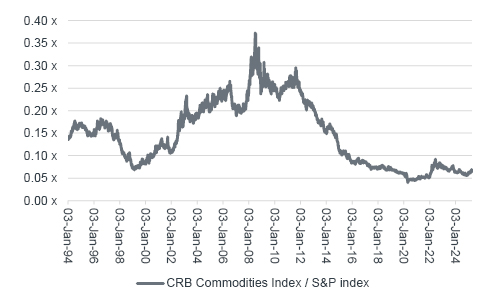
…Commodities trade near all-time lows relative to equities
Source: LSEG Refinitiv data
Raw materials generate no cash so they are hard to value, and all investors can really use to judge their downside risk is the incremental cost of production. They may be a bit off the beaten track, but it does look like commodities are trading at very low levels relative to equities and it was Investment Biker author Jim Rogers who once noted that “Nearly every time I have strayed from the herd, I have made a lot of money. Wandering away from the action is the way to find the new action.”
Past performance is not a guide to future performance and some investments need to be held for the long term.



This area of the website is intended for financial advisers and other financial professionals only. If you are a customer of AJ Bell Investcentre, please click ‘Go to the customer area’ below.
We will remember your preference, so you should only be asked to select the appropriate website once per device.