Here we go again. Shares in GameStop (GME:NYSE) are surging, US equity markets are setting new highs and a lowly reading on the VIX index suggests investors are confident that volatility will remain low and equity markets buoyant. This is all barely three years after the GameStop melt-up (and, lest it be forgotten, subsequent melt-down), which also saw social media influencers and commentators stir interest in a range of meme stocks, including AMC Entertainment (AMC:NYSE) and even silver (which seems to now be doing rather well despite the Reddit crowd’s apparent loss of interest in the commodity). The last meme stock surge did not last long and, it could be argued, presaged 2021-22’s nasty correction in risk assets.
The GameStop games begin again
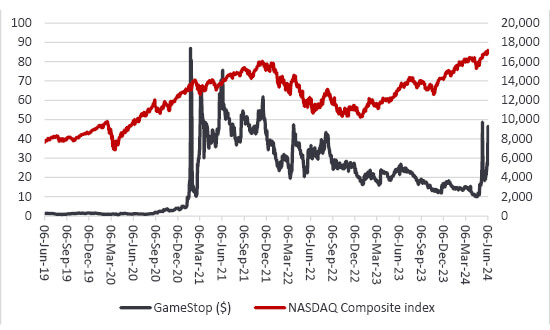
LSEG Datastream data
Benjamin Graham, Warren Buffett’s mentor, argued that the best long-term investment returns were reaped by realists who bought from pessimists and sold to optimists. You can argue that the short squeezers are at least buying from pessimists when it comes to GameStop but it may be that more than a few optimists are piling in now, hoping to ride the share price momentum to a quick gain.
Such a devil-may-care attitude to risk can lead to trouble and the precedents are clear to see in the overheated markets seen in the late 1920s and late 1990s and (to a lesser degree) the mid part of the first decade of this century. They all ended in tears and big market setbacks which hurt a lot of investors and traders, and ultimately did damage to the wider economy as money was misallocated and squandered.
“Perhaps we should therefore all be heeding the warning of economist (and stock market investor) John Maynard Keynes when he said, ‘When the capital development of a country becomes the by-product of a casino the job is likely to be ill-done.’”
Perhaps we should therefore all be heeding the warning of economist (and stock market investor) John Maynard Keynes when he said, ‘When the capital development of a country becomes the by-product of a casino the job is likely to be ill-done.’
Quite what the plan of the latest round of GameStop buyers is remains to be seen, but previous efforts to squeeze short sellers in this stock ultimately failed and it is hard to push around the price of a security or asset on a sustained basis, for three reasons.
“The collapse of the South Sea Bubble in 1720 eventually germinated Sir John Barnard’s Act in 1734. Similar responses followed the 1929 Wall Street Crash, in the form of the Glass-Steagall Act, and the 2007-09 Great Financial Crisis, with Wall Street Reform and Consumer Protection Act (or Dodd-Frank, as it is more commonly known). The theme across all three acts was limits to use of derivatives and leverage.”
The collapse of the South Sea Bubble in 1720 eventually germinated Sir John Barnard’s Act in 1734. Similar responses followed the 1929 Wall Street Crash, in the form of the Glass-Steagall Act, and the 2007-09 Great Financial Crisis, with Wall Street Reform and Consumer Protection Act (or Dodd-Frank, as it is more commonly known). The theme across all three acts was limits to the use of derivatives and leverage.
However, the use of margin debt continues to flourish in the USA, even if overall levels are still slightly below their record highs.
Margin debt is piling up again…
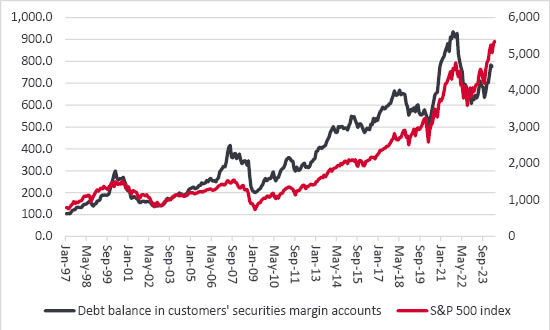
NYSE data to February 2010, FINRA data from February 2010. LSEG Datastream data
That could be helping to fuel markets now, but history shows that confidence soon evaporates if the market stumbles and history suggests the liquidation (forced or voluntary) of positions bought on margin accentuates any subsequent market decline.
…and this leverage has a record of accentuating market swings
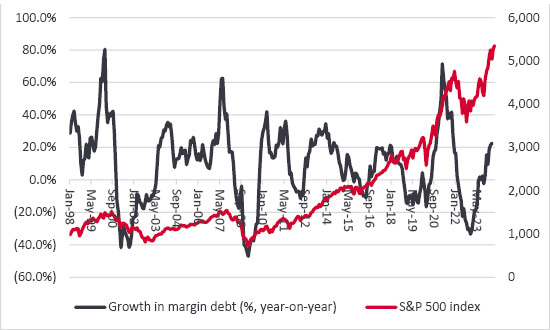
NYSE data to February 2010, FINRA data from February 2010. LSEG Datastream data
“Financial innovation, coupled with central-bank-provided liquidity, is creating trouble and eroding the stability of financial markets, which have blundered from one crisis to the next with ever-greater regularity in the last 30 years – from Orange County to the Tequila Sunset to Barings to the Asian currency crisis to the Russian debt crisis and LTCM to the tech bubble to the mortgage securities bubble and the Big Short and beyond.”
It is here that the greatest dangers may lie today, in these over-the-counter, lightly-regulated, trillion-dollar markets which are funded by leverage. Financial innovation, coupled with central-bank-provided liquidity, is creating trouble and eroding the stability of financial markets, which have blundered from one crisis to the next with ever-greater regularity in the last 30 years – from Orange County to the Tequila Sunset to Barings to the Asian currency crisis to the Russian debt crisis and LTCM to the tech bubble to the mortgage securities bubble and the Big Short and beyond.
US money market fund balances sit at an all-time high
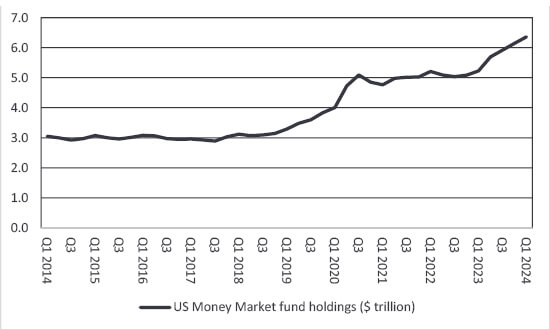
FRED – St. Louis Federal Reserve database
“The prospect of the Fed cutting interest rates when there is $6.4 trillion sitting in US money market funds, ready to look for a new home, may just have students of stock market bubbles reaching for their history books.”
Central banks have a very difficult balancing act ahead of them, as they try to do what they feel is right for the real economy without handing out too much rocket fuel to financial markets. It can be argued that fifteen years of zero interest rates and quantitative easing (plus surging house, stock, bond and asset prices) mean the economy is excessively liquid. The prospect of the Fed cutting interest rates when there is $6.4 trillion sitting in US money market funds, ready to look for a new home, may just have students of stock market bubbles reaching for their history books.
Past performance is not a guide to future performance and some investments need to be held for the long term.



This area of the website is intended for financial advisers and other financial professionals only. If you are a customer of AJ Bell Investcentre, please click ‘Go to the customer area’ below.
We will remember your preference, so you should only be asked to select the appropriate website once per device.