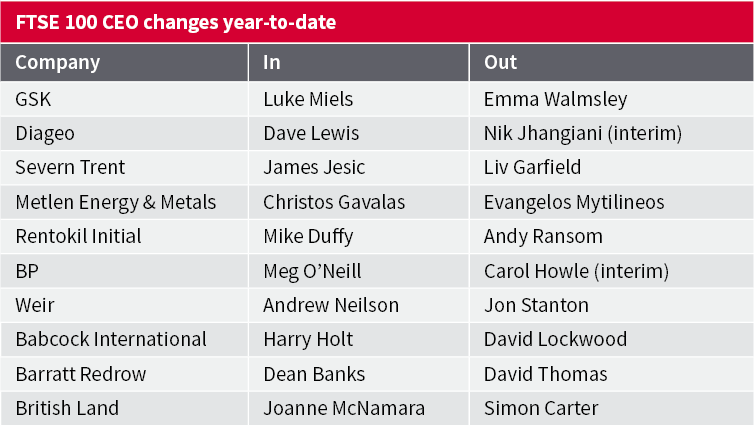
The FTSE 100 is enjoying an unusually quiet year for boardroom upheaval. Only 10 companies have changed chief executive so far in 2026, according to AJ Bell analysis, putting the index on track for one of the lowest turnover rates in years.
This year’s number is only marginally higher than the eight changes seen in 2021, which is the lowest level recorded based on data going back to 2000.
Strong stock market returns and an uncertain economic backdrop have reduced the appetite for change.
Source: LSEG
Fewer changes in the CEO and Chief Financial Officer (CFO) roles suggest many FTSE 100 companies are seeing the benefits of stable leadership teams focused on execution. While leadership changes are not always a negative, a high turnover of senior executives can sometimes signal that a company is facing challenges.
Babcock, British Land, Diageo, GSK and Severn Trent are among the companies to have installed new leaders in 2026. A handful of others have confirmed CEO changes will happen next year, including B&Q owner Kingfisher.
FTSE 100 CEOs typically last just over six years in the job, according to AJ Bell data going back to 2000. One reason why 2026 has been relatively quiet for new CEOs is the fact that the previous four years saw above-average leadership changes, including 19 new CEOs in 2023.
In absence of disaster, CEOs are normally given time to prove themselves. A new boss typically leads to a tweak in strategy or a new growth plan, both of which take time to iron out and execute.
AJ Bell analysis finds that CFO turnover happens more frequently, with an average of 3.8 years in the job for FTSE 100 number crunchers. Nearly twice the average number of changes per year were recorded in 2023, with 32 new CFOs in the role. A further 24 changes happened in 2024 and 25 last year. It’s no wonder this year’s number is significantly down, as the new intake of CFOs will still be relatively fresh in the job.
An uncertain economic backdrop might have also contributed to a lower-than-average change in CEO and CFO in 2026. Growing cost pressures from a higher oil price and understanding how much to invest in AI services create a cloud of unknowns as companies navigate an ever-changing landscape. For some companies, it might be the wrong time to rock the boat with new leadership, so maintaining leadership continuity could be viewed as the lower-risk option.
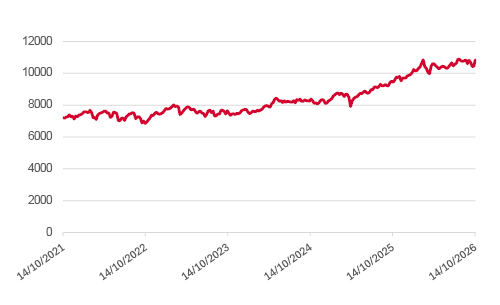
Disappointing share price performance can lead to CEO and CFO changes. The FTSE 100 last year achieved its fifth best year since inception in 1984, with a 25.8% total return.
Source: LSEG
So far in 2026 the UK blue chip index has returned 9.9% including dividends, which isn’t quite as good but still a decent return based on historical standards. On that basis, investors have little to grumble about at index level.
One fifth of the FTSE 100 (19 stocks) has underperformed the broader market this year on a total return basis. Of the worst offenders, Rentokil, Babcock and Barratt Redrow have changed their CEOs in 2026, while Barratt and Fresnillo have changed their CFOs.
Activist investors often act as a catalyst for leadership change, yet the FTSE 100 currently has relatively few high-profile activist campaigns under way.
The ones to watch are Bunzl and Whitbread, as their respective shareholder registers include the type of names to push for change.
Bunzl’s CEO Frank van Zanten has been in the role since April 2016 and has presided over a 61% total return for Bunzl shareholders, less than half the 146% from the FTSE 100.
Whitbread boss Dominic Paul took the CEO job in January 2023, and shareholders have subsequently lost 6.6% of their investment, even after accounting for dividends. Activist shareholder Corvex recently called for one of its representatives to join the board and Whitbread recommended to its shareholders on 13 October that they should vote against the resolution.
Activists typically push for new management, asset sales, or more share buybacks. Bunzl and Whitbread have encountered their fair share of challenges of late, meaning disgruntled investors might welcome an activist shake-up.
Past performance is not a guide to future performance and some investments need to be held for the long term.



This area of the website is intended for financial advisers and other financial professionals only. If you are a customer of AJ Bell Investcentre, please click ‘Go to the customer area’ below.
We will remember your preference, so you should only be asked to select the appropriate website once per device.