Anyone lucky enough to have enjoyed a long summer holiday and focused on the beach rather than their portfolio might not have noticed a jolt in global stock markets. While the second half of July was a miserable time for markets amid fears of a US recession, the scale of the subsequent rebound has been remarkable.
Glance at your portfolio now and you might only see a small dent. There is certainly none of the panic that gripped markets in July, and the Vix measure of market volatility has more than halved since spiking in August.
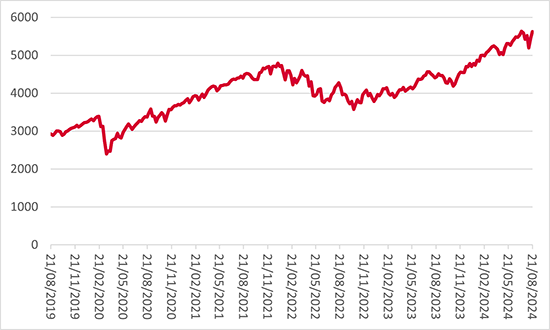
The S&P 500 index of US shares even had its best week of the year, rising 3.9% for the five days to 16 August 2024.
S&P 500
Source: LSEG
While an investor who held their nerve and did nothing with their portfolio might now be glad of their inaction, what about those individuals compelled to transact in their ISA or SIPP because share prices were moving fast?
Certain investors might have been lucky and locked in profits before the sell-off accelerated and then bought back at a cheaper level. In reality, not everyone will have timed the market correctly. It is inevitable that certain investors will have sold at the height of the market panic, and then seen markets rebound and bought back at a higher level. That is not sound investment practice.
To find out how investors behaved during the summer market whirlwind, AJ Bell analysed non-advised customer transactions across the peak to trough for the Nasdaq Composite (10 July to 7 August), an index of US stocks with large exposure to the big technology names that have helped to drive markets in recent years.
Admittedly, this is a brief period and investors should judge investments over years, not months. That said, the data does provide an interesting snapshot of how investors were thinking during times of market stress.
The Nasdaq fell by 13% during the ‘sell-off’ period in July to August, a large movement by historical standards in such a brief period. Since late 2023 until July 2024, investors had been content with the idea that inflationary pressures would ease and lead to interest rate cuts, particularly in the US. This was the idea that ‘good news’ would encourage the Federal Reserve to reduce the cost of borrowing as there was no reason to keep it high.
Certain investors did not consider the idea that central banks might need to cut interest rates to revive the economy because businesses were worried, labour markets were weakening, and spending from corporates and consumers had waned.
Realising we might be heading towards a state of peril meant the narrative was flipped on its head and implied ‘bad news’ would drive interest rate cuts. Stirring investors into a panic during the summer was gloomy economic data which support the ‘bad news’ case.
Between 10 July and 7 August, the biggest number of stocks sold by AJ Bell customers were a mixture of the best-performing shares in recent years, including Nvidia and Rolls-Royce; high yielding UK names which have been staples of many pensions and investment accounts, including Lloyds and British American Tobacco; and more speculative names which have been popular among individuals who regularly trade in and out of positions, such as Microstrategy and Ocado.
One can see logic behind such stock choices. If you were faced with a gloomier backdrop, it is natural to first think about locking in some gains from stuff that has done well, then trimming positions in names which might represent a large part of your portfolio or stepping away from higher-risk names when markets are in risk-off mode.
However, there is a much more interesting story once you delve deeper into the transaction trends. The ‘net buys’ figure aggregates the total number of buys and sells for a particular stock. A ‘net buy’ is when more people have bough the stock than sold. A ‘net sell’ is the opposite.
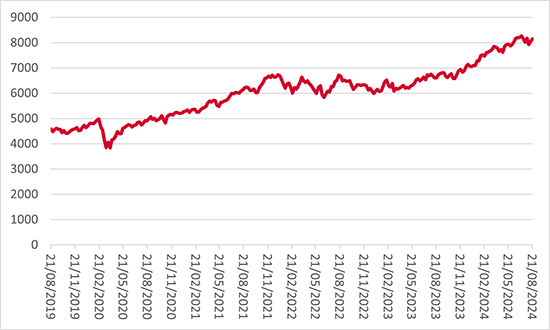
Two of the most widely sold stocks during the 10 July to 7 August period were also among the biggest net buys, namely Nvidia and the ‘VUSA’ Vanguard S&P 500 ETF, a passive fund tracking specific parts of the US stock market.
Vanguard S&P 500 UCITS ETF (VUSA)
Source: LSEG
The real nugget from the data was that the number of people buying these specific stocks was a multiple of those selling in both two cases. In the case of the Vanguard S&P 500 ETF, six times more AJ Bell customers bought the stock than sold it. That implies certain investors have taken a long-term view and pounced on the opportunity to buy at a cheaper price.
Fruitful investment decisions can happen when investors go against the crowd and buy when broader market sentiment is weak. This strategy does not always work out, but history suggests it can be a wise move if nothing has changed to the core investment case of a stock.
It takes nerve to deploy more money into the markets when the headlines are so negative, but there is merit in forming an investment plan and sticking to it.
Past performance is not a guide to future performance and some investments need to be held for the long term.



This area of the website is intended for financial advisers and other financial professionals only. If you are a customer of AJ Bell Investcentre, please click ‘Go to the customer area’ below.
We will remember your preference, so you should only be asked to select the appropriate website once per device.