Investing in firms that develop and sell life-changing drugs has been a rewarding trade over the past five years. The MSCI World Healthcare index has returned 73%, according to FE Fundinfo. That’s nearly twice the return of the FTSE 100 (42%) in dollar terms.
Over the long-term, those kind of returns are an incredibly powerful driver for wealth creation in an investment portfolio, although, like any sector, there will be good and bad years. There is also no guarantee that returns from the healthcare sector will always be that strong.
If you think that 73% is a decent return, there is one stock that’s outperformed the MSCI index 11 times over. That stock is Eli Lilly which has a duopoly with Novo Nordisk in the provision of weight-loss drugs. Eli Lilly has returned 806% in five years – the kind of gains most investors can only dream of.
Eli Lilly vs Novo Nordisk vs MSCI Healthcare
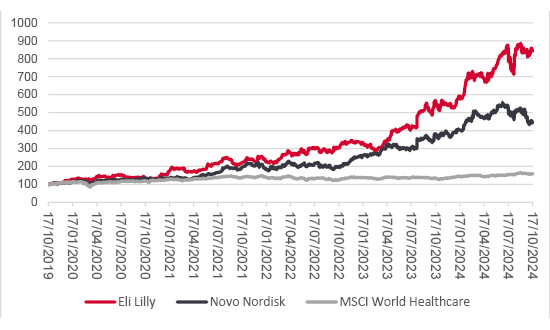
Source: LSEG, rebased to 100, 5 year data in US dollars to 18 October 2024
A study published in the JAMA Internal Medicine journal recently found that Eli Lilly’s Mounjaro was more successful at helping users lose weight than Novo Nordisk’s Ozempic (known as Wegovy in the UK). Does that explain why Eli Lilly has eclipsed Novo Nordisk on the stock market, with the latter ‘only’ achieving 350% returns over the past five years?
Whether that is purely a coincidence or not, demand currently exceeds supply for weight-loss drugs from both companies. This situation puts pressure on Eli Lilly and Novo Nordisk to complete investments into additional production capacity so they can get more product onto the market.
It doesn’t look like a coincidence that their shares have stumbled given the supply constraints. Eli Lilly’s share price has been flat in recent months while Novo Nordisk’s shares have eased back.
Investors can see potential challengers on the horizon as the next 12 to 24 months could bring phase three trial data for rival products. Drugs have to go through multiple tests before the regulator will consider them for commercial use, and phase three trials are the last stage of testing before submission to the authorities for approval.
So many names are trying to get in on the game; from small biotechnology companies to large players such as Amgen, AstraZeneca and Pfizer.
Eli Lilly and Novo Nordisk have enjoyed massive success commercially and on the stock market because they found a way to make weight-loss drugs more effective. The downside is that users can experience nasty side-effects such as nausea, which has led people to come off the drugs.
The next phase in the weight-loss drug boom is for scientists to find ways to reduce the side-effects. Whoever does crack the magic formula could make a fortune.
Greater volumes of weight-loss drugs should bring down prices, yet that should also broaden the potential market as the products become more affordable. It implies the sector still has a large opportunity to make money while at the same time helping to transform people’s lives.
“It’s human nature that we don’t all want to diet and exercise, it’s not cutting it in terms of the obesity problem we’ve got, and people are getting more obese,” says Ailsa Craig, joint fund manager of the International Biotechnology Trust. That might explain why individuals are looking for a different solution and embracing a weight-loss drug such as Zepbound or Wegovy. They are even more powerful than you think, with far-reaching benefits.
“It’s not just a lifestyle drug (to lose weight),” adds Craig. “It’s also helping patients because it can reduce heart disease, hypertension, cholesterol, diabetes and kidney disease. All these comorbidities, each of which are separately treated with other drugs, could be prevented if these patients lost weight.”
The benefits go even further. There is the potential to have a weight-loss drug on the market that not only tackles obesity but also helps to reduce alcohol or substance use, and even used on a wider basis such as potentially helping to prevent dementia and improve cognitive function in people with Alzheimer’s disease.
This broad spectrum of applications explains why weight-loss drugs have been one of the hottest investment themes in recent years, second only to artificial intelligence. No-one knows who the big players of tomorrow will be, and investing in the biotechnology and pharmaceutical industries comes with considerable risk. That’s why investors typically prefer to use a diversified specialist fund that isn’t betting everything on a single company.
Just because Eli Lilly and Novo Nordisk’s share price rallies have lost steam doesn’t mean the weight-loss drug theme has fully played out. It’s perfectly normal to see a pause as the industry transitions to its next phase. We’re definitely at that stage now, but what’s certain is that the space is getting even more interesting rather than fading away.
Past performance is not a guide to future performance and some investments need to be held for the long term.



This area of the website is intended for financial advisers and other financial professionals only. If you are a customer of AJ Bell Investcentre, please click ‘Go to the customer area’ below.
We will remember your preference, so you should only be asked to select the appropriate website once per device.