The review of the ‘patchwork of returns’ shows how quickly market leadership can change, and how rarely the reasons are captured by a simple regional label. US equities often dominate discussions because of the size of the market, but for UK investors measuring returns in sterling, they were the top performer in only two of the ten years to the end of August 2026.
Currency matters too. Overseas returns reflect both the local market return and movements in sterling. A weaker pound can lift returns for UK investors, while a stronger pound can reduce them.
The table also shows why recent winners should not be treated as permanent leaders. The order changes quickly, and the gap between leaders and laggards can be wide enough to make tactical calls look obvious only with hindsight.
One-year total returns
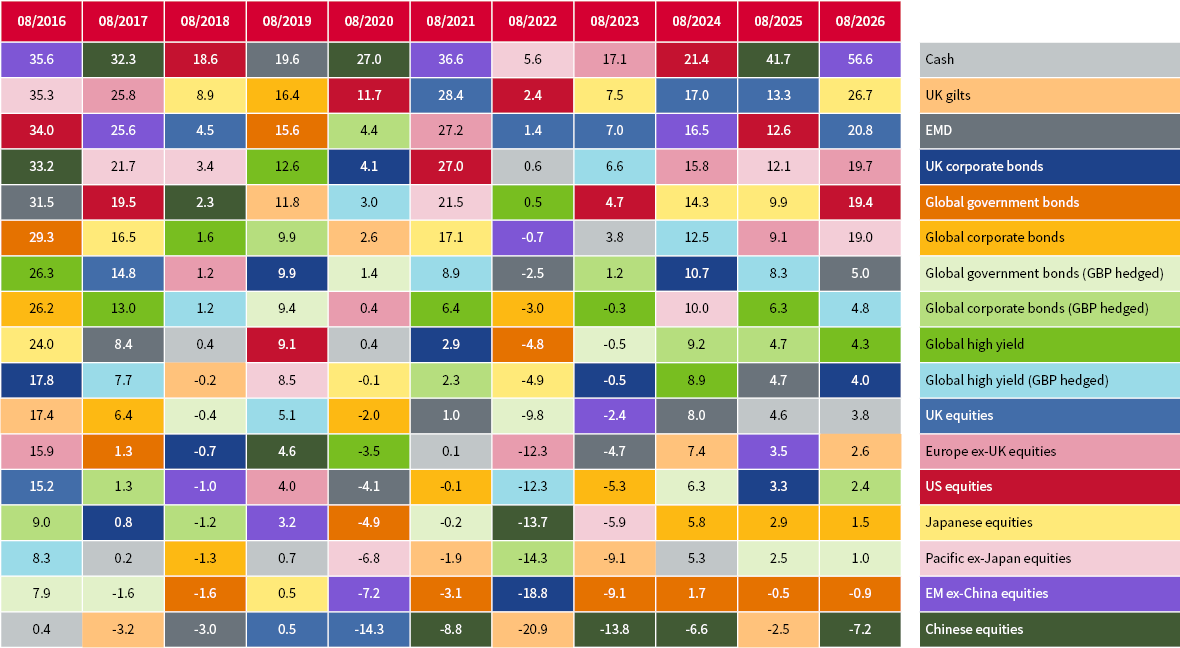
Source: Morningstar Direct, one-year total returns to 31 August in each year shown, for asset classes used in the AJ Bell asset allocation. Using Morningstar TME Net Return GBP and Bloomberg Total Return Indices. Returns are shown in the currency of the selected AJ Bell benchmark series and rounded to one decimal place.
First, the latest year brought another sharp rotation. EM ex-China equities returned 56.6%, ahead of Japanese equities at 26.7%, UK equities at 20.8% and US equities at 19.4%. The ranking is a clear reminder that US equity leadership is not inevitable.
Second, this was not simply a regional story. Taiwan and South Korea sit at the centre of the semiconductor, memory and technology hardware supply chain. That helped EM ex-China benefit from rising investment in computing capacity and AI infrastructure.
Third, sector allocation matters. Advisers are used to client questions about US concentration, where a small number of mega-cap companies dominate the top of the index. The same principle applies elsewhere, even where the concentration sits behind a broader regional classification.
EM ex-China is a good example. Large weights in Taiwan and South Korea mean an allocation can bring sizeable exposure to semiconductors, memory, components and the infrastructure needed to support demand for computing power. Two allocations with different labels can therefore still be exposed to the same underlying theme. These exposures are not necessarily a problem, but they should be recognised, sized appropriately and understood in the context of the rest of the portfolio.
For advisers, the key message is that a portfolio can look diversified by geography but still be concentrated by sector or theme. Markets such as the UK and parts of Europe can provide exposure to financials, healthcare, energy and industrials, which may behave differently from technology-heavy markets.
The patchwork does not offer a reliable guide to next year’s winner, but it can sharpen the portfolio review. What has driven the return: currency, valuation, earnings growth, a sector cycle or a narrow group of companies? And does the portfolio already have the same exposure through another route?
Bonds tell a different story. Gilts and global government bonds performed well in several earlier years, before inflation and higher interest rates produced substantial losses. More recently, returns have been modest and uneven, leaving investors to balance the defensive characteristics of high-quality bonds against the risk that yields remain volatile. Corporate bonds have generally been more resilient, helped by income and credit spreads, but investors still need to be selective about duration and credit risk.
That does not mean avoiding recent winners. It means understanding what has driven their return, and how much of that exposure already exists elsewhere in a portfolio. A diversified strategic asset allocation can give clients access to several sources of return while reducing reliance on any one region, sector or market theme.
The value of investments can go down as well as up and your client may not get back their original investment.
Past performance is not a guide to future performance and some investments need to be held for the long term.



This article was written on 1 October
Many people choose to spread their investments around the world, but doing so effectively is often easier said than done.


This area of the website is intended for financial advisers and other financial professionals only. If you are a customer of AJ Bell Investcentre, please click ‘Go to the customer area’ below.
We will remember your preference, so you should only be asked to select the appropriate website once per device.