In recent years, global equity markets have become increasingly concentrated, with a handful of large, primarily US-based technology companies dominating major global indices. This trend has heightened stock-specific risk for investors, as portfolios tied closely to market-cap-weighted indices have become more exposed to the fortunes of a few companies and sectors. Investors buying global index trackers are now gaining more exposure to Nvidia, the largest stock in the US market, than they are to the UK, Japan or China individually, and Germany and France combined.
Percentage in top 10 index holdings
Source: Morningstar Direct, as of 31/12/25. Morningstar Target Market Exposure (TME) indices. (Europe ex UK data unavailable between 01/01/25 and 31/11/25)
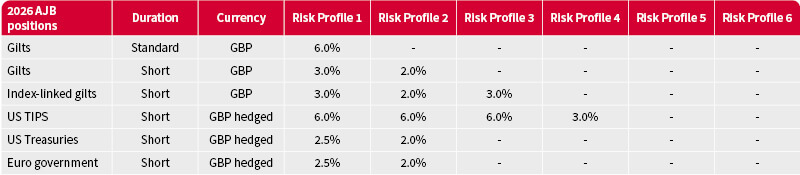
Recognising these risks, we’ve enacted a series of changes to the AJ Bell Funds and Passive MPS with the aim of enhancing diversification and reducing concentration risk, whilst at the same time taking advantage of valuation opportunities in sectors that have the potential to benefit from AI implementation and wider themes.
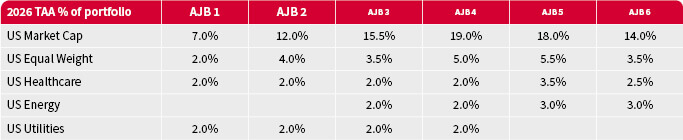
1. Broader US equity exposure: While our 2026 Strategic Asset Allocation called to increase the overall allocation to US equities, the approach to US exposure has fundamentally shifted via our tactical intervention.
Rather than simply tracking the market-cap-weighted index, which is heavily skewed towards a small number of technology giants, the portfolios now include a blend of:
This “barbell” approach balances defensive value with selective cyclical opportunities, ensuring that portfolios are not overly dependent on any single theme or sector.
2. Reduced regional concentration.
Our Strategic Asset Allocation has also seen a reduction in allocations to Europe ex-UK and Emerging Markets ex-China; the latter has also seen growing concentration risk. For example, Taiwan Semiconductor Manufacturing Co. now accounts for over 15% of the EM ex-China index. By diversifying away from these increasingly concentrated regions, the portfolios are less vulnerable to the fortunes of individual companies or countries.
3. Sector and factor diversification
Defensive sectors such as Healthcare and Utilities have been emphasised not only for their diversification benefits but also for their attractive valuations and potential to benefit from technological innovation, such as AI-driven efficiency gains.
Mitigating concentration risk
By moving away from a “one-size-fits-all” approach and introducing sector-specific allocations, the portfolios are now less exposed to the performance of a few mega-cap stocks. This is particularly important given that the US accounts for over 65% of many global equity indices and Nvidia, the largest stock in the US market, is now larger than many countries combined.
Enhancing resilience
Defensive sectors like Healthcare and Utilities have historically shown lower correlation to the broader US market, especially during periods of market stress. Their inclusion is designed to provide ballast to portfolios, helping to smooth returns when markets become volatile.
Positioning for opportunity
While reducing concentration risk, the portfolios remain engaged with ongoing structural themes such as AI, but do so in a way that spreads exposure across a wider range of sectors and companies. This ensures that investors can benefit from innovation and economic growth without being overexposed to any single narrative.
The changes enacted for 2026 reflect our commitment to prudent risk management and portfolio construction. By proactively addressing concentration risk and enhancing diversification, we are ensuring portfolios are better positioned to weather market shifts and capture opportunities across the global equity landscape.
If you have any questions about how these changes affect your portfolio, please contact your Investment Business Development Manager.
For deeper insight into our 2026 asset allocation approach, download our latest brochure.
The value of investments can go down as well as up and your client may not get back their original investment.
Past performance is not a guide to future performance and some investments need to be held for the long term.



This article was written on 1 October
Many people choose to spread their investments around the world, but doing so effectively is often easier said than done.


This area of the website is intended for financial advisers and other financial professionals only. If you are a customer of AJ Bell Investcentre, please click ‘Go to the customer area’ below.
We will remember your preference, so you should only be asked to select the appropriate website once per device.