UK takeovers moved up a gear in 2024 as predators targeted bigger companies. The average value of deals was £1.07 billion, nearly three times higher than the £390 million average in 2023. In total, there were £49 billion worth of recommended bids versus £17.2 billion last year.
A bounty of unloved or underappreciated companies were swept off their feet, signalling the UK market as being ‘on sale’ and how there was widespread value on offer.
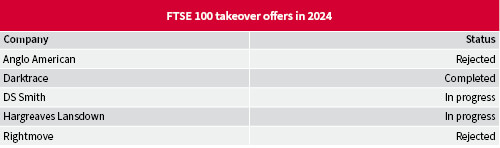
Five FTSE 100 companies and 19 stocks in the FTSE 250 index received bids, the bulk of which were successful. That’s remarkable given last year there were only three FTSE 250 takeovers and none among FTSE 100 stocks.
FTSE 100 takeover offers in 2024
FTSE 250 takeover offers in 2024

Source: AJ Bell, company announcements
It took multiple attempts to get certain deals away, but there is a right price for every listed company, and it was just a case of doing the M&A dance on price negotiations until the stars aligned. Investors on the receiving end of a bid have cottoned on to the fact that predators are not giving up at the first hurdle.
That’s given shareholders confidence to say no at the initial bid and ask for more – because, in most cases, they are getting it. Just look at how quickly it took Aviva to stump up more cash for Direct Line.
It made two bids and got a recommended offer in just nine days. Couples often spend months or years getting to know each other before marriage.
Bidders know the structure of a deal is important, hence why the majority of 2024’s UK takeovers were all-cash offers. Cash is king and investors would prefer something in their hand than paper or a mixture of the two. Only eight successful deals involving UK-listed companies in 2024 had a cash and shares structure, while a mere three were all-share deals.
The average bid premium was 45%, slightly less than 2023’s 52% average but still a nice sweetener for investors on the receiving end of offer. The term ‘bid premium’ describes the extra amount (in percentage terms) the buyer offers compared to the market value on the night before the takeover approach went public.
If you consider the FTSE 100 has returned in the region of 11% this year including dividends, investors with a takeover in their portfolio in 2024 effectively received the equivalent of four years’ worth of UK stock market returns upfront.
There was a common thread among UK takeovers in that bidders thought a company was worth much more than attributed by the market. Buyers typically take a multi-year view on a company whereas the collective stock market is often short-term in its thinking.
For years it’s been clear that unless the market attributed fair value, companies would be picked off one by one via takeovers. That trend remains in motion and could continue across 2025 unless investors are happier to pay a higher price for UK shares and bargain situations diminish.
Britvic and TI Fluid Systems are good examples of where the buyer spotted an opportunity to gain scale in their respective market through acquisition. Carlsberg was looking for ways to strengthen its footprint in Western Europe and be a bigger player in non-alcoholic drinks, and Britvic ticked all the right boxes. ABC Technologies buying TI Fluid Systems will expand its global footprint and broaden its customer base.
On certain occasions, bids came from an existing shareholder who subsequently decided they’d like to own the whole company. Pre-bid, Joshua Alliance and his family (plus associates) owned more than half of clothing retailer N Brown. He took the view that the company would be better away from the spotlight of the stock market and without the listing costs.
Fifteen UK-listed companies fought off takeover approaches during 2024 including two from the FTSE 100 – Anglo American and Rightmove. In both cases and the same for fellow bid ‘survivor’ Currys, the stocks have gone on to trade on higher multiples of earnings.
The bid activity functioned as a wake-up call for investors that the stocks had something to offer. Rigorous bid defence can cause investors to reappraise a stock – they wonder why the board has rejected a bid (or multiple bids) and take a deeper look. In the case of Anglo American, Rightmove and Currys, it’s clear that investors’ interest was piqued after bids came and went.
Anglo American now trades on 16.5 times next 12 months’ forecast earnings versus 12.4 times on the eve of BHP trying to buy the miner. Part of Anglo American’s bid defence was to announce a sharper focus on fewer commodities and to exit certain areas including diamonds. The market liked this plan and that will have contributed to its subsequent equity re-rating.
Rightmove saw its valuation multiple move from 19.7 times forward earnings immediately before REA’s bid interest to now trade on 23.3 times. The bid was a reminder that the UK stock market contains high quality companies. Sometimes all it takes is a bid to remind people what’s on offer.
As for Currys, it was clear that the electronic retailer’s board had no interest in the offers, which led US investment firm Elliott Advisors to walk away after making takeover attempts. Additional bid interest from China’s JD.com didn’t amount to anything, but investors were curious as to why Elliott was so eager to own Currys.
Currys’ shares now trade on 8.3 times forward earnings versus 5.5 times on the eve of Elliott’s first approach, with the re-rating amplified by positive news flow. The frenzy around all things to do with AI has created a tailwind for Currys because electronic manufacturers are launching AI computing products, and the public seems keen to snap them up.
Past performance is not a guide to future performance and some investments need to be held for the long term.



This area of the website is intended for financial advisers and other financial professionals only. If you are a customer of AJ Bell Investcentre, please click ‘Go to the customer area’ below.
We will remember your preference, so you should only be asked to select the appropriate website once per device.