January is habitually the time of year when we all make promises to get fitter and healthier. It used to be primarily about signing up for a gym membership before sheepishly cancelling a few months later as all those good intentions slipped quietly away. But in the last decade or so the month of January has become a money spinner for more than just the fitness sector. Dry January, Veganuary – both have become embedded in our culture, and both have created massive opportunities for food and drinks manufacturers to attempt to cash in on our virtuous spending.
Right now, our supermarket shelves are piled high with a burgeoning range of zero-alcohol beers, wines and spirits, and fridges and freezers groan with a plethora of vegan options that quite simply boggle the mind. Competition is fierce, especially this year when health isn’t the only motivator.
“Dry January, Veganuary – both have become embedded in our culture, and both have created massive opportunities for food and drinks manufacturers to attempt to cash in on our virtuous spending.”
The cost-of-living crisis might have been largely ignored during the festive period as sales updates suggest most of us indulged in our favourite food and drink over Christmas, but as credit card bills land on doorsteps price is once again in focus. I’ve spoken to a number of friends and family who are cutting back on alcohol and meat in order to cut their grocery bills.
Let’s push alcohol to one side and focus on food, and plant-based products in particular. A recent survey on food trends carried out by US research company Datassentials found that 40% of consumers were planning to buy these products this year.
It’s a multi-billion-dollar market and Beyond Meat (BYND Nasdaq) is probably one of the most recognizable players in the sector. But for investors it’s not exactly lived up to the hype.
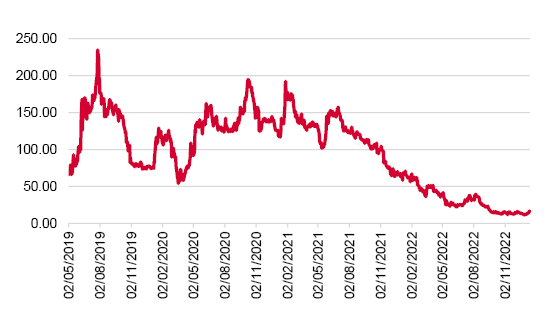
Beyond Meat share price since IPO
Source: Refinitiv
Down a staggering 87.5% since it exploded onto the Nasdaq in May 2021, the company’s financials seem to have more in common with those big tech start ups than with other global food manufacturers. It’s fall from grace will have been a blow for investors seduced by the hype and glossy marketing. With a focus determinedly on growth rather than profitability it has undoubtedly been a victim of last year’s supply issues and cost pressures, despite the reopening of hospitality businesses which make up a good chunk of its revenues. It’s losses more than doubled again last year and there’s a sense that it’s lost its first mover advantage.
“Established players like Unilever, Tyson Food and Nestlé have deep pockets, better distribution and established manufacturing capabilities which can enable them to charge the consumer less.”
Whilst it’s signed strategic partnerships with both McDonalds and Yum Brands to develop new lines, right now Beyond Meat is pretty much just about a burger. And that’s a big issue when some of the world’s biggest manufacturers are chewing off market share.
And established players like Unilever, Tyson Food and Nestlé have deep pockets, better distribution and established manufacturing capabilities which can enable them to charge the consumer less. And that’s important because the 2023 Food Trends Report also found that one in five people had previously tried plant-based meat but don’t plan to buy it again, with price being one of the primary reasons for that decision.
Beyond Meat is executing a “full force pivot”, fully understanding there is a lot of work to do if it’s to achieve its objective of being a long-term protein player in the meat industry. It needs to bring costs down if it’s to appeal to flexitarians more concerned with budget than with ideology.
But ideology has a part to play, and the plant-based trend isn’t just about meat – non-dairy milk is also a massive part of this equation.
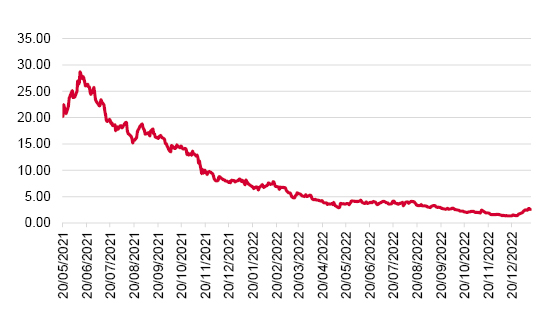
Oatly share prices since IPO
Source: Refinitiv
With the plant-based milk market expected to surpass $123 billion by 2030, according to data from Strategic Market Research published last month, you might be forgiven for wondering why shares in one of the biggest names in the sector fell almost 80% last year.
“Can the January bounce be sustained throughout the year? The plant-based market is undoubtedly filled with opportunities even with the current budget squeezes being felt by households globally.”
Oatly is faced with some of the same issues as Beyond Meat, thought it is a more established player and revenues have continued to grow despite what it called “production challenges”: a strong dollar and, until recently, COVID-19 restrictions in Asia. The company has placed its foot firmly on the brakes when it comes to its future growth strategy, opting for a more moderate approach in a world of high inflation and higher interest rates. Spending less, getting leaner and in turn, it expects, more profitable.
Like Beyond Meat it has enjoyed a new year boost. But can the January bounce be sustained throughout the year? The plant-based market is undoubtedly filled with opportunities even with the current budget squeezes being felt by households globally.
Price will always be a factor and size can be the biggest advantage during difficult times, as can diversification, which is why investors may be more inclined to focus their attention on producers that love the plant but also know some consumers want real meat and dairy too.
Past performance is not a guide to future performance and some investments need to be held for the long term



This area of the website is intended for financial advisers and other financial professionals only. If you are a customer of AJ Bell Investcentre, please click ‘Go to the customer area’ below.
We will remember your preference, so you should only be asked to select the appropriate website once per device.