

Warren Buffett is perhaps the world’s most famous living investor. Berkshire Hathaway is the company he turned from a struggling textile business into a trillion-dollar empire.
For six decades the two names were almost interchangeable, but that relationship finally came to an end in 2026. Greg Abel took over as CEO on 1 January, before Buffett officially retired in September and his son Howard succeeded him as non-executive chair.
Berkshire’s track record under Buffett is astounding, with growth in book value per share doubling the return of the S&P 500 index. That works out at an annualised return of 19.7% a year, turning $100 into $6 million versus $46,000 for the S&P 500.
It’s worth noting Berkshire’s returns are calculated after corporate taxes while the S&P 500 return is before an investor’s personal taxes.
Nobody is expecting Abel to repeat that performance for the simple reason Berkshire today is a trillion-dollar operation which touches all parts of the US economy, which is a far cry from the modest textile business that Buffett began with in 1962. Berkshire now has operations which span insurance, freight rail, utilities, manufacturing services and retail.
At his first shareholder meeting as CEO, Abel confirmed that Berkshire would retain its culture and decentralised operating model.
“We operate a decentralised model with autonomy grounded in deserved trust. We minimize bureaucracy to provide our managers the independence to focus relentlessly on their business,” wrote Abel in his shareholder letter in February.
Abel will need Buffett’s discipline to stick exclusively to compelling investment opportunities and resist the temptation to spend Berkshire’s $360 billion cash pile just because it acts as a drag on corporate performance.
The early evidence suggests evolution rather than revolution. Abel has resumed share buybacks after almost two years, which is interesting because Berkshire shares are trading close to all-time highs, suggesting his assessment of intrinsic value has also moved into new territory.
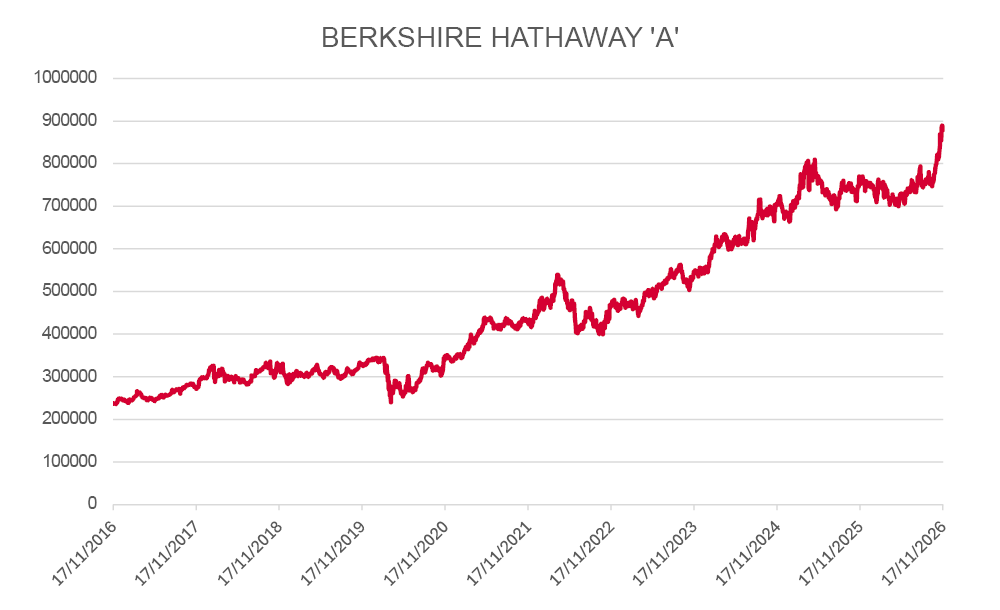
Source: LSEG (share price in US Dollars)
In June, Berkshire agreed to buy US housebuilder Taylor Morrison for a total value including debt of $8.5 billion, marking Abel’s first major acquisition since succeeding Buffett.
This potentially tells investors more about Abel’s leadership style which is likely to be more ‘hands-on’ than Buffett. Berkshire already owns Clayton Homes, one of the biggest housebuilders in the US, as well as housing-related businesses like Benjamin Moore and Johns Manville.
This suggests Abel will make more of an effort to knit together Berkshire’s sprawling empire to create greater operational integration.
An insight into Abel’s thinking might be glimpsed from his recent comments which put the Taylor Morrison acquisition into context: “Over time, we expect to unify our site-built homebuilding operations into a combined platform.”
The most significant change to Berkshire’s portfolio of stock holdings in 2026 has been the purchase of Alphabet shares, which means the Google-owner has become Berkshire’s third largest holding, after Apple and American Express, representing around 12% the portfolio.
The shape of the portfolio has become a lot more concentrated with the number of positions being reduced from 42 to 29 with notable exits from long-standing holdings in Visa and Mastercard.
Berkshire re-entered the airline industry for the first time since 2020 after initiating a $5.4 billion stake in Delta Air Lines, representing around 2% of the portfolio.
The four largest positions of Apple, American Express, Alphabet and Coca-Cola continue to dominate, accounting for roughly 60% of its overall holdings.
Berkshire’s insurance float has provided an ever-growing pool of low-cost funding over decades, which has become a key component of its financial success.
Berkshire’s insurance operations like Geico collect premiums upfront, and the associated claims may not be paid for months or even years with certain forms of reinsurance
During the intervening period Berkshire has custody of the money or ‘float’ which can be used to invest in Treasury bills, equities and other assets. It is crucial to understand that the float isn’t Berkshire’s money in an accounting sense as it is recorded as a liability on the balance sheet.
Nevertheless, Berkshire has use of the money and Buffett has referred to float as a cheap source of funding. The key insight which Buffett had is that when Berkshire’s insurance operations make an underwriting profit, the float is effectively free money.
If claims and expenses exceed premiums, float has a cost. But if Berkshire’s insurance operations are profitable over time (a combined ratio of under 100%), the effective cost of that funding can be zero or negative.
Over the last 25 years Berkshire has achieved an average combined ratio (premiums less claims and operating costs as percentage of premiums) of 92.2%, a remarkable underwriting achievement for a business of Berkshire’s scale.
This means Berkshire is not restricted to investing shareholders’ equity, with its insurance operations supplying an additional pool of investable funds.
The early signs suggest Abel isn’t trying to be Buffett 2.0. He is putting more of Berkshire’s cash to work, concentrating the stock portfolio and appears willing to take a more hands-on approach to the operating businesses.
That is probably sensible. Trying to recreate Buffett’s remarkable six-decade run would be an impossible task, particularly now Berkshire is so enormous.
The real test is whether Abel can preserve the ingredients that made Berkshire different: patience, discipline and a willingness to sit on its hands when there is nothing worth buying.
Abel doesn’t need to find the next Berkshire Hathaway. He just needs to work out what to do with the one Buffett left him.
Past performance is not a guide to future performance and some investments need to be held for the long term.

This area of the website is intended for financial advisers and other financial professionals only. If you are a customer of AJ Bell Investcentre, please click ‘Go to the customer area’ below.
We will remember your preference, so you should only be asked to select the appropriate website once per device.