The conflict in Iran has brought another inflation shock to the bond market and the repricing we have seen presents an opportunity, in our view. We are reallocating a portion of cash and cash equivalents into short-dated government bonds across all MPS ranges. Here is what is changing, why, and what it means for your clients.
For some time, cash and short-term money market funds have been a rational defensive holding. Yields on cash have been competitive and the absence of any price risk was additive to portfolio optimisation, providing ballast against government bond volatility. But we believe the balance of the argument is shifting in favour of moving up the curve into short-dated government bonds.
The key issue with cash at this point is one of timing. Yes, cash yields could improve further if central banks deliver the rate hikes that are widely anticipated – but those hikes will only feed through into money market returns once they happen. The bond market, by contrast, has already priced in the expected path of rate rises. That means investors in short-dated government bonds are being compensated today for the outlook, rather than waiting for it to materialise.
"Bond markets have already priced in the expected path of rate rises – investors are being compensated today for the outlook, not waiting for it to materialise in cash rates."
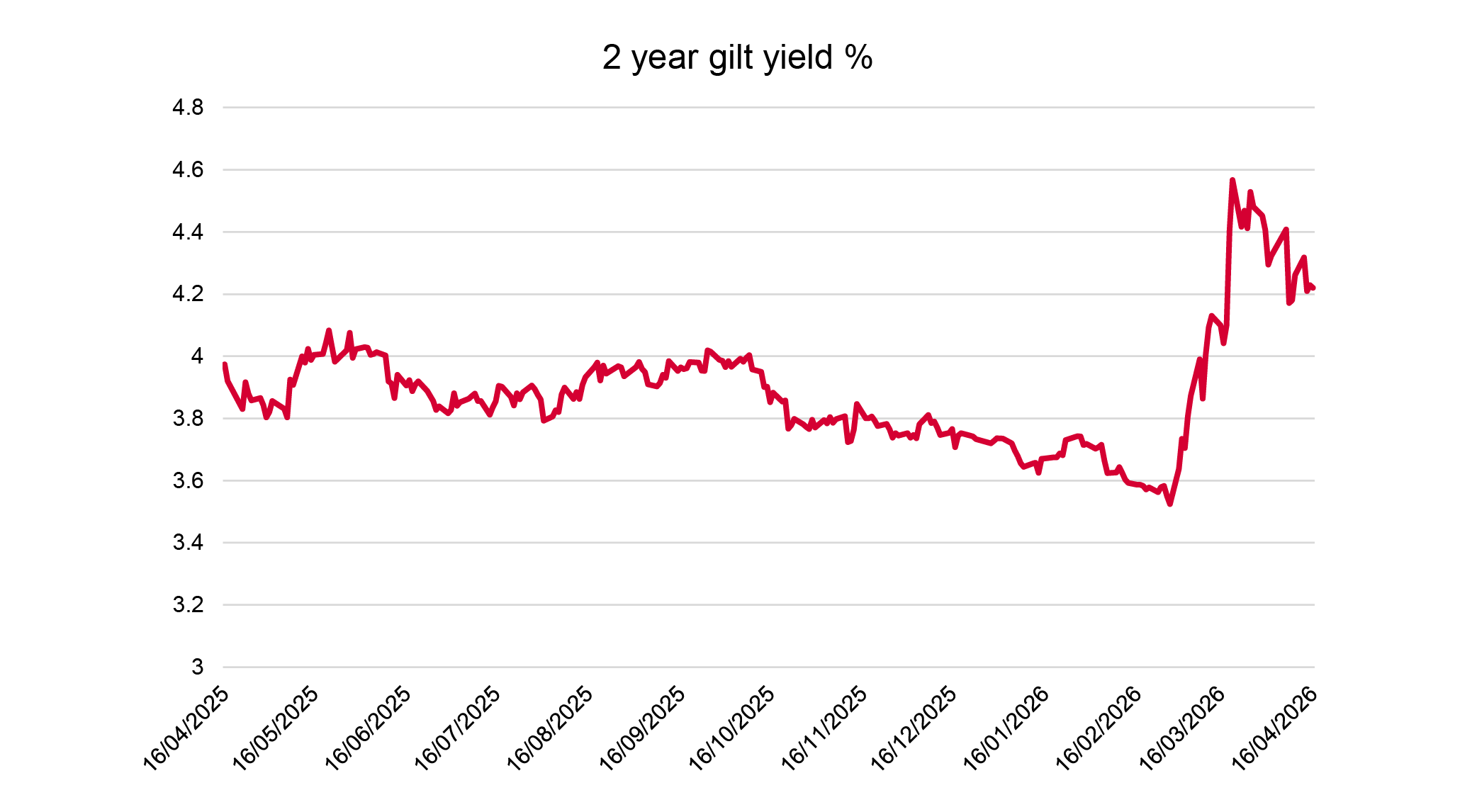
Source: AJ Bell, as of 16/04/26.
This also creates a more favourable asymmetry. If rate hikes do come through as expected, short-dated bonds and cash are likely to perform similarly. But if those hikes fail to materialise – perhaps because recession risk rises or the economic backdrop deteriorates – bonds are better placed than cash. A fall in rate expectations would support bond prices in a way that cash simply cannot benefit from.
It is worth stressing that we are keeping duration deliberately short. This is not a move into long-dated bonds. The objective is to capture a better starting yield and a modest degree of rate sensitivity, without meaningfully increasing interest rate risk relative to a cash position.
Bonds and cash perform similarly. Bond markets have already priced in hikes. Short-dated bonds benefit alongside cash as yields adjust.
Bonds considerably better placed. Softening rate expectations would support bond prices. Cash cannot benefit from falling rate expectations in the same way.
The natural first instinct might be to concentrate this move entirely in UK gilts. The yield pick-up available in the UK has been the most attractive of the three regions. However, UK yields have also been the most volatile since the outbreak of the conflict in Iran, which has shifted rate expectations across multiple central banks – with several now anticipated to raise rates during 2026.
Concentrating the entire allocation in UK gilts would therefore introduce a more meaningful single-market risk. By splitting the reallocation across UK, US and European government bonds – with the non-sterling exposures managed on a GBP-hedged basis – we achieve regional diversification whilst eliminating the currency risk that would otherwise accompany the US dollar and euro positions.
The headline changes across risk profiles 1 to 3 are as follows. The larger reductions in cash occur in the lower-numbered (lower-risk) profiles, which held the largest cash weightings to begin with.
| Asset class | Risk Profile 1 | Risk Profile 2 | Risk Profile 3 |
|---|---|---|---|
| GBP cash | -8.0% | -4.0% | -2.0% |
| UK gilts | +3.0% | +2.0% | +2.0% |
| US Treasuries (GBP-hedged) | +2.5% | +1.0% | — |
| Euro government (GBP-hedged) | +2.5% | +1.0% | — |
The change applies to all portfolios carrying an existing allocation to UK gilts and global government bonds (GBP-hedged). The ranges in scope are:
AJ Bell Funds: Cautious, Moderately Cautious, Balanced and Income.
| MPS range | Profiles included |
|---|---|
| Passive MPS | Profiles 1–3, including Passive Income MPS 1 |
| Active MPS | Profiles 1–3, including Active Income MPS 1 |
| Pactive MPS | Profiles 1–3 |
| Responsible MPS | Profiles 1–3 |
There is no immediate action required. We are implementing the changes across affected MPS portfolios on your behalf. If you have any questions about our tactical asset allocation, or anything else, please contact us.
Past performance is not a guide to future performance and some investments need to be held for the long term.



This article was written on 1 October
Many people choose to spread their investments around the world, but doing so effectively is often easier said than done.
This area of the website is intended for financial advisers and other financial professionals only. If you are a customer of AJ Bell Investcentre, please click ‘Go to the customer area’ below.
We will remember your preference, so you should only be asked to select the appropriate website once per device.