It’s been a prosperous time to have invested in the markets. Each one of the major share indices around the world has delivered a positive total return over the past 12 months, factoring in share price performance and dividends.
At the top end, the US has returned 32.5% as measured by the S&P 500 index; Japan’s Nikkei 225 index has returned 15.3%; and even the ‘unloved’ UK has lined investors’ pockets with a 12.1% return from the FTSE 100, according to SharePad data. On a five-year basis, the FTSE All-World global stock market benchmark has returned 81.6% in sterling terms, based on data from FE Fundinfo.

Source: AJ Bell, SharePad. Data to 15 November 2024
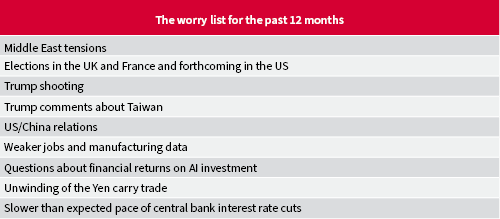
Investors would take those kind of returns any day of the week, and what’s really interesting is how markets faced an extensive list of worries.
Five years ago, we were only months from a global pandemic which caused considerable economic disruption. Since then, we’ve had Russia invade Ukraine, a rapid increase in inflation and interest rates, Middle East tensions, and disappointment over the pace of interest rate cuts.
Over the past year alone, there have been major political elections in the UK, US and France. The unwinding of the Yen carry trade caused brief chaos on markets over the summer. Investors who had borrowed in the cheap Japanese currency to invest in higher yielding assets closed their positions when the Bank of Japan pushed up rates.
The Budget, mixed economic data globally, questions about when massive investment into AI will result in positive financial returns; the worry list goes on and on.
Source: AJ Bell
An investor who held their nerve and remained invested in the markets will now be reaping the rewards. Patience is vital with investing and what’s happened over the past one and five years perfectly illustrates the point.
History suggests there will always be something for markets to worry about. It’s often called ‘noise’ and it’s important not to let it overwhelm you. Don’t ignore it completely; instead, be aware of the issues and how they might affect you, but at the same time try and hold your nerve.
While it is tempting to try and second guess what’s happening in the world and how it might affect an investment, constantly trading in and out of positions can rack up costs and this eats into your returns.
Diversification is an investor’s best friend. Rather than trying to time the market, such as guessing a certain sector could soon do well, consider spreading your money across different areas. This might result in parts of your portfolio lagging other areas, but when the tide turns and the market rotates to favouring another area, you might already have exposure to the shifting trend. It means spreading your risks across different geographies, sectors and asset class.
Source: LSEG
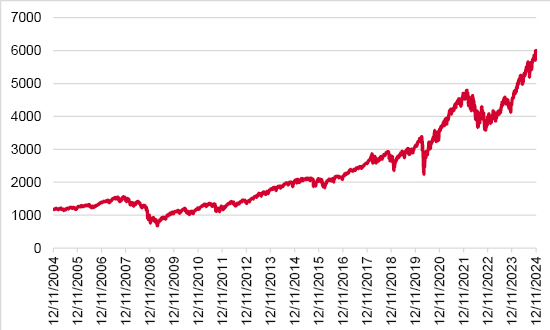
Investors often like to discover what’s doing well and follow the crowd, hoping today’s winners will retain that status tomorrow. The US stock market has been one of the best performing regions for more than 10 years and UK investors have increasingly looked in this part of the world for opportunities.
In its latest survey of fund managers around the world, Bank of America says this class of investors has the highest allocation of assets to US shares since August 2013, implying that professional investors see this as a vibrant place to make money going into 2025. But that doesn’t mean they have restricted themselves to US shares unless that’s the only region in which their fund operates. A fund manager with a global perspective will have exposure to other parts of the world as well.
When constructing a portfolio, it is important to think beyond what’s hot, and consider having investments that should provide stability if markets go through more challenging times. An equity income fund is one example, as it can work nicely alongside more growth-oriented investments.
Often ignored by investors who think they don’t need them until retirement, income funds can work magic during the wealth accumulation phase, particularly if you reinvest dividends and sit back and enjoy compound benefits. They can add the defensive ballast we all need in our portfolios.
To pay a dividend, a company needs to be in a strong financial position and have surplus cash. In tougher times, the companies that struggle are often the ones with the weakest finances and so investors often gravitate towards dividend payers in the belief they should be able to ride out the storm. Certain investors are prepared to pay a higher multiple of earnings to own these types of companies.
It’s like having two few cars on your driveway. You might have a Tesla or an Audi which looks smart and is nippy on the roads. But you might also have an old Volvo which is a dependable runner, keeping it because you know it’s always going to get you from A to B, even though it might be unfashionable. Think of portfolio construction in the same way.
Past performance is not a guide to future performance and some investments need to be held for the long term.



This area of the website is intended for financial advisers and other financial professionals only. If you are a customer of AJ Bell Investcentre, please click ‘Go to the customer area’ below.
We will remember your preference, so you should only be asked to select the appropriate website once per device.